SERIES 03 · ANCIENT EGYPT

The gods and signs of ancient Egypt

The ankh, the djed, the Eye of Horus, the scarab: signs carved, painted and worn along the Nile for three thousand years. Here are twenty-one of them, each drawn for our solid-brass round frame and made to order, with what it meant to the people who first wore it, and the pins, brooches and earrings in our Etsy shop.

IN BRASS · MADE TO ORDER
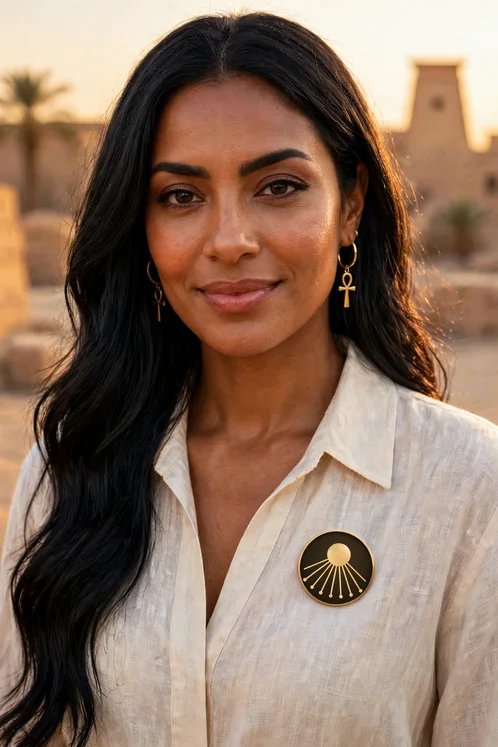
Round Aten brooch, the sun disk and its rays, worn on a white linen shirt, with ankh earrings
WORN · 身に着ける
Gold in the sun, as on the Nile

Egyptians wore their signs on the body: on broad collars, rings and amulets hung at the throat. The Aten, the sun disk whose rays end in hands holding the ankh, sits as well today on white linen as it did in the age of Akhenaten.

Aten
THE SUN DISK · TO ORDER

Signs of life and power 生命と王権

Ankh, ancient Egyptian sign, in brass

Ankh

ꜥnḫ, “life”

The hieroglyph for life. Gods hold it by its loop and offer it to the king’s nose, the breath of life; it was worn as an amulet and written into blessings such as “given life for ever.” Egypt’s Coptic Christians later took it up as the crux ansata.

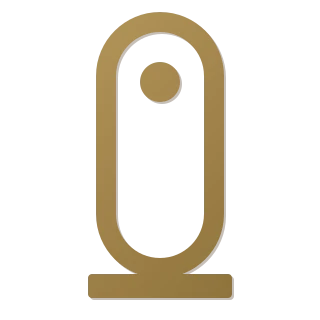
Djed pillar, ancient Egyptian sign, in brass

Djed pillar

ḏd, “stability”

A column with four bars at its top, read as stability and endurance. It was linked with Osiris and called his backbone; at the festival of Raising the Djed the king hauled a great pillar upright with ropes. The Book of the Dead asks for a djed of gold to be placed at the neck of the dead.

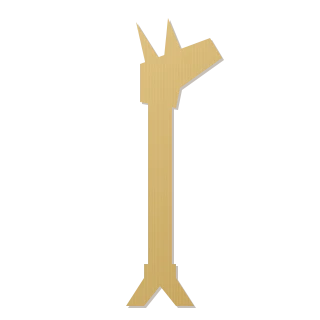
Was sceptre, ancient Egyptian sign, in brass

Was sceptre

wꜣs, “power”

A long staff with a forked foot and an animal’s head: power and dominion. Gods hold it in nearly every temple scene, and Thebes was called Waset, the city of the was sceptre. The animal on top is usually taken to be the creature of the god Seth.

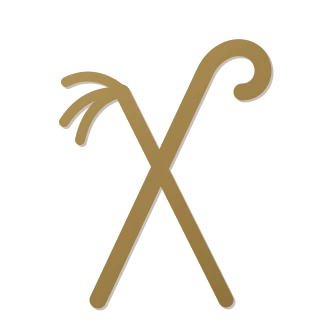
Crook and flail, ancient Egyptian sign, in brass

Crook and flail

ḥqꜣ and nḫꜣḫꜣ

The shepherd’s crook and the flail, held crossed over the chest by Osiris and by kings: the ruler who guides his people and drives off what threatens them. The word heqa, ruler, is written with the crook, and Tutankhamun’s gold coffins show him holding both.

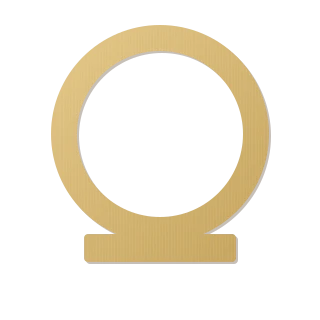
Shen ring, ancient Egyptian sign, in brass

Shen ring

šn, “encircle”

A loop of rope tied off at the bottom, with no beginning and no end: eternity and protection. Falcon and vulture gods hold it in their talons over the king. Drawn out long, it became the cartouche.

Cartouche, ancient Egyptian sign, in brass

Cartouche

šnw, the royal name-ring

An oval loop of rope drawn around a king’s or queen’s name to protect it. Cartouches let Champollion find the names Ptolemy and Cleopatra and begin reading hieroglyphs in 1822. Your own name, written in hieroglyphs, can go inside.

Nefer, ancient Egyptian sign, in brass

Nefer

nfr, “good, beautiful”

The sign pictures a heart and windpipe and means good, beautiful, complete. It is in the names of Nefertiti, “the beautiful one has come,” and Nefertari, and was strung as an amulet for health and good fortune.

The sun and the sky 太陽と天空

Eye of Horus, ancient Egyptian sign, in brass

Eye of Horus

wḏꜣt, “the sound one”

Horus lost his eye fighting Seth, and it was made whole again; the healed eye became the most popular protective amulet in Egypt, worn by the living and laid with the dead. The markings beneath it recall the cheek of a falcon.

Winged sun disk, ancient Egyptian sign, in brass

Winged sun disk

Behdety, Horus of Behdet

The sun with a falcon’s wings and two cobras, the emblem of Horus of Behdet. It spreads across the lintel of almost every temple gateway, guarding all who pass beneath, and travelled from Egypt into Persian and Near Eastern art.

Aten, ancient Egyptian sign, in brass

Aten

jtn, “sun disk”

The disk of the sun, its rays ending in small hands. Around 1350 BC Akhenaten made the Aten the centre of worship, and in the art of his reign the hands hold the ankh to the faces of the royal family. The image vanished with him.

Horizon, ancient Egyptian sign, in brass

Horizon

ꜣḫt

The sun between two hills, where it rises and sets each day, and so a sign of daily rebirth. The Great Sphinx of Giza was later called Horemakhet, “Horus in the horizon.”

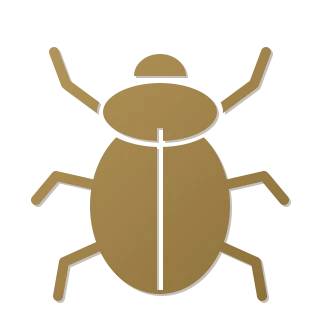
Scarab, ancient Egyptian sign, in brass

Scarab

ḫprr, the god Khepri

The dung beetle rolls a ball before it, as Khepri was imagined rolling the sun into the sky each morning; its name shares a root with “to come into being.” Scarabs were Egypt’s most common amulet and seal, and a heart scarab was laid over the heart of the dead.

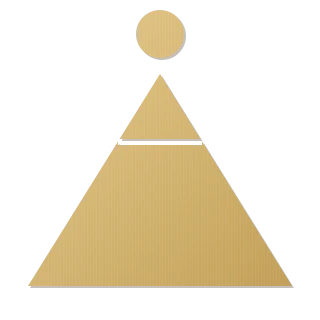
Benben, ancient Egyptian sign, in brass

Benben

bnbn, the first mound

The first land to rise from the waters at creation, where the sun first stood. A sacred stone at Heliopolis stood for it, and the gilded capstones of pyramids and obelisks echo its shape, catching the first light of day.

Blue lotus, ancient Egyptian sign, in brass

Blue lotus

sšn

The blue water lily of the Nile opens at dawn and closes at dusk, so it stood for the sun and for rebirth: the young sun god rises from a lotus, and a famous carved head of Tutankhamun emerges from one. It was the flower of Upper Egypt.

Gods and creatures 神と生き物

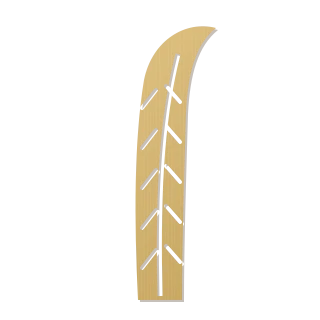
Feather of Maat, ancient Egyptian sign, in brass

Feather of Maat

mꜣꜥt, truth and order

Maat was truth, justice and the right order of the world, and her emblem was a single ostrich feather. In the judgement of the dead the heart was weighed against it; a heart heavy with wrongdoing was eaten by the monster Ammit.

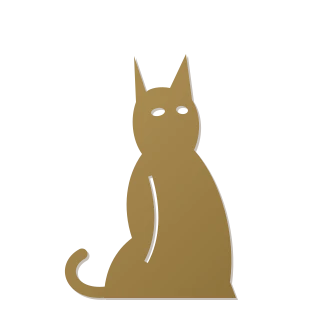
Cat of Bastet, ancient Egyptian sign, in brass

Cat of Bastet

mjw, “cat”

Bastet began as a lioness and became the cat: guardian of the home, of women and children. The Egyptian word for cat, miu, echoes its call, and seated cats like this one were cast in bronze by the thousand as offerings at Bubastis.

Bee, ancient Egyptian sign, in brass

Bee

bjt

The bee stood for Lower Egypt, and with the sedge of Upper Egypt it spelled one of the king’s oldest titles, “he of the sedge and the bee.” A myth tells that bees were born from the tears of the sun god Ra.

Ouroboros, ancient Egyptian sign, in brass

Ouroboros

the serpent that eats its tail

A serpent with its tail in its mouth: the endless round of time. Its oldest known image is on a gilded shrine from the tomb of Tutankhamun; from Egypt it passed to Greek alchemists, who named it “tail-eater.”

Protection and the afterlife 護りと来世

Knot of Isis, ancient Egyptian sign, in brass

Knot of Isis

tjt

A knot of cloth, like an ankh with its arms hanging down, linked with the goddess Isis. The Book of the Dead asks for a tyet of red jasper to be hung at the throat of the dead, so that the power of Isis would protect them.

Heart, ancient Egyptian sign, in brass

Heart

jb

To the Egyptians the heart, not the brain, held thought, memory and conscience. A heart amulet shaped like a jar with handles was laid on the body, and the heart was left inside the mummy, because it would be weighed at the judgement.

Ka, ancient Egyptian sign, in brass

Ka

kꜣ, the life force

Two raised arms: the ka, the life force each person is born with, which lives on after death. Offerings of food were made to the ka and statues in tombs gave it a home; the sign crowns the head of the wooden ka statue of king Hor.

Every sign above can be made in solid brass, in S Ø20, M Ø25 or L Ø30 and either finish, alone or in a group order. A cartouche can carry your own name in hieroglyphs.

ORDER A SIGN IN BRASS

More signs of ancient Egypt

Some of Egypt’s best-known images are whole figures, too fine to read at the size of a brooch. We list them here; several can be made larger, as a pendant or a coin, on request.

Falcon of HorusThe sky god and protector of kingship; every king was “the living Horus.”
UraeusThe rearing cobra of the goddess Wadjet, set on the king’s brow to spit fire at his enemies.
VultureNekhbet of Upper Egypt; with the cobra she formed the “Two Ladies” who guarded the crown.
Jackal on a shrineAnubis, or Wepwawet the opener of the ways, lying watch over the necropolis.
Ba birdA bird with a human head: the part of a person that could leave the tomb by day.
IbisThoth, god of writing, wisdom and the moon, who recorded the weighing of the heart.
Sema-tawyLotus and papyrus tied around a windpipe: the union of the Two Lands, carved on royal thrones.
PapyrusWadj, green and flourishing; the plant of Lower Egypt.
SistrumThe sacred rattle of Hathor, shaken in her temples for music and joy.
MenatA heavy beaded necklace of Hathor, held out as a blessing of life and fertility.
FrogHeqet, who helped at births; the tadpole was the hieroglyph for 100,000.
Taweret and BesA hippopotamus goddess and a lion-maned dwarf god, both guardians of the household and of childbirth.
Double crownThe red crown of Lower Egypt and the white crown of Upper Egypt, worn together as one.

SEVENTY-THREE SIGNS IN THE EGYPT ATLAS →

IN THE ETSY SHOP · 販売中

Pins, brooches and earrings

Anubis, Bastet, the ankh and the cobra and bee of the pharaohs, ready to order from our Etsy shop.

Gods and guardians

Anubis, who watched over the dead, and Bastet, the cat goddess who guarded the home.

Signs of life and kingship

The ankh, the sceptre and the cobra of the pharaoh’s brow: the signs that gods and kings held and wore.

READING THE SIGNS · 読み解く

Picture and word at once

In hieroglyphic writing a sign could stand for a thing, for a sound, or for both, so a symbol was also a word: the ankh is written for ankh, “life.” Worn on the body, a sign became an amulet, a word that went on working. The living wore the ankh, the eye of Horus and the scarab; the dead were wrapped with dozens of amulets between the linen bands, and the Book of the Dead gives spells to be said over some of them.

Colour carried meaning too. Black was the colour of the silt the Nile flood laid on the fields each year, and so of fertility and new life; the Egyptians called their country Kemet, “the black land.” Gold, which never tarnishes, was the flesh of the gods. Green, the colour of growing papyrus, stood for health and renewal.

Questions about Ancient Egypt

Are these religious symbols?
They were, three thousand years ago: Anubis, Bastet and the ankh belonged to the religion of ancient Egypt. Today they are worn as art and history, and for what they meant: protection, the home, life itself.
What are they made of, and what sizes are they?
Each piece is different: enamel pins, cast brooches, a medallion and earrings. The materials, size and the current price are on each Etsy listing, linked from the piece’s page.
Can you make an Egyptian symbol in your brass round frame?
Yes. The ankh, the eye of Horus, a scarab or a cartouche can be redrawn for our solid-brass round brooch, like our family crests. See Custom & Wholesale.