
A field guide to the sacred signs of the world’s faiths
Forty-six signs held sacred, from the cross and the menorah to Om, the khanda, the dharma wheel and the torii: what each shows, what it means to those who hold it sacred, and where you will see it. Use it to read a sign you have met, or to choose one we can make for you in brass.
基督教・ユダヤ教・イスラム・ヒンドゥー教・仏教・シク教とジャイナ教・道教と神道、そして古代と新しい信仰。八つの伝統の聖なる印を紹介します。
Each sign is drawn in one of its usual forms; most have many. Signs marked BROOCH are in our Sacred Series. The F1 and F2 buttons are a colour preview, not a brooch render.
基督教Christianity15
The cross in its many forms, and the monograms, creatures and knots the Church has carried since the catacombs. Several began as hidden signs, when to show the cross openly was still dangerous.
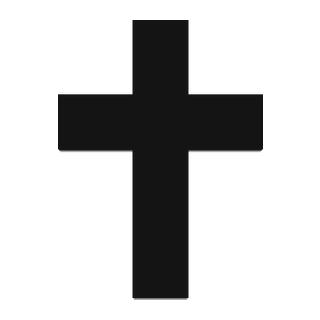 Latin crossEmpty cross, crux immissaBROOCH
The cross on which Jesus was crucified, drawn with a long lower arm. Shown empty, without the figure of Christ, it speaks of the Resurrection as much as of the death: the work finished and the tomb left behind.
WHERE IT IS SEEN Shared by nearly every Christian church. The empty cross is the usual form in Protestant churches; Catholic and Orthodox churches also use the crucifix, the cross with the body of Christ upon it.
Early Christians were slow to show the cross openly, since crucifixion was still a Roman execution. It became the common sign of the faith after Constantine abolished the penalty in the fourth century.
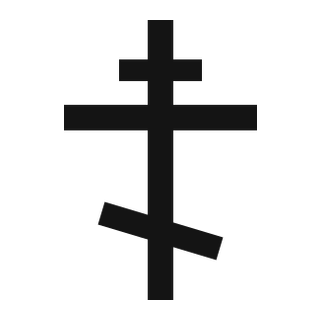 Orthodox cross☦Russian cross, three-bar cross
A cross with three bars. The short top bar is the board Pilate had nailed above Christ’s head, “Jesus of Nazareth, King of the Jews”; the long bar holds the arms; the slanting bar below is the footrest.
WHERE IT IS SEEN The cross of the Russian Orthodox Church and of much of the Slavic Orthodox world, on the domes of churches, on icons and on the small baptismal crosses worn under the clothes.
The footrest is said to point up towards the penitent thief, who was crucified at Christ’s right hand and promised paradise, and down towards the thief who mocked him. The sign has its own character in Unicode, ☦.
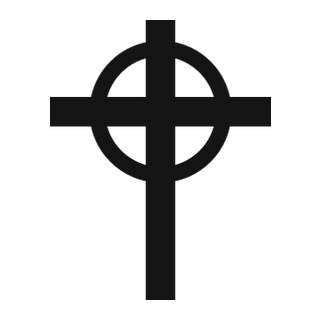 Celtic crossRinged cross, high cross
A cross with a ring around the meeting of its arms. Some read the ring as a halo or the sun, others as eternity; on the great stone crosses it may first have been a way of bracing the heavy arms.
WHERE IT IS SEEN The carved high crosses of Ireland and Britain, from the eighth century on, such as Muiredach’s Cross at Monasterboice. Since the Celtic Revival of the nineteenth century it has been a favourite for gravestones far beyond Ireland.
A plain ringed cross with square arms is also used by some extremist groups. It has nothing to do with the carved crosses of the Irish church, and context usually makes the difference plain.
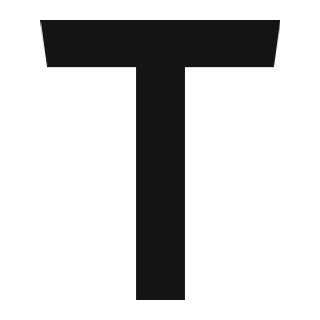 Tau crossCross of St Anthony, crux commissa
A cross in the shape of the Greek letter tau, with no arm above the bar. It recalls the mark set on the foreheads of the faithful in Ezekiel 9:4, and the staff of the hermit St Anthony of Egypt.
WHERE IT IS SEEN Above all the Franciscans: St Francis of Assisi signed his letters with a tau, and Franciscan friars and many lay people wear a tau carved in wood on a cord.
Francis is said to have taken up the sign after Pope Innocent III preached on Ezekiel’s mark at the Fourth Lateran Council in 1215. In the Hebrew of Ezekiel the mark is the letter tav, written in the old script as a cross.
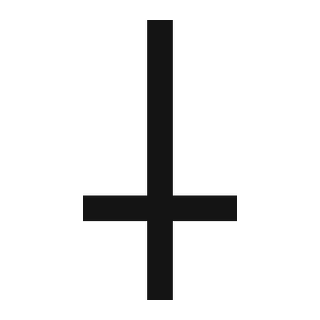 Cross of St PeterPetrine cross, inverted cross
A Latin cross turned upside down. Early tradition holds that the apostle Peter, condemned in Rome, asked to be crucified head downwards because he was not worthy to die as Christ had died. The cross stands for humility.
WHERE IT IS SEEN In Catholic art it marks St Peter and, through him, the papacy; it is carved on the back of the papal throne and in churches dedicated to the saint.
Since the twentieth century the inverted cross has also been used in horror films and heavy metal as an anti-Christian sign. Its old meaning is the opposite: devotion so deep that it refused an equal place with Christ.
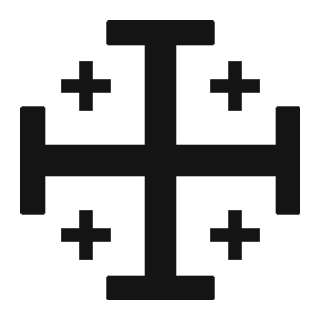 Jerusalem crossCrusader’s cross, fivefold cross
A great cross with a crossbar at the end of each arm, and a small cross in each of the four corners. The five crosses are read as the five wounds of Christ, or as Christ and the four evangelists carrying the Gospel to the four corners of the world.
WHERE IT IS SEEN The arms of the crusader Kingdom of Jerusalem after 1099, in gold on silver; today the emblem of the Franciscan Custody of the Holy Land, which looks after the holy places, and of pilgrims to Jerusalem.
The flag of Georgia carries a similar design: a red cross of St George with four small crosses in its corners.
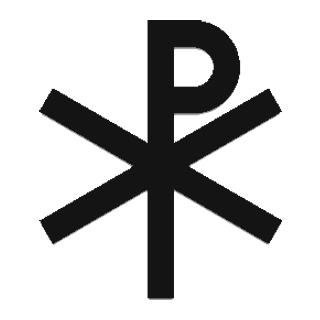 Chi-RhoΧΡChristogram, labarumBROOCH
The Greek letters chi (Χ) and rho (Ρ), the first two letters of Christos, laid over one another. It is one of the oldest monograms of Christ, older as a public sign than the plain cross.
WHERE IT IS SEEN Roman sarcophagi and catacombs, the coins and standards of Constantine and his successors, and today altar cloths, vestments and church doors, especially in the Catholic, Anglican and Lutheran churches.
Lactantius tells that before the Battle of the Milvian Bridge in 312 Constantine was told in a dream to mark the heavenly sign on his soldiers’ shields. His standard bearing the Chi-Rho, the labarum, became the banner of a Christian empire.
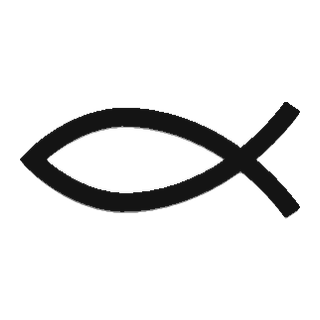 IchthysΙΧΘΥΣJesus fishBROOCH
Two arcs that cross to form a fish. The Greek word for fish, ΙΧΘΥΣ, gives the initials of “Iēsous Christos, Theou Yios, Sōtēr”: Jesus Christ, Son of God, Saviour.
WHERE IT IS SEEN Early Christian tombs and inscriptions from the second century on; today car badges, church signs and jewellery, especially among evangelical Christians.
Around 200 Clement of Alexandria told Christians which signs to choose for the seal rings they wore: a dove, a fish, a ship, a lyre or an anchor. The fish is the first Christian emblem we know of that was chosen to be worn.
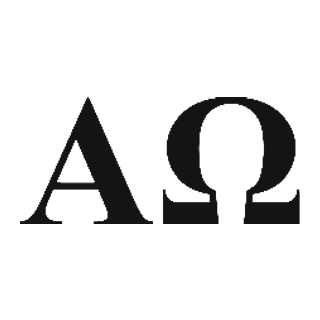 Alpha and OmegaBROOCH
The first and last letters of the Greek alphabet. In Revelation God, and then Christ, says “I am Alpha and Omega, the beginning and the end” (Revelation 1:8, 22:13): the one before all things and after all things.
WHERE IT IS SEEN Hanging from the arms of the Chi-Rho in the catacombs and on early sarcophagi; on altars, gravestones and the Paschal candle.
At the Easter Vigil the priest traces a cross on the new Paschal candle, with the alpha above it, the omega below and the numbers of the year in its corners, saying “Christ yesterday and today, the beginning and the end, Alpha and Omega.”
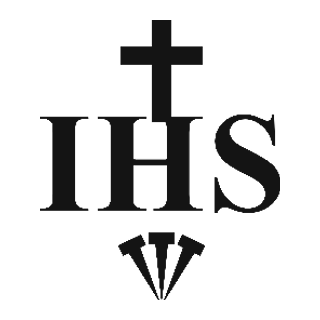 IHS ChristogramΙΗΣHoly Name, IHCBROOCH
The first three letters of the name of Jesus in Greek, ΙΗΣΟΥΣ, written in Latin letters. Later readers took it for a Latin phrase, Iesus Hominum Salvator, “Jesus, Saviour of mankind”, but that came afterwards.
WHERE IT IS SEEN Catholic churches, altar breads and vestments; above all the Society of Jesus, whose seal shows IHS in a sun, with a cross rising from the H and three nails beneath.
The Franciscan preacher Bernardino of Siena (1380–1444) held up a board painted with the golden IHS at the end of his sermons and asked the crowds to venerate the Holy Name. Ignatius of Loyola took the monogram for the Jesuits a century later.
 AnchorAnchor of hope, anchored crossBROOCH
Hope that holds firm, from Hebrews 6:19: “Which hope we have as an anchor of the soul, both sure and stedfast.” Its stock and shank also form a cross, hidden in plain sight.
WHERE IT IS SEEN Carved on tombs in the Roman catacombs of Priscilla and Domitilla; later the emblem of St Clement of Rome, who was said to have been drowned tied to an anchor, and of St Nicholas, patron of sailors.
The anchor was on Clement of Alexandria’s list of fitting signs for a Christian’s seal ring. It faded from Christian art in the Middle Ages and returned with the hope-and-faith jewellery of the nineteenth century.
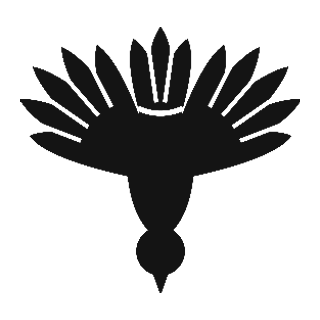 Dove of the Holy SpiritDescending doveBROOCH
The Holy Spirit, who came down upon Jesus at his baptism “in a bodily shape like a dove” (Luke 3:22). Drawn head down and wings raised, it is descending; with an olive branch, it is Noah’s dove bringing word that the Flood was over (Genesis 8:11).
WHERE IT IS SEEN Confirmation and Pentecost, baptismal fonts and the canopies over pulpits; Pentecostal and charismatic churches use it as their sign.
The dove with the olive branch passed from the Bible into general use as the sign of peace; Picasso’s dove, drawn for the Paris Peace Congress of 1949, carried it around the world.
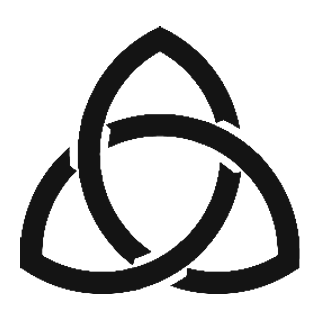 Trinity knotTriquetraBROOCH
Three pointed loops drawn as one unbroken line. Read by Christians as the Trinity: three persons, one God, without beginning or end. A circle is often woven through it.
WHERE IT IS SEEN Celtic and Anglo-Saxon manuscripts and metalwork, the Book of Kells (around 800), Celtic Revival jewellery and many church designs, especially in Ireland.
The knot is older than its Christian reading: it appears in Germanic and Celtic art, and on pagan stones in Scandinavia, before the conversion. Christian artists took it up and gave it the meaning it carries today.
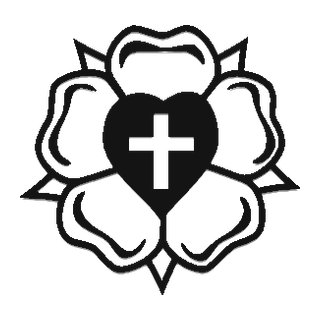 Luther roseLuther sealBROOCH
A black cross in a red heart, set on a white rose, in a sky-blue field ringed with gold. Luther explained it himself: faith in the crucified Christ, which brings joy, peace and the hope of heaven, and a blessing that has no end.
WHERE IT IS SEEN The seal Martin Luther used from 1530, and since then the emblem of Lutheran churches around the world, on church windows, hymnals and the bookplates of pastors.
Luther described each part in a letter of 8 July 1530 to Lazarus Spengler, written from Coburg Castle while the Diet of Augsburg was debating the Lutheran confession.
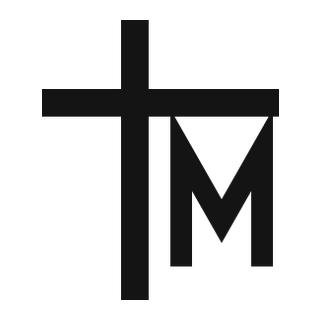 Marian crossCross with the letter MBROOCH
A cross with the letter M below its right arm: Mary standing at the foot of the cross, where Jesus gave her to the disciple John as his mother (John 19:26–27).
WHERE IT IS SEEN Catholic devotion to Mary; best known from the coat of arms of Pope John Paul II, who placed it there in 1978 with his motto Totus tuus, “totally yours”.
The motto comes from the consecration to Mary taught by St Louis de Montfort, which the young Karol Wojtyła read while working in a Kraków chemical factory during the war.
ユダヤ教Judaism4
Judaism is wary of images, and its signs are few and old: the lampstand of the Temple, the tablets of the Law, a word, and a star that became the sign of a people.
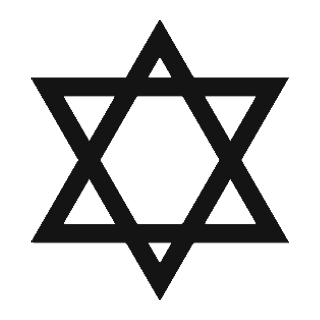 Star of Davidמגן דודMagen David, Shield of DavidBROOCH
Two equilateral triangles laid over one another, the Magen David, “shield of David”. Many meanings have been read into it, but its value today is simpler: it is the sign by which the Jewish people is known.
WHERE IT IS SEEN Synagogues, Jewish graves and jewellery, the flag of Israel, and the Magen David Adom, Israel’s emergency medical service.
The hexagram decorates the Leningrad Codex of 1008 and medieval churches and mosques alike. Prague’s Jewish community used it on its flag from the fourteenth century; the Zionist Congress of 1897 adopted it; the Nazis forced Jews to wear it in yellow; and in 1948 it was set on the flag of the new State of Israel.
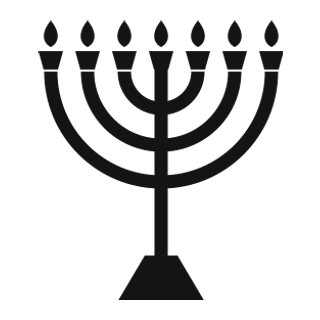 MenorahמנורהSeven-branched lampstand
The seven-branched golden lampstand made for the Tabernacle in the wilderness (Exodus 25:31–40) and kept burning in the Temple in Jerusalem: the oldest symbol of Judaism, and a sign of the light of God’s teaching.
WHERE IT IS SEEN Synagogues, ancient mosaics and tombs, and the emblem of the State of Israel since 1949.
The Arch of Titus in Rome, built around 81, shows Roman soldiers carrying the Temple menorah away from Jerusalem after its fall in 70. The nine-branched lamp lit at Hanukkah is a different lamp, the hanukkiah.
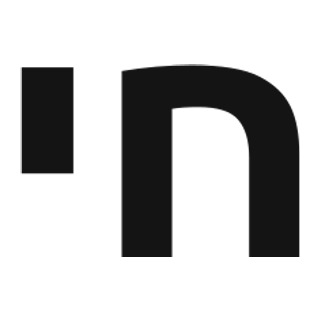 ChaiחיLife
The Hebrew word chai, “alive” or “life”, written with the letters chet (ח) and yod (י). It is a sign of the value Judaism places on life itself, heard in the toast l’chaim, “to life!”
WHERE IT IS SEEN Pendants and jewellery, above all since the 1960s and 1970s; gifts and charity.
In Hebrew every letter is also a number: chet is 8 and yod is 10, so chai is 18. Gifts at weddings and bar mitzvahs and donations to charity are therefore often given in multiples of 18.
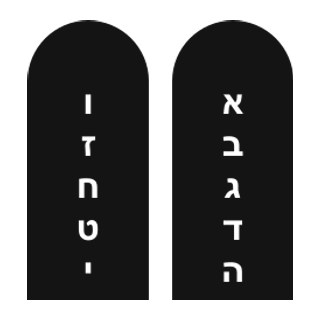 Tablets of the Lawלוחות הבריתTen Commandments, luchot
The two stone tablets on which the Ten Commandments were written, given to Moses on Mount Sinai (Exodus 31:18). Shown here, as they often are, with the first ten letters of the Hebrew alphabet standing for the ten commandments.
WHERE IT IS SEEN Above the ark that holds the Torah scrolls in synagogues, on the curtain before it, and on the badges of Jewish chaplains in the armed forces.
The Bible says only that the tablets were of stone and written on both sides (Exodus 32:15). The round-topped shape we know comes from European art; the right tablet carries the first five commandments, since Hebrew reads from right to left.
イスラムIslam3
Islam has no official symbol and avoids images of the sacred. What it has instead are marks in the Qur’an, a moon that keeps its calendar, geometry without end, and a protective hand shared with its neighbours.
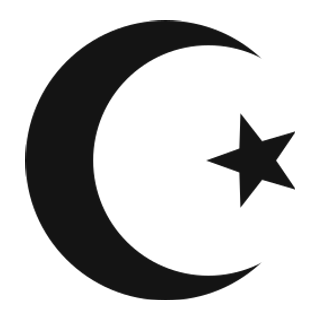 Star and crescentهلالHilal
A crescent moon with a star in its arms. Islam has no official symbol, and many Muslims do not regard this as a religious sign at all; but the new moon matters in Islam, because it marks the start of every month of the lunar calendar, Ramadan among them.
WHERE IT IS SEEN The finials on the domes and minarets of mosques, and the flags of Turkey, Pakistan, Algeria, Tunisia, Malaysia and others; the Red Crescent, the counterpart of the Red Cross.
The star and crescent is older than Islam: it was a sign of ancient Byzantium. It became associated with Islam through the Ottoman Empire, whose flag carried it. The Red Crescent was first used by Ottoman medical services in the war with Russia of 1876–78.
 Rub el Hizbربع الحزبQuarter of the hizbBROOCH
An eight-pointed star of two overlapping squares, with a circle at its centre. In the printed Qur’an it marks the divisions of the text for recitation: the Qur’an is divided into sixty parts, each a hizb, and the star marks every quarter of a hizb.
WHERE IT IS SEEN In the margins of the Qur’an; and, as an endless geometric pattern, in Islamic tilework, woodwork and metalwork from Andalusia to Central Asia.
The sign has its own character among the Arabic marks of Unicode, ۞, used to begin a quarter in digital texts of the Qur’an.
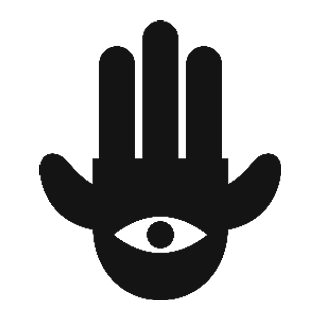 HamsaخمسةHand of Fatima, Hand of MiriamBROOCH
An open right hand, often with an eye in the palm, held up against the evil eye. Khamsa is Arabic for “five”, the fingers of the hand.
WHERE IT IS SEEN Across North Africa and the Middle East, on doors, in cars and as jewellery: among Muslims it is the Hand of Fatima, after the Prophet’s daughter; among many Jews, especially from North Africa, the Hand of Miriam, after the sister of Moses.
It is a folk sign of protection rather than a sign of either faith’s scripture, and some religious teachers on both sides frown on amulets. The open hand as a guard against harm is older than both.
ヒンドゥー教Hinduism4
A sacred sound, a sign of good fortune, the weapon of a god and a diagram for meditation: signs that are spoken, drawn on thresholds and worshipped, not only worn.
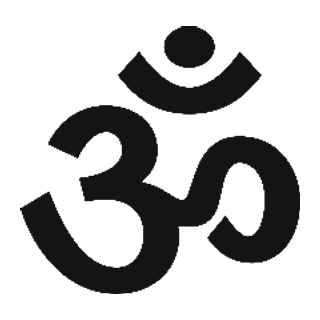 OmॐAum, pranavaBROOCH
The sacred syllable, spoken before and after prayers, mantras and the reading of scripture. The Mandukya Upanishad reads its three sounds, A, U and M, as waking, dreaming and deep sleep, and the silence after them as the fourth state, pure consciousness beyond all three.
WHERE IT IS SEEN Hindu temples, shrines in the home, the opening of texts and letters; it is chanted in yoga and meditation around the world.
Om is sacred in Buddhism and Jainism too. Buddhists open mantras with it, as in Om mani padme hum; for Jains it joins the first sounds of the five supreme beings honoured in their oldest prayer.
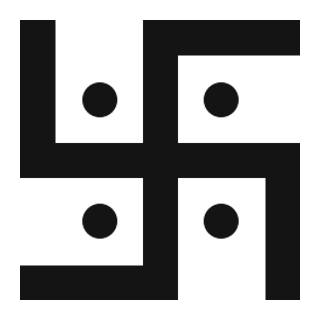 Swastikaस्वस्तिकSvastika, sathiya
From the Sanskrit su, “good”, and asti, “it is”: a sign of well-being and good fortune. Its arms turning clockwise follow the path of the sun; in Hindu use four dots are often set between the arms.
WHERE IT IS SEEN Drawn at the thresholds of houses, on the first page of account books at Diwali, on wedding invitations and at the start of rituals; in Jainism it is the emblem of the seventh tirthankara, Suparshvanatha.
In 1920 the Nazi party took the sign, tilted on its point, as its emblem, and in Europe and America it has meant that ever since; in many countries the Nazi form is banned. For a billion people in India and Asia it remains what it always was, a blessing. Shown here upright with its four dots, as Hindus draw it.
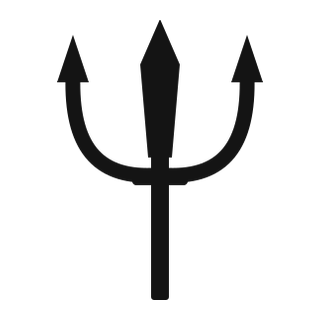 Trishulaत्रिशूलTrident of Shiva
The three-pronged trident carried by Shiva, and by the goddess Durga in her battle against the buffalo demon. Its prongs are read as creation, preservation and destruction, or as past, present and future, held in one hand.
WHERE IT IS SEEN Shiva temples, where great tridents stand before the shrine; the foreheads of Shaiva devotees, marked with three lines of ash; small tridents carried by ascetics.
A small double-headed drum, the damaru, often hangs from the shaft: in Shiva’s hands its beat is the rhythm of creation.
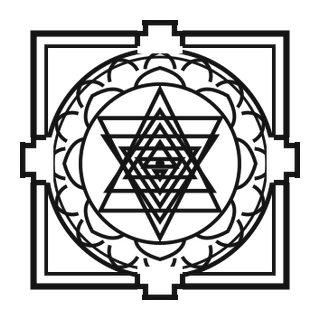 Sri Yantraश्रीयन्त्रSri Chakra
A diagram for meditation: nine interlocking triangles around a central point, the bindu. Four point upwards, the masculine Shiva; five point downwards, the feminine Shakti; together they form forty-three smaller triangles, the whole of creation.
WHERE IT IS SEEN The Shri Vidya tradition, in the worship of the goddess Lalita Tripurasundari; temples and household shrines, drawn, engraved on metal or cut in crystal.
Around the triangles run rings of eight and sixteen lotus petals, and the whole is set in a square wall with a gate on each side. The exact geometry is famously demanding; our drawing is a simplified reading of it, not a ritual diagram.
仏教Buddhism6
Before the Buddha was shown in human form, he was shown by signs: a wheel, a tree, a footprint. They remained, joined by the eight auspicious signs of Tibet and the brush circle of Zen.
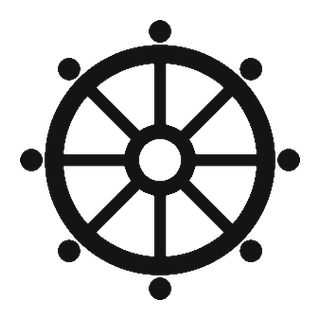 Dharma wheelधर्मचक्रDharmachakra, wheel of the teachingBROOCH
The wheel of the Buddha’s teaching, set turning in his first sermon in the Deer Park near Sarnath. Its eight spokes are the Noble Eightfold Path; the hub is moral discipline, the rim the concentration that holds it together.
WHERE IT IS SEEN Buddhist temples throughout Asia; in Tibet it is shown between two deer, recalling the Deer Park. Before artists showed the Buddha in human form, they pictured him by signs such as this wheel, a footprint or an empty seat.
The emperor Ashoka set wheels on stone pillars across India in the third century BC; one of them, with twenty-four spokes, is at the centre of India’s flag.
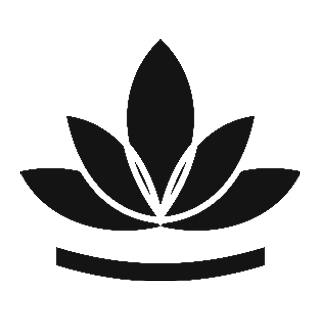 Lotusपद्मPadmaBROOCH
A flower that roots in the mud and opens clean above the water: the mind that rises through the world and its suffering to awakening, without being stained by it.
WHERE IT IS SEEN Buddhist art everywhere: the Buddha and the bodhisattvas sit or stand on open lotuses, and in Japan the lotus pedestal carries almost every temple image. In Hinduism it is the seat of Brahma and the flower of Lakshmi, goddess of fortune.
One of the eight auspicious signs of Tibetan Buddhism, and the name of one of the most loved scriptures of East Asia, the Lotus Sutra.
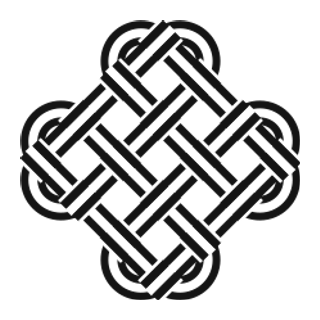 Endless knotདཔལ་བེའུEternal knot, shrivatsa
A lattice of interwoven lines with no beginning and no end: the way all things arise in dependence on one another, and the union of wisdom and compassion. It is one of the eight auspicious signs.
WHERE IT IS SEEN Tibetan and Mongolian Buddhism, on temple hangings, prayer flags and gifts; in China, as the panchang knot, it is a common sign of long life and endless good fortune.
The eight auspicious signs are the parasol, the two golden fish, the treasure vase, the lotus, the conch, the endless knot, the victory banner and the wheel. They are offered to the Buddha and painted on the doors of Tibetan homes.
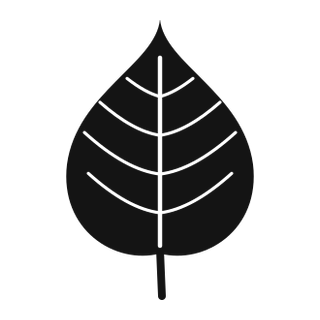 Bodhi leafबोधिLeaf of the sacred fig
The heart-shaped leaf, with its long tapering tip, of the sacred fig, Ficus religiosa: the tree under which the Buddha sat at Bodh Gaya until he attained awakening, bodhi.
WHERE IT IS SEEN Buddhist temples, where bodhi trees are planted and honoured; carvings and paintings, in which the tree long stood for the Buddha himself.
The Sri Maha Bodhi at Anuradhapura in Sri Lanka is said to have grown from a cutting of the original tree, brought by the nun Sanghamitta, daughter of Ashoka, in the third century BC. It is one of the oldest trees planted by people whose planting is recorded.
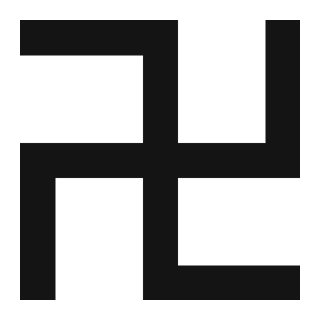 Manji卍Buddhist swastika
The swastika as East Asian Buddhism writes it, usually with its arms turning anticlockwise: the auspicious mark on the Buddha’s chest, and a sign of the Buddha’s teaching and compassion.
WHERE IT IS SEEN Temples in Japan, China and Korea; on Japanese maps the 卍 marks a Buddhist temple. Several samurai families bore it as a crest, among them the Tsugaru, and it is the emblem of the city of Hirosaki.
In 2016 Japan’s mapping agency proposed a pagoda symbol for temples on maps for foreign visitors, to avoid confusion with the Nazi emblem; the 卍 stays on maps made for Japanese readers.
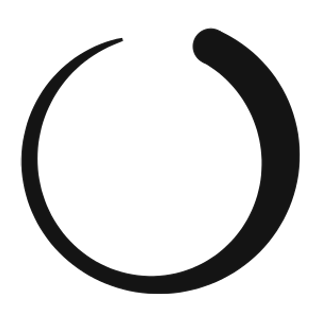 Ensō円相Zen circle
A circle drawn in a single stroke of the brush. In Zen it stands for awakening, emptiness and the whole of things, and for the mind of the moment in which it was drawn; nothing can be added afterwards.
WHERE IT IS SEEN Zen temples and the scrolls hung in tea rooms, often with a line of verse beside the circle. Some masters leave the circle open, some close it.
The Edo-period monks Hakuin and Sengai drew many. Sengai wrote beside one: “Eat this, and have a cup of tea.”
シク教・ジャイナ教Sikhism & Jainism3
Two faiths of India that defined themselves by a teaching: the oneness of God for the Sikhs, non-violence for the Jains, each set into a single emblem.
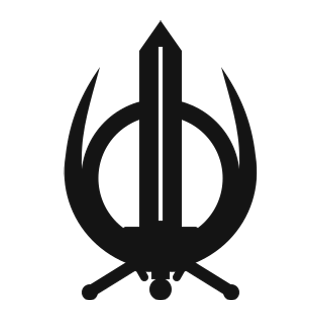 Khandaਖੰਡਾ
A double-edged sword, the khanda, at the centre, standing for divine knowledge that cuts truth from falsehood; a ring, the chakkar, for the oneness of God without beginning or end; and two curved swords for spiritual and worldly authority, piri and miri.
WHERE IT IS SEEN The saffron flag, the Nishan Sahib, that flies over every gurdwara; Sikh homes, turbans and jewellery.
The two swords recall Guru Hargobind, the sixth Guru, who wore two swords for the two kinds of authority. The emblem took its present form in the twentieth century.
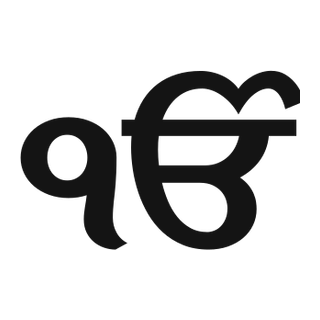 Ik OnkarੴOne Creator
“There is one Creator.” The figure for one, ੧, joined to the letter for the sacred syllable Om, with a flourish that carries it on. They are the first words of the Mul Mantar, the opening of the Guru Granth Sahib, and the heart of Guru Nanak’s teaching.
WHERE IT IS SEEN At the head of the scripture and of Sikh prayers, over the doors of gurdwaras and homes, and as a pendant.
The sign has its own character in Unicode, ੴ, and is written as one sign, not spelt out letter by letter.
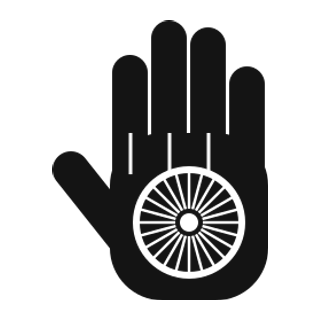 Jain handअहिंसाAhimsa hand
A raised open hand, “do not fear”, with a wheel in the palm. The word written in the wheel is ahimsa, non-violence, the first vow of Jainism; the wheel’s twenty-four spokes are the twenty-four tirthankaras, the teachers who crossed over.
WHERE IT IS SEEN Part of the emblem all Jain traditions agreed on in 1974, for the 2,500th anniversary of the nirvana of Mahavira, the last tirthankara; temples, books and calendars.
The full emblem sets the hand in the outline of the universe, below a swastika, three dots, a crescent and a dot, with the motto Parasparopagraho jīvānām: “souls render service to one another.”
道教・神道China & Japan4
The circle of yin and yang and the eight trigrams of Taoism, and the gate and swirling commas of Shinto, the native faith of Japan, whose signs passed into the family crests.
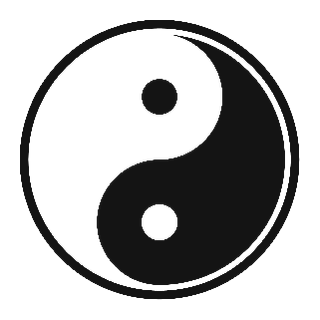 Yin and yang太極図TaijituBROOCH
Dark and light curled into one circle, each holding a seed of the other: the two forces whose balance and constant change make up the world in Chinese thought. Neither exists without the other, and each turns into the other at its height.
WHERE IT IS SEEN Taoist temples and robes, martial arts, traditional medicine; the flag of South Korea, in red and blue.
The idea is ancient, set out in the commentaries on the Book of Changes. The circle we know became the usual way of drawing it only in the Ming dynasty, after the diagrams of Song-dynasty philosophers such as Zhou Dunyi.
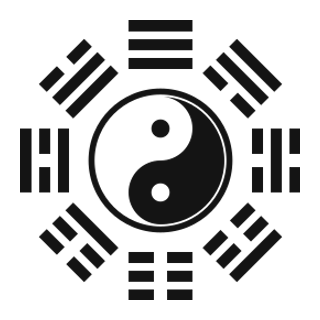 Bagua八卦Eight trigrams
The eight trigrams of the Book of Changes, each three lines whole or broken, set round a yin and yang: heaven, earth, fire, water, thunder, wind, mountain and lake. Combined in pairs they make the sixty-four hexagrams of divination.
WHERE IT IS SEEN Taoist temples and charms; the eight-sided bagua mirror hung over doors to turn away harm; feng shui; four of the trigrams frame the circle on the flag of South Korea.
There are two classic arrangements. This one is the “Earlier Heaven” order ascribed to the sage Fu Xi, with heaven (☰) at the top and earth (☷) at the bottom; the “Later Heaven” order of King Wen sets fire at the top.
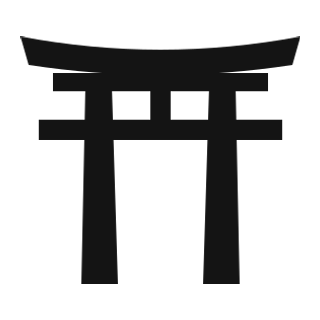 Torii鳥居Shrine gate
The gate at the entrance to a Shinto shrine: two pillars and two crossbeams marking where the everyday world ends and the sacred ground of the kami, the gods, begins. Visitors bow before passing through.
WHERE IT IS SEEN Every Shinto shrine in Japan, from village shrines to the great ones; on Japanese maps the torii marks a shrine, and it has its own character in Unicode, ⛩.
The best known stand in the sea at Itsukushima, so that the tide flows through them, and in tunnels of thousands of vermilion gates at Fushimi Inari in Kyoto, each given by a worshipper or a business.
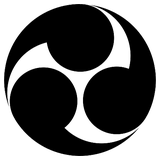 Mitsudomoe三つ巴Triple comma, tomoe
Three comma shapes turning around a centre, like water swirling. In Shinto it is a sign of the turning of the world and of the god Hachiman; its link with whirlpools made it a charm against fire.
WHERE IT IS SEEN Hachiman shrines and many others; the skins of festival drums, taiko; the round end tiles of temple and castle roofs. As a family crest it was borne by many samurai houses, the Kobayakawa among them.
Its origin is debated: a curled bow guard, the magatama jewel, a whirlpool. Korea has a related sign of three colours, the sam-taegeuk.
古代と新しい信仰Ancient & new faiths7
The life sign of Egypt, the hammer and knot of the Norse gods, a spiral older than the pyramids, and the stars and moons of faiths founded in the last two centuries.
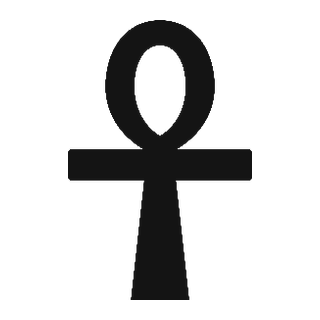 AnkhꜥnḫKey of life
The hieroglyph for life in ancient Egypt. Gods hold it by its loop and offer it to the king’s nose, the breath of life itself; it is carried in the hands of the gods in temple reliefs for three thousand years.
WHERE IT IS SEEN Tombs, temples and amulets of ancient Egypt; today modern Kemetic religion, and jewellery worn as a sign of life and of Africa’s heritage.
The Coptic Christians of Egypt took it up as a form of the cross, the crux ansata, “cross with a handle”, and it appears in their early textiles and manuscripts.
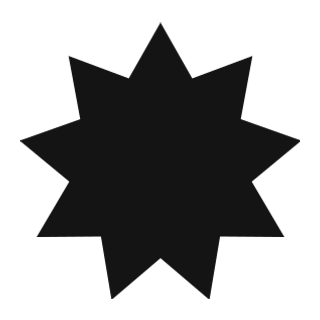 Nine-pointed starBahá’í star
A star of nine points. Nine is the highest single number, a sign of completeness, and in the Arabic system of letters and numbers it is the value of Bahá, “glory”, from which the Bahá’í Faith takes its name.
WHERE IT IS SEEN Bahá’í homes, books and gravestones; Bahá’í Houses of Worship are built with nine sides and nine doors.
The star is the sign most often used for the faith, but its own formal emblems are the calligraphy of the Greatest Name and the ringstone symbol.
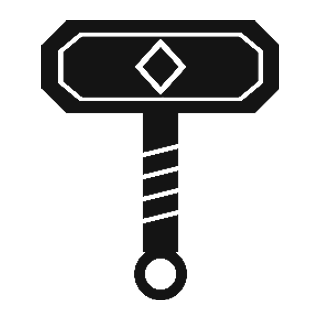 Thor’s hammerMjǫllnirMjölnirBROOCH
The hammer of the thunder god Thor, with which he defended gods and people against the giants; it also blessed weddings and births. In the Prose Edda the dwarves forged it and made its handle too short by mistake.
WHERE IT IS SEEN Small hammer pendants of silver and iron, found across Viking-age Scandinavia; today modern Heathenry, or Ásatrú, whose followers wear it as Christians wear a cross.
A soapstone mould found at Trendgården in Denmark has room to cast crosses and hammers side by side: one smith, serving both faiths. Since 2013 the hammer has been an approved emblem of belief for American veterans’ headstones.
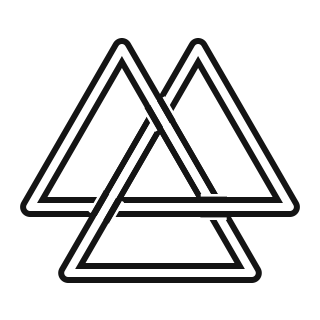 ValknutKnot of the slain
Three interlocked triangles. The name is modern, from Norwegian, “knot of the slain”, but the sign appears on Viking-age picture stones beside Odin and the dead, and is read as the god’s power over life and death.
WHERE IT IS SEEN The Gotland picture stones of Stora Hammars and Tängelgårda, and a bedpost from the Oseberg ship burial; today modern Heathenry and Norse-inspired art.
Like other Norse signs, it is also used by some white-supremacist groups, and anti-hate organisations list it with that warning; its ancient meaning lies elsewhere.
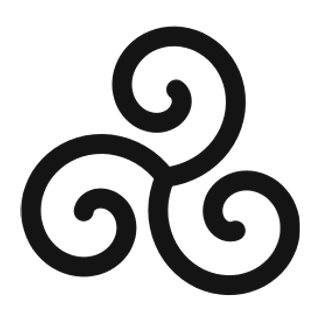 Triple spiralTriskele, triskelion
Three spirals unwinding from one centre. Its makers left no explanation; modern readers see in it the cycles of life, the sun or the three realms of land, sea and sky, and Christians in Ireland have read it as the Trinity.
WHERE IT IS SEEN Carved inside the passage tomb at Newgrange in Ireland, around 3200 BC, older than the pyramids; Celtic La Tène metalwork; today Celtic neopaganism and Irish jewellery.
The triskelion of three running legs, on the flags of the Isle of Man and Sicily, is a cousin of the same idea: threefold movement turning around a centre.
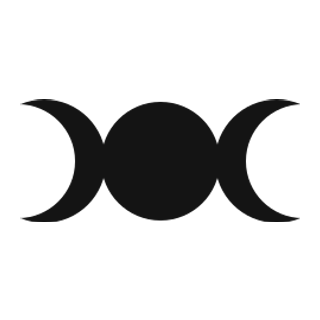 Triple moonTriple goddess
A waxing crescent, a full moon and a waning crescent: the goddess as maiden, mother and crone, and the cycle of growth, fullness and decline.
WHERE IT IS SEEN Wicca and other modern pagan religions, on altars, robes and jewellery.
The triple goddess of modern paganism owes much to Robert Graves’s book The White Goddess (1948), which gathered older ideas of the moon’s three faces into a single figure.
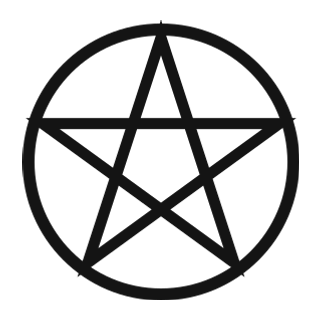 PentaclePentagram in a circle
A five-pointed star drawn in one line, inside a circle. In Wicca its points are earth, air, fire and water, with spirit at the top above them; the circle binds them together. Point upwards, it is a sign of protection.
WHERE IT IS SEEN Wicca and modern paganism, on altars and as jewellery; since 2007 an approved emblem of belief on American veterans’ headstones.
The pentagram was once a Christian sign as well: in the fourteenth-century poem Sir Gawain and the Green Knight it is painted on Gawain’s shield for the five wounds of Christ and the five joys of Mary.
No sign matches. Try the name (“menorah”), the faith (“Sikh”) or the sign itself (☦, ॐ, 卍).
Written in our own words from public reference works; each entry lists its sources. A sign means different things in different communities, and within one faith people read the same sign differently: we give the meanings most widely held, and say where a sign is shared, disputed or has been misused. We are designers, not teachers of these faiths. If you see something we have got wrong, please write to us.
The drawings are our own, made for this atlas, except the one listed below. Where a sign is drawn from the motif of one of our brooches, the brooch is linked from its entry.
- Mitsudomoe — Mukai, Wikimedia Commons, CC BY-SA 3.0