
A field guide to the signs of ancient Egypt
Seventy-three hieroglyphs: the signs of life and kingship, the sun and the sky, the crowns, the gods and their animals, the parts of the soul, and the twenty-four signs of the alphabet. Each with its Egyptian name, what it meant and where it was seen, and its number in Gardiner’s sign list, the standard catalogue of the script.
生命と王権・太陽と天空・王冠・神と聖なる動物・魂と来世、そしてアルファベットにあたる一子音文字。古代エジプトのヒエログリフを紹介します。
THE ANCIENT EGYPT SERIES IN BRASS →WRITE YOUR NAME IN HIEROGLYPHS →
Each sign is drawn as it is written in the standard type of the script. The italic name is the Egyptian word in the usual transliteration; the Egyptians wrote no vowels, so how the words sounded is partly guesswork. Signs marked BRASS are in our Ancient Egypt Series. The F1 and F2 buttons are a colour preview, not a brooch render.
生命と王権Life & kingship10
The signs a king held and the gods gave: life, stability, power and eternity, and the ring of rope that guarded a royal name.
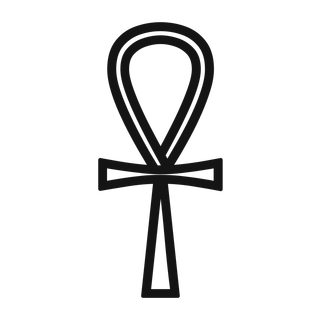 Ankhꜥnḫ“life” · Gardiner S34BRASS
The sign for life. Gods hold it by its loop and offer it to the king’s nose, the breath of life itself, and carry it in their hands in temple reliefs for three thousand years. Its origin is uncertain: a sandal strap, a knot, a mirror.
WHERE IT IS SEEN Tombs, temples, amulets and mirrors; the names of kings, as in Tutankhamun, “living image of Amun”.
The Coptic Christians of Egypt took it up as a form of the cross, the crux ansata, “cross with a handle”.
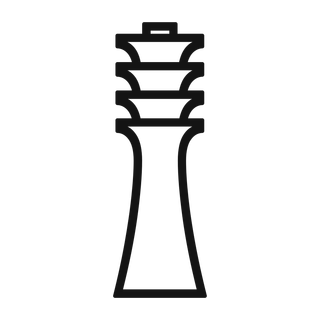 Djed pillarḏd“stability” · Gardiner R11BRASS
A column with four bars at its top: stability and endurance. It was linked with Osiris and called his backbone, and its amulet was laid on the mummy’s spine so that the dead would stand up again.
WHERE IT IS SEEN Amulets of green faience and gold; temple friezes, often in a row with the tyet knot and the ankh.
At the festival of Osiris the king and priests hauled a great djed upright with ropes, “raising the djed”, a sign of the god restored to life.
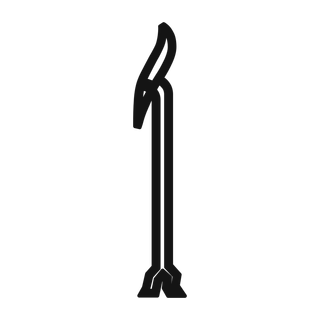 Was sceptrewꜣs“power, dominion” · Gardiner S40BRASS
A long staff with a forked foot and the head of an animal, perhaps the god Seth: power and dominion. Gods hold it in nearly every temple scene, and two of them often hold up the sky at the edges of a scene.
WHERE IT IS SEEN Temple reliefs, tomb paintings, and real staffs placed in burials.
Thebes, the great city of the south, was called Waset, and its emblem was a was sceptre decorated with a feather and a ribbon.
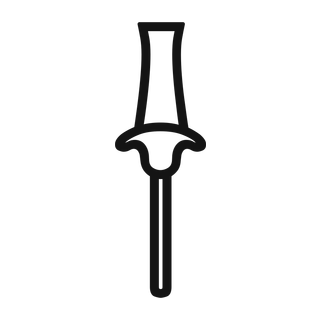 Sekhem sceptresḫm“power, might” · Gardiner S42
A flat sceptre with a broad top, carried as a sign of authority over offerings and over others. The same word means might and control, and sekhem was one of the powers of a person in the afterlife.
WHERE IT IS SEEN Scenes of kings and high officials before an offering table, and in the hands of statues.
The lion goddess Sekhmet takes her name from the same word: “the powerful one”.
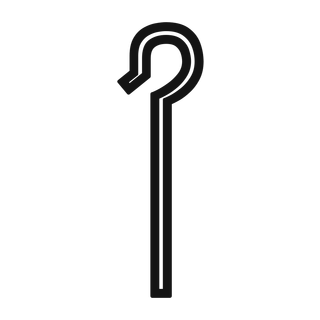 Crookḥqꜣ“rule” · Gardiner S38BRASS
The shepherd’s crook: the ruler who guides and protects his people as a shepherd his flock. As a hieroglyph it writes the word for ruler, heqa.
WHERE IT IS SEEN Held crossed over the chest with the flail by Osiris and by kings, as on the coffins of Tutankhamun.
The Hyksos, the foreign kings who ruled the north of Egypt around 1650–1550 BC, take their name from heqa khasut, “rulers of foreign lands”.
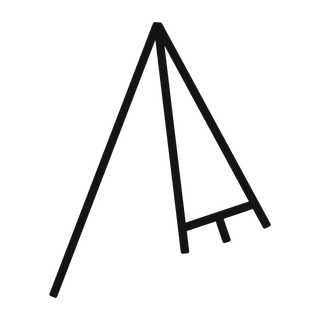 Flailnḫꜣḫꜣ“flail” · Gardiner S45BRASS
A rod with three strings of beads, held with the crook as a sign of kingship: the ruler who also corrects and punishes, or who provides the harvest.
WHERE IT IS SEEN In the hands of Osiris, of the god Min, and of kings in statues and on coffins.
Its origin is debated: a herdsman’s whip, a fly whisk, or a tool for gathering the sweet resin labdanum from shrubs.
 Shen ringšn“encircle” · Gardiner V9BRASS
A loop of rope tied off at the bottom, with no beginning and no end: eternity and protection, all that the sun encircles.
WHERE IT IS SEEN In the claws of the falcon god Horus and the vulture goddess Nekhbet, spread over the king; amulets and jewellery.
Stretched long enough to hold a name, the shen ring becomes the cartouche.
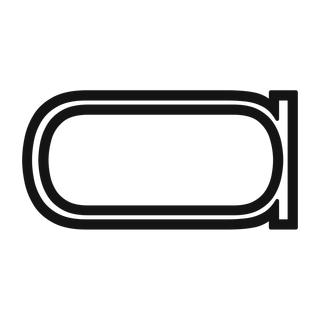 Cartouchešnw“the royal name-ring” · Gardiner V10BRASS
An oval loop of rope drawn around the name of a king or queen to protect it. The French word is a soldier’s name for it: Napoleon’s men thought it looked like a cartridge.
WHERE IT IS SEEN Royal names on temples, obelisks, scarabs and seals.
Because cartouches marked royal names, they let Thomas Young and then Champollion, in 1822, find the name of Ptolemy on the Rosetta Stone and of Cleopatra on an obelisk from Philae, and begin to read the script.
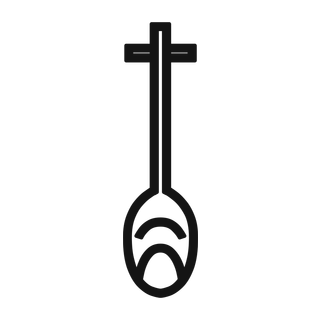 Nefernfr“good, beautiful” · Gardiner F35BRASS
A heart with its windpipe, read as good, beautiful, complete. It was a favourite amulet, often strung in rows on necklaces.
WHERE IT IS SEEN Names and titles throughout Egyptian history, and the formula netjer nefer, “the good god”, used of the king.
It is in the names of Nefertiti, “the beautiful one has come”, and Nefertari, “the beautiful companion”.
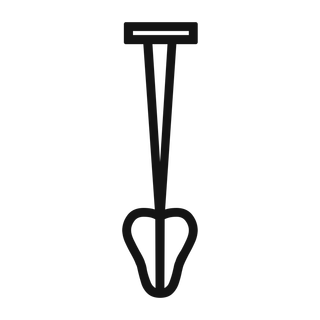 Semazmꜣ“unite” · Gardiner F36
Lungs and windpipe, the organs that join breath to body: the sign for union. Tied with the lotus of Upper Egypt and the papyrus of Lower Egypt it becomes the sema-tawy, “the union of the Two Lands”.
WHERE IT IS SEEN The sides of royal thrones, where two Nile gods pull the plants tight around the sign.
The union of Upper and Lower Egypt under one king, around 3100 BC, was the founding act of Egyptian kingship; every king renewed it.
太陽と天空Sun, sky & creation10
The sun crossing the sky by day and the underworld by night, the horizon where it is reborn, the beetle that rolls it, and the first mound of creation.
 Sunrꜥ“sun, day” · Gardiner N5
The disk of the sun with a dot at its centre: the sun, the day, and the sun god Ra himself. Written after a word, it marks words of time.
WHERE IT IS SEEN Royal names: from the Fourth Dynasty on, every king was “son of Ra”, and Ramesses means “Ra is the one who bore him”.
The same sign, the circle with a central dot, was later used by astronomers and alchemists for the sun and for gold.
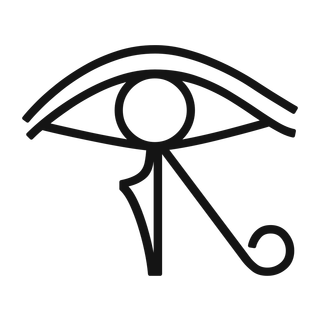 Eye of Horuswḏꜣt“the sound one” · Gardiner D10BRASS
Horus lost his eye fighting his uncle Seth, and it was made whole again; the healed eye became the most popular protective amulet in Egypt, a sign of health and restoration.
WHERE IT IS SEEN Amulets, the sides of coffins (so the dead could look out), and the bows of boats.
Scribes once took its parts for the fractions of a grain measure, one half to one sixty-fourth; Egyptologists now doubt that the system was ever really used.
 Horizonꜣḫt“horizon” · Gardiner N27BRASS
The sun between two hills, where it rises and sets each day, and so a sign of daily rebirth. Temple pylons, two towers with a gate between, were built in its image.
WHERE IT IS SEEN Temples, tomb paintings and the names of places.
Akhenaten called his new capital Akhetaten, “horizon of the Aten”, and the Great Sphinx of Giza was later called Horemakhet, “Horus in the horizon”.
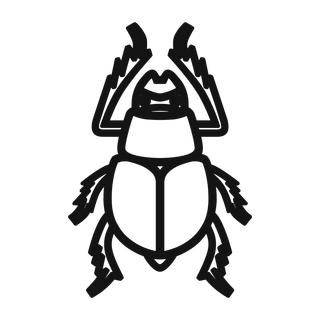 Scarabḫpr“to come into being” · Gardiner L1BRASS
The dung beetle rolls a ball before it, as the god Khepri was imagined rolling the sun into the sky each morning. Its name shares a root with the verb “to come into being”.
WHERE IT IS SEEN The commonest amulet in Egypt, and the seal of officials; large “heart scarabs” were laid over the heart of the mummy.
Amenhotep III issued large scarabs carved with news of his reign, a lion hunt or his marriage, and sent them around the country like bulletins.
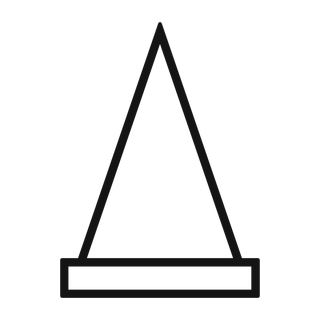 Pyramidmr“pyramid” · Gardiner O24BRASS
A pyramid. Its form recalls the benben, the first mound of land to rise from the waters at creation, on which the sun first stood.
WHERE IT IS SEEN The pyramids themselves, and the pyramid-shaped capstones, gilded to catch the first light, that crowned pyramids and obelisks.
A sacred stone called the benben stood in the temple of the sun at Heliopolis. The polished granite capstone of Amenemhat III’s pyramid at Dahshur survives in the Egyptian Museum in Cairo.
 Starsbꜣ“star” · Gardiner N14
A five-pointed star. The Egyptians drew stars with five points, and the same word, seba, also meant door and teaching, so the star could write all three.
WHERE IT IS SEEN The ceilings of tombs and temples, painted blue and covered in yellow stars; the names of the hours of the night.
The oldest religious texts, carved inside the pyramid of Unas around 2350 BC, lie under a ceiling of stars: the king was to join the stars that never set.
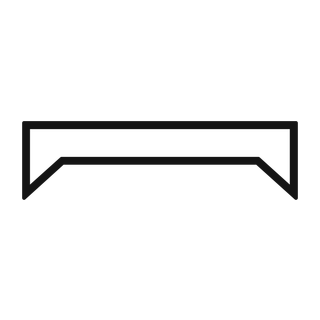 Skypt“sky” · Gardiner N1
The sky drawn as a flat roof over the world. Over a scene it marks the top of the world, often held up by two was sceptres.
WHERE IT IS SEEN The tops of stelae and temple doorways.
In myth the sky was also the goddess Nut, arching her body over the earth god Geb, who swallowed the sun each evening and gave birth to it each morning.
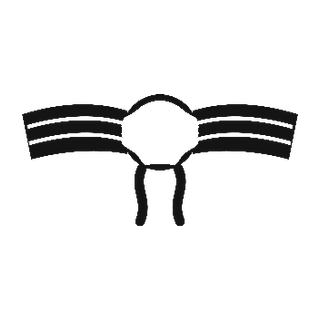 Winged sun diskbḥdtjBehdety, Horus of BehdetBRASS
The sun with the spread wings of a falcon and two cobras: the emblem of Horus of Behdet, spread over a doorway to protect all who pass beneath.
WHERE IT IS SEEN The lintel of almost every temple gateway in Egypt, and the tops of stelae.
The sign travelled far beyond Egypt: Assyrians, Persians and Phoenicians adopted winged disks of their own.
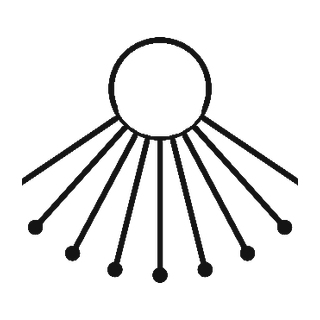 Atenjtn“the sun disk”BRASS
The disk of the sun, its rays ending in small hands that hold out the ankh. Around 1350 BC Akhenaten made the Aten the centre of worship and closed the temples of the other gods.
WHERE IT IS SEEN The art of Amarna, Akhenaten’s capital, where only the king and his family receive the rays.
The Great Hymn to the Aten, carved in a tomb at Amarna, has often been compared with Psalm 104.
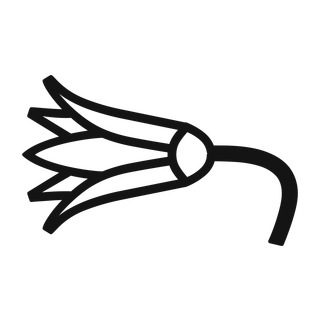 Blue lotussšn“lotus” · Gardiner M9BRASS
The blue water lily of the Nile opens at dawn and closes at dusk, so it stood for the sun and for rebirth: the young sun god rises from a lotus at the first morning.
WHERE IT IS SEEN Banquet scenes, where guests hold and smell the flower; the plant of Upper Egypt; the god Nefertem wears it as a crown.
A painted wooden head of the young Tutankhamun shows him rising from a lotus, as the sun god does.
王冠と神器Crowns & regalia9
The white crown of the south and the red crown of the north, worn alone or together, the crowns of war and of Osiris, and the cobra and vulture that guarded them.
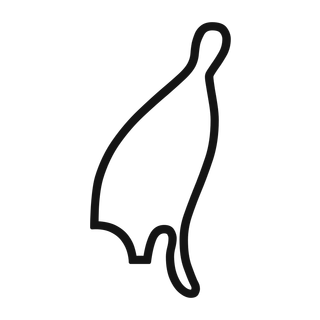 White crownḥḏtcrown of Upper Egypt · Gardiner S1
The tall white crown, shaped like a bowling pin, of Upper Egypt, the south. No real one has ever been found; it may have been made of felt or leather.
WHERE IT IS SEEN Kings and the god Osiris; in the hands of the vulture goddess Nekhbet, its protector.
On the Narmer Palette, around 3100 BC, the king wears the white crown on one side and the red crown on the other: one of the first pictures of the united kingdom.
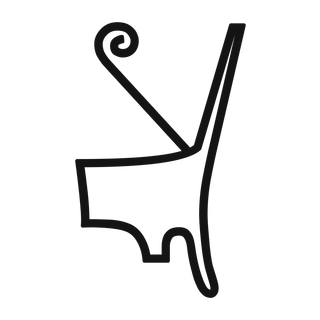 Red crowndšrtcrown of Lower Egypt · Gardiner S3
The red crown of Lower Egypt, the Delta, with a tall back and a curling wire at the front. It was protected by the cobra goddess Wadjet.
WHERE IT IS SEEN Kings, and the goddess Neith of Sais.
As a hieroglyph it was also used for the sound n.
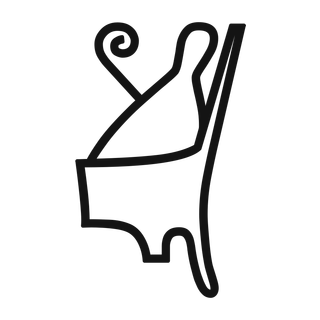 Double crownsḫmtj“the two powerful ones” · Gardiner S5
The white crown of the south set inside the red crown of the north: one king over the Two Lands. The Greeks called it pschent, from its Egyptian name.
WHERE IT IS SEEN Kings from the First Dynasty on, and the gods Horus and Atum.
The two crowns could also be worn singly on separate occasions; together they told the oldest story of Egyptian kingship, the union of the land.
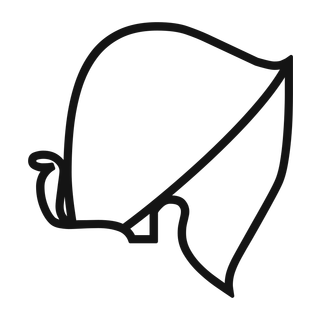 Blue crownḫpršthe war crown · Gardiner S7
A tall blue helmet-like crown covered in small disks, with a cobra at the front. It is often called the war crown, though kings wore it at ceremonies as much as in battle.
WHERE IT IS SEEN New Kingdom kings, above all Ramesses II, in statues and in reliefs of chariot battles.
It first appears in the Second Intermediate Period, around 1650 BC, and became the crown most often shown on New Kingdom kings.
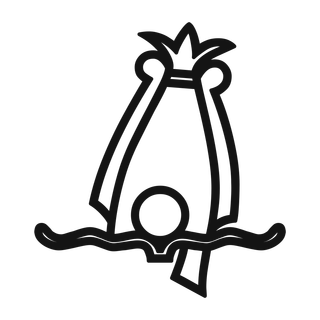 Atef crownꜣtfcrown of Osiris · Gardiner S8
The white crown with an ostrich feather on each side, often with ram’s horns and a small disk: the crown of Osiris, king of the dead.
WHERE IT IS SEEN Osiris in tomb paintings and the Book of the Dead; kings at certain rites.
The feathers are the same as the feather of Maat, truth, so the crown of the judge of the dead carries the sign by which the dead are judged.
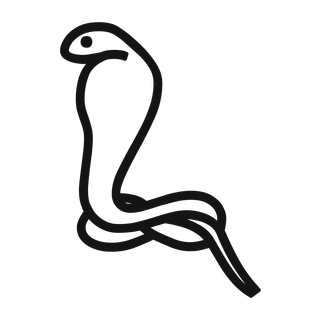 Uraeusjꜥrtthe rearing cobra · Gardiner I12
A cobra rearing up with its hood spread: Wadjet, the goddess of Lower Egypt, set on the king’s brow to spit fire at his enemies.
WHERE IT IS SEEN The front of every royal crown and headcloth; the friezes of cobras that crown temple walls.
Tutankhamun’s gold mask carries the cobra of the north and the vulture of the south side by side on its brow: the two goddesses who guarded the king.
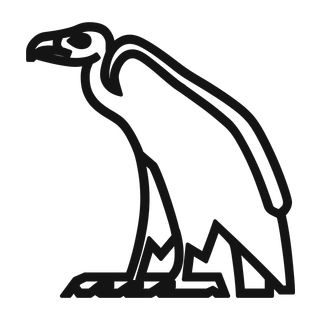 Vulturemwt“mother” · Gardiner G14
The vulture, which writes the word for mother: Nekhbet, goddess of Upper Egypt, who spreads her wings over the king, and Mut, the mother goddess of Thebes, whose name it spells.
WHERE IT IS SEEN Queens’ crowns in the form of a vulture, its wings hanging over the ears; ceilings of temple corridors, painted with vultures in flight.
With the cobra of Lower Egypt she formed the Two Ladies, nebty, one of the five names of every king.
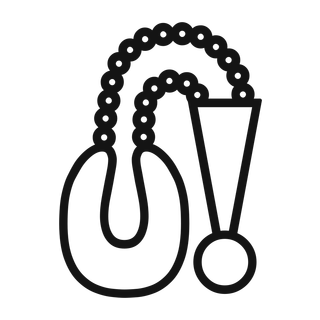 Menatmnjtnecklace of Hathor · Gardiner S18
A heavy beaded necklace with a counterweight at the back, sacred to the goddess Hathor. Priestesses shook it like a rattle in her rites, and held it out as a blessing of life and fertility.
WHERE IT IS SEEN Hathor and her priestesses; scenes of the king receiving the menat from a goddess.
Its counterweight, often of bronze or faience, was also made as an amulet on its own.
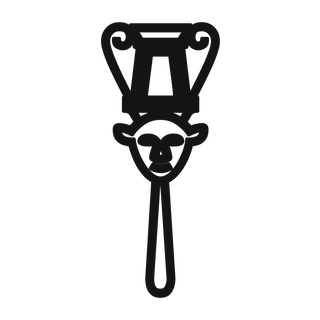 Sistrumsšštrattle of Hathor · Gardiner Y8
A sacred rattle with metal rods strung with discs, its handle often carved with the face of Hathor with cow’s ears. Shaken, it made a rustling sound like wind in papyrus, to please and calm the goddess.
WHERE IT IS SEEN Temple music and processions, and the hands of priestesses and queens.
It outlived Egypt: the cult of Isis carried it round the Roman world, and the Ethiopian Orthodox Church still shakes a sistrum, the tsenatsil, in its liturgy.
神と聖なる動物Gods & sacred animals13
Each god could appear as an animal, and the animal wrote the god’s name: the falcon of Horus, the jackal of Anubis, the ibis of Thoth, the cat of Bastet.
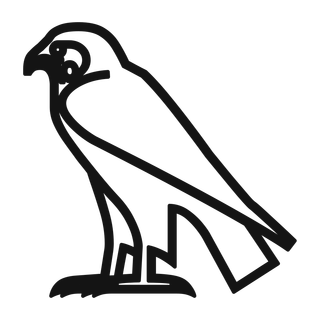 Falcon of Horusḥr“the distant one” · Gardiner G5
The falcon: Horus, god of the sky and of kingship, whose eyes were the sun and the moon. Every king was the living Horus, and his first name was written inside a palace façade with the falcon on top.
WHERE IT IS SEEN The great temple of Horus at Edfu, where granite falcons guard the gate; the shoulder of the king in the statue of Khafre.
The seated statue of Khafre in the Cairo Museum shows the falcon wrapping its wings round the back of the king’s head.
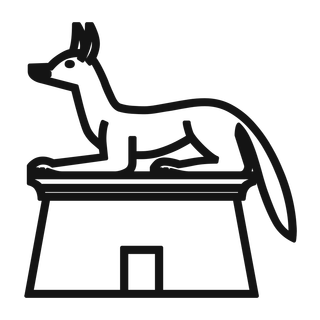 Jackal on a shrinejnpwAnubis · Gardiner E16
A black jackal lying on a shrine: Anubis, god of embalming and guardian of the necropolis, or Wepwawet, “opener of the ways”. Black was the colour of the fertile Nile mud, and of rebirth.
WHERE IT IS SEEN Tomb paintings, where Anubis tends the mummy and leads the dead to judgement; the seals of the royal tombs in the Valley of the Kings.
A life-size wooden Anubis lying on a gilded shrine guarded the treasury of Tutankhamun’s tomb.
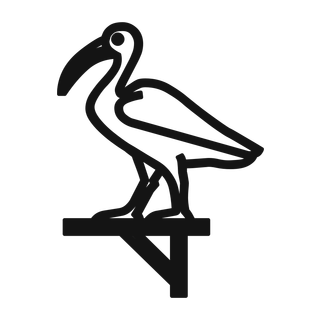 Ibis of ThothḏḥwtjThoth · Gardiner G26
The sacred ibis on a standard: Thoth, god of writing, wisdom and the moon, who invented the hieroglyphs and recorded the verdict at the weighing of the heart.
WHERE IT IS SEEN Scribes’ palettes and statues; the vast animal cemeteries of Saqqara and Tuna el-Gebel.
Millions of mummified ibises were buried in the catacombs of Saqqara and Tuna el-Gebel as offerings to Thoth. He could also appear as a baboon.
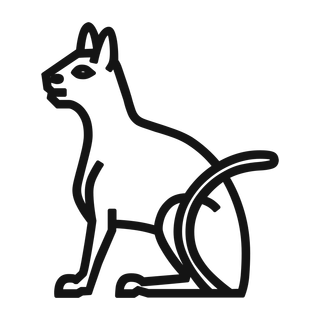 Cat of Bastetmjw“cat” · Gardiner E13BRASS
The cat: Bastet, who began as a lioness and became the gentle guardian of the home, of women and of children. The word for cat, miu, is the sound a cat makes.
WHERE IT IS SEEN Bronze cat statues and amulets by the thousand; the temple of Bastet at Bubastis in the Delta.
Herodotus describes the festival at Bubastis, where hundreds of thousands came by boat with music and dancing, and says that killing a cat in Egypt was punished by death.
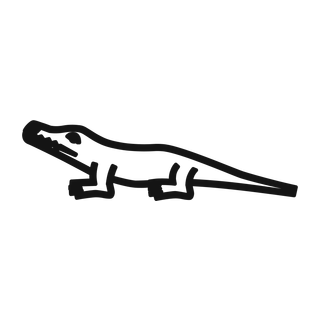 CrocodilemsḥSobek · Gardiner I3
The crocodile: Sobek, lord of the waters and of fertility, feared and worshipped along the Nile, who could protect against the dangers he embodied.
WHERE IT IS SEEN The temple at Kom Ombo, shared with Horus; the Faiyum, whose city the Greeks called Crocodilopolis.
Sacred crocodiles were kept in temple pools, fed and adorned with gold, and mummified when they died; some of them are shown in the Crocodile Museum at Kom Ombo.
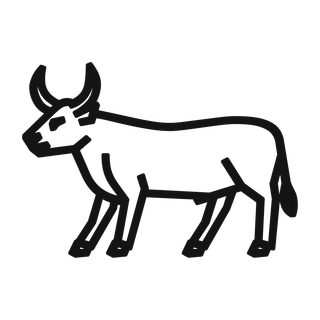 Bullkꜣthe Apis bull · Gardiner E1
The bull: strength and fertility, and a title of the king, “strong bull”. The Apis bull of Memphis, black with white markings, was the living image of the god Ptah.
WHERE IT IS SEEN The cult of Memphis; the Serapeum at Saqqara, where the Apis bulls were buried.
When an Apis died the whole land mourned. In 1850 Auguste Mariette found the Serapeum, with its giant granite coffins for the bulls.
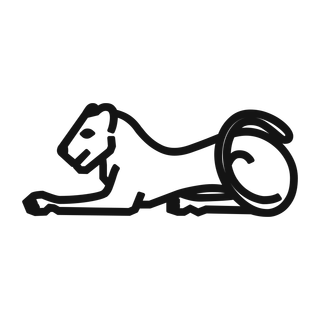 LionrwSekhmet · Gardiner E23
The lying lion: the sign for the sound rw, and the animal of fierce goddesses, above all Sekhmet, “the powerful one”, who brought plague and could also cure it.
WHERE IT IS SEEN Hundreds of granite statues of Sekhmet, set up by Amenhotep III at Thebes; lion-shaped gargoyles and beds.
Since Egyptian had no l, the lion was used for the l in Greek names such as Ptolemy and Cleopatra: one of the clues Champollion used to read the script.
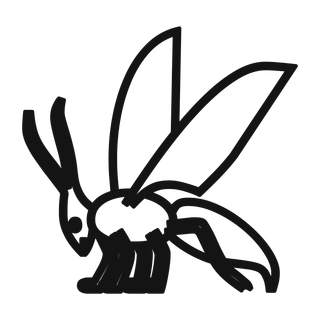 Beebjtking of Lower Egypt · Gardiner L2BRASS
The bee: Lower Egypt, and with the sedge of Upper Egypt one of the king’s oldest titles, “he of the sedge and the bee”. A myth tells that bees were born from the tears of the sun god Ra.
WHERE IT IS SEEN Royal names from the First Dynasty on; honey as an offering and a medicine.
Egyptian beekeepers kept hives of stacked clay pipes, shown in a relief in the sun temple of Niuserre, around 2400 BC.
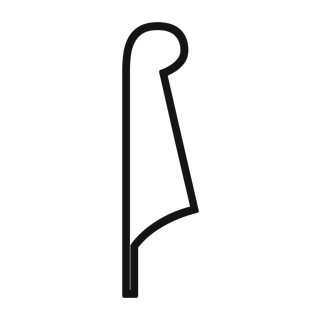 Feather of Maatmꜣꜥttruth and order · Gardiner H6BRASS
A single ostrich feather: Maat, truth, justice and the right order of the world, which every king swore to uphold.
WHERE IT IS SEEN The headdress of the goddess Maat; the scales of judgement, where the heart was weighed against the feather.
In the Book of the Dead the heart of the dead is weighed against Maat’s feather; a heart heavier than the feather was eaten by the monster Ammit.
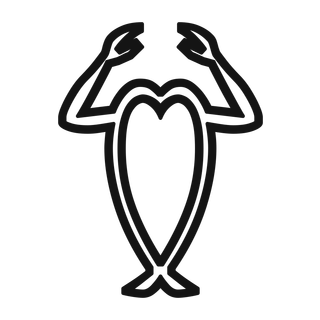 ScorpionsrqtSerqet · Gardiner L7
The scorpion: Serqet, goddess who protected against stings and poison, and guarded the dead.
WHERE IT IS SEEN Amulets and spells against scorpions; one of the four goddesses, with Isis, Nephthys and Neith, who guard the canopic shrine of Tutankhamun with outstretched arms.
Her priests were healers who treated stings and snakebites. One of the earliest known rulers of Egypt is called King Scorpion.
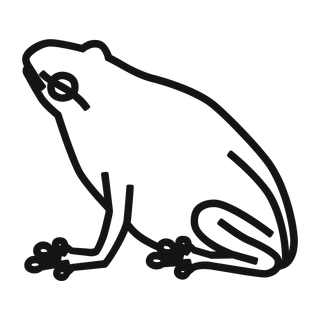 FrogḥqtHeqet · Gardiner I7
The frog: Heqet, goddess of childbirth, who appeared as the Nile flood withdrew and frogs filled the mud. Midwives may have been known as her servants.
WHERE IT IS SEEN Amulets for women and children; ivory wands carved with protective creatures, used at births.
The tadpole was the sign for 100,000. Christian lamps from Egypt bear a frog and the Greek words “I am the resurrection”.
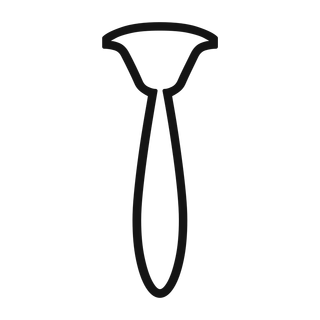 Papyruswꜣḏ“green, flourishing” · Gardiner M13
A single stem of papyrus: green, fresh and flourishing. The plant of the Delta marshes, and of Lower Egypt; from it came paper, rope, boats and mats.
WHERE IT IS SEEN Temple columns shaped like bundles of papyrus; amulets of green stone, given to the dead for lasting youth.
Our word paper comes, through Greek and Latin, from papyrus.
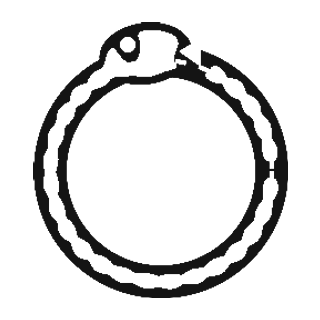 Ouroborosmḥnthe serpent that eats its tailBRASS
A serpent with its tail in its mouth: the endless round of time, the boundary of the ordered world, and the protector of the sun on its journey through the night.
WHERE IT IS SEEN Its oldest known image is on the second of the gilded shrines around Tutankhamun’s coffin, in a book of the underworld.
From Egypt it passed to Greek magic and alchemy, which gave it its name, “tail-eater”.
魂と来世Soul & afterlife7
The Egyptians saw a person as many parts: the heart that is judged, the ka that must be fed, the ba that flies by day, the akh that shines among the stars.
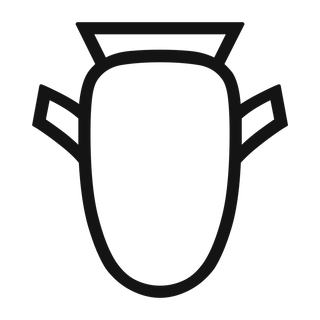 Heartjb“heart” · Gardiner F34BRASS
To the Egyptians the heart, not the brain, held thought, memory and conscience. The sign is a jar with handles, the shape of heart amulets.
WHERE IT IS SEEN Heart amulets laid on the body; the scales of judgement.
A heart scarab placed on the mummy carried Spell 30B of the Book of the Dead, asking the heart not to testify against its owner at the judgement.
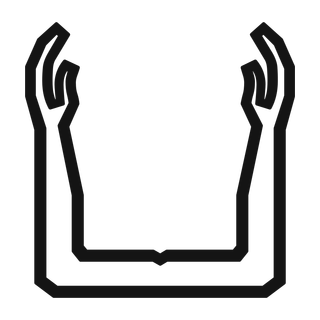 Kakꜣ“the life force” · Gardiner D28BRASS
Two raised arms: the ka, the life force each person is born with, which lives on after death and must be fed. Offerings of food and drink were made to the ka.
WHERE IT IS SEEN Tomb chapels with their false doors, through which the ka came to receive offerings; statues that gave it a home.
The wooden statue of King Hor, from Dahshur, wears the ka arms on its head.
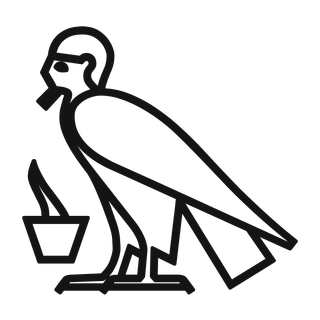 Babꜣthe soul bird · Gardiner G53
A bird with a human head: the ba, the part of a person that could leave the tomb by day, fly in the sunlight and return to the body at night.
WHERE IT IS SEEN Tomb paintings and the Book of the Dead, where the ba hovers over the mummy; small ba statuettes in late burials.
The ba is closer to what we call personality than to the soul: gods had many bas, and a king’s ba could be seen in the deeds he did.
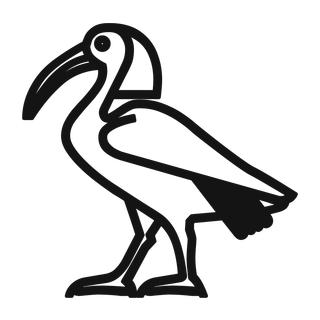 Akhꜣḫ“the effective spirit” · Gardiner G25
The crested ibis, which writes akh: the transfigured spirit of the dead, who has passed the judgement and lives among the stars, effective and shining.
WHERE IT IS SEEN Tomb texts and letters written to the dead, who as akhs could still help or trouble the living.
Akhenaten took the word into his name: “effective for the Aten”. The bird, the northern bald ibis, is now one of the rarest birds in the world.
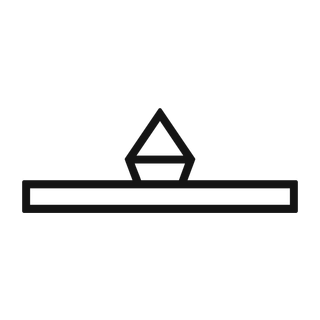 Offering tableḥtp“peace, offering” · Gardiner R4
A loaf of bread on a reed mat: an offering, and the peace and satisfaction it brings. The sign writes hotep, “to be at peace, content”.
WHERE IT IS SEEN The offering formula on almost every tomb, hetep di nesu, “an offering which the king gives”.
It is in the names of Imhotep, “who comes in peace”, and the kings called Amenhotep, “Amun is content”.
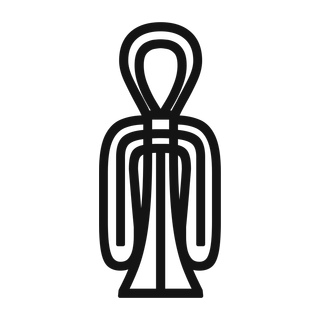 Knot of Isistjttyet · Gardiner V39BRASS
A knot of cloth, like an ankh with its arms hanging down, linked with the goddess Isis and with the blood of Isis that protects the dead.
WHERE IT IS SEEN Amulets of red stone at the neck of the mummy; temple friezes beside the djed pillar.
The Book of the Dead asks for a tyet of red jasper, dipped in water of flowering plants, to be placed on the neck of the dead.
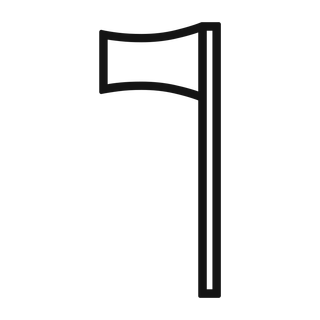 Netjernṯr“god” · Gardiner R8
A pole wrapped in cloth with a flag at its top: the sign for god, and for anything divine. It shows the flags that flew in front of shrines.
WHERE IT IS SEEN Every text that names a god; the titles of priests, “servant of the god”.
The great temples set tall flagpoles of cedar, tipped with electrum, in niches in the front of their gateways: the sign made real.
一子音文字The alphabet24
Twenty-four signs that each stand for a single sound. The Egyptians never wrote with these alone, but they are the key to reading names, and to writing your own.
 Egyptian vultureꜣthe sound ꜣ · Gardiner G1
A glottal stop, the catch in the throat; read today as a short a, as in “Amun”.
WHERE IT IS SEEN The first sign of most lists of the alphabet.
 Reed leafjthe sound j · Gardiner M17
A sound like i or y; two reeds together write y.
WHERE IT IS SEEN The first sign in the names Amun and Imhotep.
 Forearmꜥthe sound ꜥ · Gardiner D36
A sound made deep in the throat, like the Arabic ʿayn; read today as a.
WHERE IT IS SEEN The first sound of ankh, “life”.
 Quail chickwthe sound w · Gardiner G43
The sound w, or the vowel u.
WHERE IT IS SEEN A coil of rope writes the same sound in quicker writing.
 Footbthe sound b · Gardiner D58
The sound b.
WHERE IT IS SEEN Common in words for walking and travel, and in the name of the bee, bit.
 Stoolpthe sound p · Gardiner Q3
The sound p: a stool or reed mat seen from the side.
WHERE IT IS SEEN The first sign of Ptah, the god of Memphis.
 Horned viperfthe sound f · Gardiner I9
The sound f; it also means “he” or “his”.
WHERE IT IS SEEN Written after a noun it means “his”: per-f, his house.
 Owlmthe sound m · Gardiner G17
The sound m; it also means “in” or “with”.
WHERE IT IS SEEN Unusually, the owl is drawn with its face turned to the reader.
 Ripple of waternthe sound n · Gardiner N35
The sound n; it also means “of” or “for”.
WHERE IT IS SEEN Three ripples together mean water.
 Mouthrthe sound r · Gardiner D21
The sound r; it also means “to” or “at”.
WHERE IT IS SEEN The Egyptians wrote no l; the mouth or the lion stood in for it.
 Reed shelterhthe sound h · Gardiner O4
The sound h, as in “house”.
WHERE IT IS SEEN A courtyard or reed hut seen from above.
 Twisted wickḥthe sound ḥ · Gardiner V28
A stronger h, breathed from deep in the throat.
WHERE IT IS SEEN The first sound of hotep, peace, and of Heru, the name of Horus.
 Sieve or placentaḫthe sound ḫ · Gardiner Aa1
A rough sound like the ch in Scottish “loch”.
WHERE IT IS SEEN The first sound of Khepri and of Khafre.
 Belly with teatsẖthe sound ẖ · Gardiner F32
A softer ch, as in German “ich”.
WHERE IT IS SEEN The belly of an animal, with its tail.
 Door boltzthe sound z · Gardiner O34
The sound z, later merged with s.
WHERE IT IS SEEN A bolt that slid across a door to lock it.
 Folded clothsthe sound s · Gardiner S29
The sound s.
WHERE IT IS SEEN The commonest way of writing s.
 Poolšthe sound š · Gardiner N37
The sound sh.
WHERE IT IS SEEN A garden pool seen from above.
 Hill slopeqthe sound q · Gardiner N29
A k made far back in the throat.
WHERE IT IS SEEN A sandy slope seen from the side.
 Basket with handlekthe sound k · Gardiner V31
The sound k; it also means “you” or “your”.
WHERE IT IS SEEN The basket with a handle at its side.
 Jar standgthe sound g · Gardiner W11
The sound g.
WHERE IT IS SEEN A ring stand for a round-bottomed jar.
 Loaf of breadtthe sound t · Gardiner X1
The sound t; it also marks a feminine word.
WHERE IT IS SEEN Among the commonest signs of all, ending every feminine noun.
 Tethering ropeṯthe sound ṯ · Gardiner V13
A sound like tch.
WHERE IT IS SEEN A rope for tying up animals.
 Handdthe sound d · Gardiner D46
The sound d.
WHERE IT IS SEEN The hand, from the wrist to the fingertips.
 Cobraḏthe sound ḏ · Gardiner I10
A sound like dj.
WHERE IT IS SEEN The cobra at rest, not the rearing uraeus; it writes the word djet, eternity.
No sign matches. Try the English (“falcon”), the god (“Thoth”) or the Gardiner number (“G5”).
Written in our own words from public reference works; each entry lists its sources. Sign numbers follow Alan Gardiner’s Egyptian Grammar (1927), the list Egyptologists and the Unicode standard still use. Meanings changed over three thousand years, and scholars disagree about many: we give the readings most widely held, and say where they are uncertain.
The hieroglyphs are drawn from Noto Sans Egyptian Hieroglyphs, a typeface released under the SIL Open Font License, whose signs come from the public-domain drawings of the Egyptological type tradition. The winged sun, the Aten and the ouroboros, which have no sign of their own, are drawn from our brass motifs.