
A field guide to European heraldry
Forty-five terms of the herald’s language: the tinctures and furs, the ways a shield is divided, the bands called ordinaries, the lions, eagles, lilies and shells laid on it, and the helm, crest, supporters and motto around it. What each looks like, what it is called in blazon, and where you will see it.
色彩と毛皮・盾の分割・幾何図形・具象図形、そして兜や飾りなど紋章の外装を紹介します。
Colours are drawn in the hatching heralds use for black-and-white engraving. Each term is drawn on a plain shield or on its own, in one of its usual forms. The F1 and F2 buttons are a colour preview, not a brooch render.
色彩と毛皮Tinctures & furs9
Two metals, five colours and two furs. Every coat of arms is made of them, and the first rule of heraldry is that metal is not put on metal, nor colour on colour.
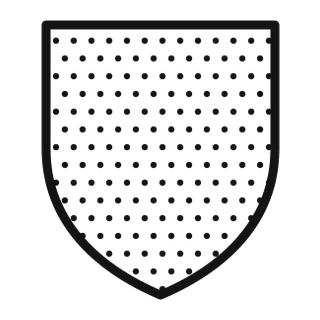 OrorGold, yellow
Gold, one of the two metals of heraldry, painted in gold leaf or in yellow. Engraved in black and white, it is shown by a field of small dots, in the system of hatching published by the Jesuit Silvester Petra Sancta in 1638.
WHERE IT IS SEEN Everywhere in heraldry: the field of the arms of Flanders and of the old kingdom of Aragon, and the lions and fleurs-de-lis laid on blue and red fields across Europe.
The first rule of heraldry is that metal is not put on metal, nor colour on colour, so that the arms can be told apart at a distance: gold goes on red, blue, green, purple or black, and not on silver.
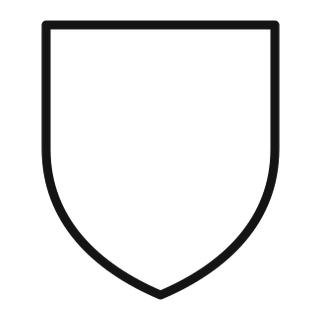 ArgentargentSilver, white
Silver, the second metal, almost always painted white, since real silver leaf tarnishes to black. In engraving it is left plain, with no hatching at all.
WHERE IT IS SEEN The white field of the cross of St George, the white cross of Savoy and of Switzerland, and the white eagle of Poland.
Because white and silver are the same tincture, a white field and a silver one are blazoned alike, argent; heraldry cares about which tincture is meant, not about the exact shade.
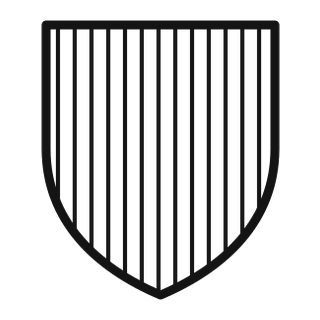 GulesgueulesRed
Red, the commonest colour of medieval heraldry. Its name comes from the Old French gueules, perhaps the red-dyed fur trimmings worn at the throat. In engraving it is shown by vertical lines.
WHERE IT IS SEEN The cross of St George, the field of the lions of England and the cross of Savoy; in the rolls of arms of the twelfth and thirteenth centuries, more coats carry red than any other colour.
The French historian Michel Pastoureau, counting medieval arms, found red more often than any other colour; blue, rare at first, caught up only in the later Middle Ages.
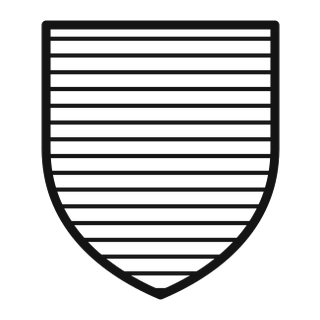 AzureazurBlue
Blue, a word that came to French from the Persian lāzhward, lapis lazuli, by way of Arabic. In engraving it is shown by horizontal lines.
WHERE IT IS SEEN The arms of the kings of France, azure with gold fleurs-de-lis, and the blue of the saltire of Scotland; the Virgin Mary’s colour in Christian art.
Blue was rare in the first arms of the twelfth century. It spread in the thirteenth with the arms of France and the cult of the Virgin, and by the end of the Middle Ages it had become the second colour of heraldry.
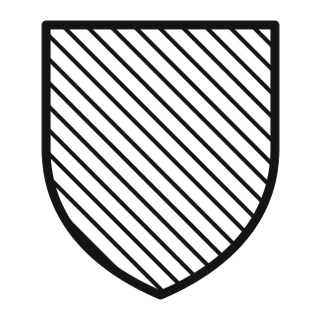 VertsinopleGreen
Green, the rarest of the five common colours in medieval arms. In engraving it is shown by diagonal lines running from the upper left as you look at the shield, the bearer’s right, down to the lower right.
WHERE IT IS SEEN Rare in the Middle Ages, more common in later grants and in the arms of countries and towns that took green as their colour.
French heralds call green sinople, from the red earth of Sinope on the Black Sea. The word first meant red, and only by the fourteenth century had it come to mean green.
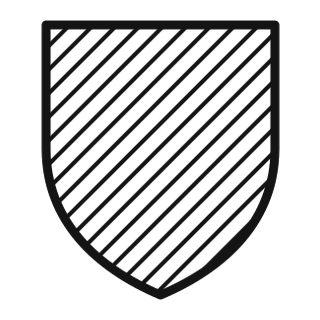 PurpurepourprePurple
Purple, the fifth colour, much rarer than the others. In engraving it is shown by diagonal lines running the opposite way to green, from the upper right down to the lower left.
WHERE IT IS SEEN The lion of the old kingdom of León, a purple lion on silver, and the robes and fields of a few later arms.
Painted purple has varied from a reddish violet to grey, and some heralds doubted whether it was a true colour at all; the lion of León was often painted red.
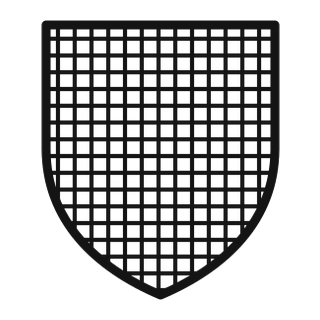 SablesableBlack
Black, named after the dark fur of the sable, a marten of the northern forests. In engraving it is shown by crossed horizontal and vertical lines.
WHERE IT IS SEEN The black eagle of the Holy Roman Empire on its gold field, and the black lion of Flanders, also on gold.
Black was a noble colour in heraldry, not a sombre one; the fur of the sable was among the most costly in medieval Europe.
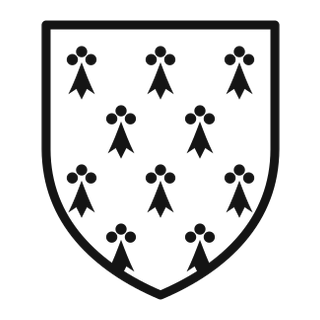 ErminehermineFur: white with black tails
A fur: white, strewn with black spots that stand for the tails of the stoat in its winter coat, sewn onto the white pelts. Furs may lie on either metal or colour, outside the rule of tincture.
WHERE IT IS SEEN The arms of Brittany, plain ermine since Duke John III in 1316, and the robes of peers, judges and kings.
The spots take many shapes, from a simple tail to an arrowhead under three dots. Black spots on white is ermine; white on black is ermines; black on gold is erminois.
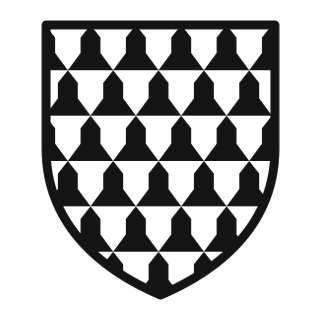 VairvairFur: blue and white bells
The second fur: rows of bell shapes in blue and white, the grey-blue backs and white bellies of squirrel skins sewn together in alternating rows, as they were in medieval cloaks.
WHERE IT IS SEEN Medieval French and Low Countries arms, among them the house of Coucy, whose shield was barred with vair and red.
It is often said that Cinderella’s slipper was first of fur, vair, and became glass, verre, by a slip of the pen; scholars doubt it, since glass slippers appear in other versions of the tale.
盾の分割Partitions of the field7
The simplest arms divide the shield by straight lines into two, four or eight parts of different tinctures; each line follows the line of an ordinary.
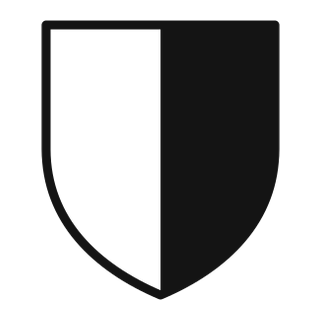 Per palepartiParty per pale
The field divided down the middle by a vertical line. The two halves usually take different tinctures, one a metal and one a colour.
WHERE IT IS SEEN Many simple medieval arms, and the arms of every married couple’s arms in the old English way, the husband’s arms on the dexter half and the wife’s on the sinister, which heralds call impalement.
Dexter and sinister are the bearer’s right and left, as if standing behind the shield: so dexter is on the left as you look at it.
 Per fesscoupéParty per fess
The field divided across the middle by a horizontal line, into an upper and a lower half.
WHERE IT IS SEEN Arms across Europe, especially in Germany and Central Europe, where many town arms are halved in this way, often with a beast or a building rising from the line.
The upper half is always named first in a blazon: per fess azure and or is blue above and gold below. A field divided by several horizontal lines into stripes is called barry, and the number of pieces is given, barry of six or of eight.
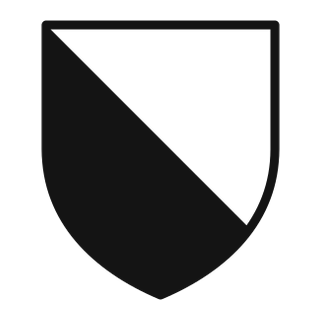 Per bendtranchéParty per bend
The field divided by a diagonal line from the dexter chief, the upper corner on the bearer’s right, to the sinister base.
WHERE IT IS SEEN Common in German and Swiss arms, and in the arms of many towns.
The line running the other way, from the upper sinister corner, is per bend sinister. Neither has anything to do with illegitimacy; that belongs to a narrow band, not to a divided field.
 Per chevronParty per chevron
The field divided by a line shaped like an inverted V, rising to a point in the middle of the shield.
WHERE IT IS SEEN English and French arms, often with charges set two above the line and one below it, so that the three sit where the shield has most room.
The partitions take their names from the ordinaries: each follows the line of the band of the same name, without the band.
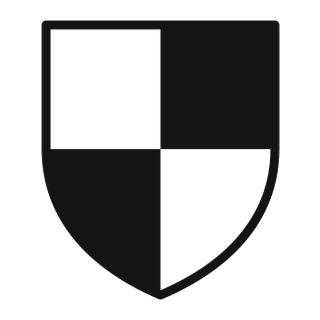 QuarterlyécarteléParty per cross
The field divided into four by a cross of lines, the first and fourth quarters usually matching, and the second and third.
WHERE IT IS SEEN The arms of Castile and León, quartered by Ferdinand III after he united the two kingdoms in 1230; the royal arms of England from 1340, quartering France and England; and countless arms that join two inheritances.
Quartering became the way to show descent from heiresses, and some families ended with dozens of quarters. A quarterly field of two plain tinctures is also an old and simple arms in its own right.
 Per saltireécartelé en sautoirParty per saltire
The field divided into four triangles by two diagonal lines crossing in the middle, in the shape of the saltire.
WHERE IT IS SEEN Spanish, Italian and Swiss arms; and the arms of Sicily, which divide the stripes of Aragon from the eagle of the Hohenstaufen in this way.
The triangles are named top, dexter, sinister and base, and the top and base usually match.
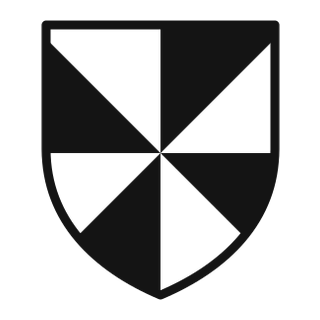 GyronnygironnéGyronny of eight
The field divided into eight triangles, gyrons, by lines of the cross and the saltire meeting in the middle, in two tinctures in turn, like a pinwheel.
WHERE IT IS SEEN The arms of the Campbells of Argyll, gyronny of eight gold and black, carried by the chief of Clan Campbell and the dukes of Argyll.
The gyron, a single triangle, is also a charge in its own right; Spanish heraldry has many arms in which the field is gyronny.
幾何図形Ordinaries11
The broad bands laid across the shield: the oldest and plainest charges, which could be painted on a wooden shield with a few strips of leather or paint.
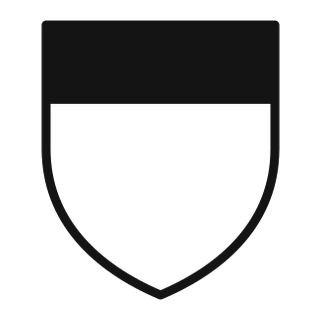 ChiefchefIn chief
A broad band across the top of the shield, a third of its height in theory, often a little less in practice. Charges may be placed on it, and things set in the upper part of the field are said to be “in chief”.
WHERE IT IS SEEN English and French arms; and the many later arms that add a chief to an older shield as an honour or an augmentation.
The chief is the highest part of the shield, and sits over everything else on it; in Italian heraldry a chief carrying the arms of a ruler, the capo, showed which party a family took.
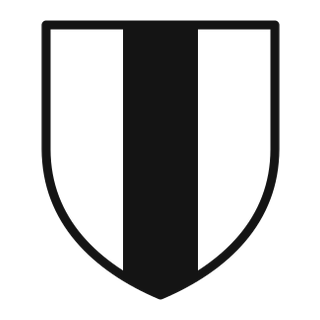 PalepalPalewise
A broad vertical band down the middle of the shield. Several narrow ones make the field paly, striped from top to bottom.
WHERE IT IS SEEN The red and gold pales of Aragon and Catalonia; and the flag of Canada, whose white centre is so wide that heralds call it a Canadian pale.
Charges set one above another down the middle are said to be in pale, and anything turned upright is palewise.
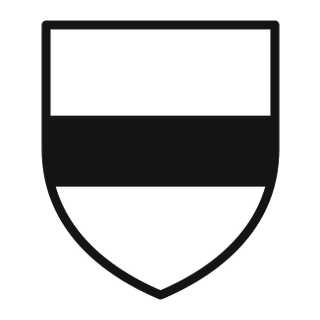 FessfasceFesse
A broad horizontal band across the middle of the shield. Narrower ones are bars, and many of them make the field barry, striped across.
WHERE IT IS SEEN The arms of Austria, red with a silver fess, which became the red-white-red of the Austrian flag; and the arms of Beauchamp, a gold fess between cross crosslets.
Japanese heraldry has its own bars: the Ashikaga shoguns bore two black bars in a circle, maru ni futatsu hikiryō.
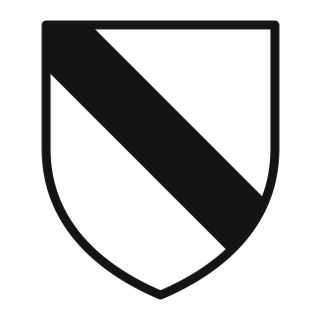 BendbandeBendwise
A broad diagonal band from the upper corner on the bearer’s right to the lower corner on the left, as a baldric is worn across the chest.
WHERE IT IS SEEN The arms of Baden, gold with a red bend; the Scrope and Grosvenor case, fought from 1385 to 1390 over who might bear azure, a bend or, which Scrope won.
The bend sinister, running the other way, is an ordinary like any other. The popular “bar sinister” as a sign of illegitimacy is a muddle: a narrow bendlet or baton sinister was sometimes used, among other marks.
 ChevronchevronChevronny
A band in the shape of an inverted V, like the rafters of a roof, from the French chevron, a rafter.
WHERE IT IS SEEN The arms of the de Clare earls of Gloucester, gold with three red chevrons, and of many English and French families; the chevrons of military rank.
The chevrons worn on soldiers’ sleeves to mark rank are thought to come from heraldry, by way of the chevrons of livery and of the French army in the eighteenth century.
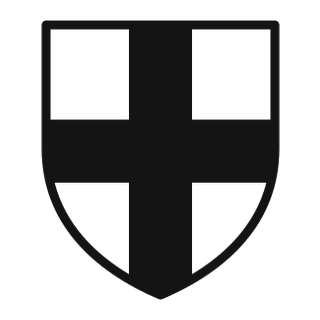 CrosscroixCross
A broad upright cross reaching the edges of the shield, the plainest of the hundreds of crosses heralds have named.
WHERE IT IS SEEN The red cross of St George on silver, borne by England and by crusaders; the white cross on red of Savoy, and of Denmark’s flag; the arms of countless churches and families.
Heralds have named hundreds of kinds of cross: pattée, moline, flory, potent, crosslet and many more, some of which are in our Orders Atlas.
 SaltiresautoirSt Andrew’s cross
A diagonal cross, the bend and the bend sinister together: the cross on which, by legend, St Andrew asked to be crucified, not thinking himself worthy to die as Christ had.
WHERE IT IS SEEN The arms and flag of Scotland, a white saltire on blue; the red saltire of St Patrick; and the red “ragged” saltire of Burgundy.
Its name comes from the French sautoir, perhaps a stirrup or a stile, something to vault over.
 PallpairlePairle, shakefork
A Y-shaped band reaching the two upper corners and the base. It comes from the pallium, the white woollen band with black crosses that the Pope sends to archbishops.
WHERE IT IS SEEN The arms of the archbishops of Canterbury and of Armagh, which show the pallium itself; Scottish arms, where a pall with its ends cut short is a shakefork.
Heraldry often keeps the history of an object in a shape: the pall is a vestment that became a geometry.
 BordurebordureBorder
A band running around the edge of the shield, inside the outline.
WHERE IT IS SEEN The arms of Portugal, whose red bordure carries seven gold castles; and Scottish arms, where a bordure is the usual way to mark a younger branch of a family.
In Scotland each cadet line takes a bordure of its own colour or pattern, and the Lord Lyon matriculates the arms afresh for each one.
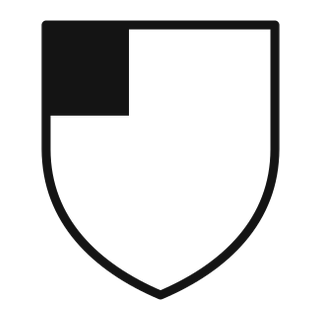 CantoncantonQuarter
A square in the upper corner on the bearer’s right, smaller than a quarter. It often carries an addition to older arms.
WHERE IT IS SEEN Flags as well as shields: the corner of a flag next to the pole is its canton, as on the Stars and Stripes or the old ensigns of the British Empire.
English baronets, a hereditary rank created by James I in 1611, show it by a canton or a small shield bearing the red hand of Ulster.
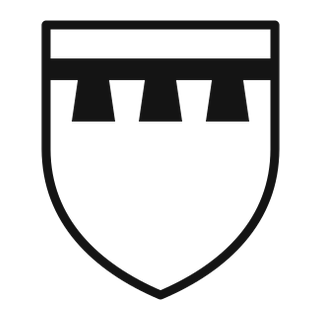 LabellambelFile with points
A narrow band across the top of the shield with pendants, usually three, hanging from it. In English heraldry it marks the eldest son while his father lives.
WHERE IT IS SEEN The British royal family, whose children and grandchildren each bear the royal arms with a white label of their own, its points charged with crosses, hearts or roses; and the label of three points of the Prince of Wales.
The label is the first of the English marks of cadency, by which each son is told apart: a crescent for the second, a mullet for the third, a martlet for the fourth, and so on to the ninth.
具象図形Charges12
The beasts, birds, flowers and objects placed on the field. Heraldry draws each in a fixed, flattened way, so that it can be told at a glance, and names its every pose.
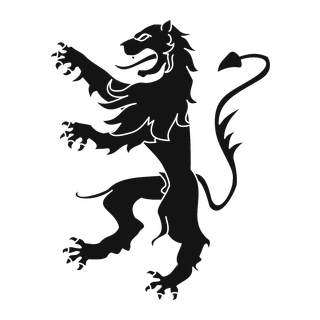 Lion rampantlionLion rearing
The lion standing on one hind leg, the other hind leg and both forepaws raised, the tail erect, facing the bearer’s right. It is the commonest beast in heraldry, the king of beasts as a sign of courage and rule.
WHERE IT IS SEEN The arms of Scotland, a red lion on gold within a double tressure; the black lion of Flanders, the gold lion of the Netherlands on blue, the lion of Bohemia, and thousands of family arms.
In the early rolls of arms, a lion standing upright was simply a lion; one walking and looking out at you was a leopard. The lion appears on so many medieval arms that Pastoureau called it the first beast of heraldry.
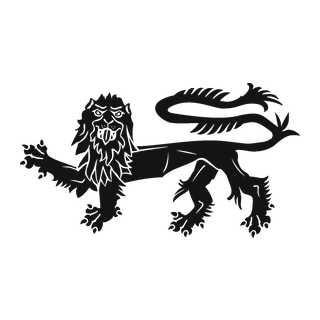 Lion passant guardantléopardLeopard, the lions of England
A lion walking, its right forepaw raised, with its face turned out towards the viewer. Old blazon calls this beast a leopard, the name heralds still use for it in French.
WHERE IT IS SEEN The three gold lions on red of the royal arms of England, borne by Richard I by 1198; and the lions of Normandy, Aquitaine and the English counties and towns that took them.
The three lions came to stand for England itself: they are on the badge of the national football team, and on the arms of the United Kingdom, quartered with Scotland and Ireland.
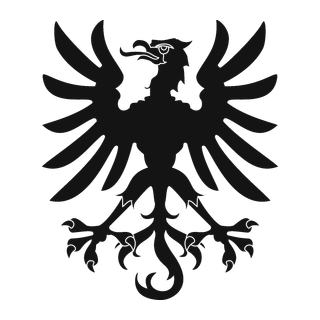 Eagle displayedaigleEagle with wings spread
The eagle seen from the front with wings and legs spread, its head turned to the bearer’s right: the bird of Jupiter and the standard of Rome, and so the sign of the emperor.
WHERE IT IS SEEN The black eagle on gold of the Holy Roman Empire, double-headed from the fifteenth century; the white eagle of Poland, the red eagle of Brandenburg and the black eagle of Prussia.
Heraldry draws the eagle flat and spread to fill the shield, its feathers spiky and its tongue out, so that it reads from far off. The double-headed eagle is in our Orders Atlas.
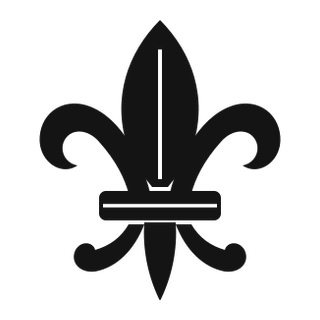 Fleur-de-lisfleur de lisLily, lis
A stylised lily or iris of three petals bound by a band: the flower of the Virgin Mary, and the sign of the kings of France.
WHERE IT IS SEEN The French royal arms, blue strewn with gold lis and reduced to three under Charles V in the 1370s; the arms of Florence, a red lis on white; the flag of Quebec, and the badge of the Scouts.
The French kings told the legend that an angel brought the lily to Clovis at his baptism. In English heraldry a fleur-de-lis is the mark of the sixth son.
 Heraldic roseroseRose barbed and seeded
A wild rose seen from the front: five petals, five green sepals or barbs between them, and a seeded centre. It is drawn flat, not as a garden rose.
WHERE IT IS SEEN The red rose of Lancaster and the white rose of York, joined in the Tudor rose by Henry VII after 1485; the emblem of England, and the rose of Lippe.
In English heraldry a rose is the mark of the seventh son. The “Wars of the Roses” is a later name; the two roses were badges, and the red rose was little used before Henry VII made it famous.
 EscallopcoquilleScallop shell, cockle
A scallop shell seen from outside, its hinge and ears at the top. It is the badge of the pilgrims to Santiago de Compostela, who brought shells home from the coast of Galicia.
WHERE IT IS SEEN The arms of the Dacres, three silver escallops on red; the Spencers and so the Churchills, whose bend carries three escallops; and arms of pilgrims and of the Order of Santiago.
The shell of St James gave its name to the dish coquilles Saint-Jacques, and to the pilgrims’ road whose waymarks still carry it.
 MulletmoletteStar of five points
A star of five straight points. Its name is the French molette, the rowel of a spur, and in French blazon a molette is pierced in the middle; a star with wavy rays is an estoile.
WHERE IT IS SEEN The arms of the de Vere earls of Oxford, a silver mullet in the first quarter; and the Washington family arms, two red bars and three red mullets, which by a favourite story inspired the Stars and Stripes.
In English heraldry a mullet is the mark of the third son. Japanese crests have stars too, drawn as round discs: the seven of the Shichiyō and the nine of the Kuyō.
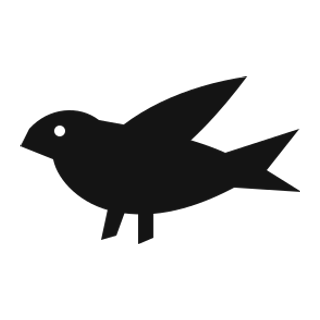 MartletmerletteSwallow without feet
A swallow or martin drawn without feet, only the tufts of its legs: a bird thought never to land. It stands, heralds say, for the younger son, who must live by his wits and not by land.
WHERE IT IS SEEN The arms attributed to Edward the Confessor, a cross between five gold martlets on blue; the arms of Sussex, six martlets; and many English and French families.
In English heraldry the martlet is the mark of the fourth son. In French blazon the merlette has no beak as well as no feet.
 CrescentcroissantCrescent increscent, decrescent
The moon in its first quarter, its horns pointing up. Turned to the bearer’s right it is increscent; to the left, decrescent, the waning moon.
WHERE IT IS SEEN Medieval and later European arms, and the Polish arms called Leliwa, a crescent with a star.
In English heraldry a crescent is the mark of the second son. In Japanese crests the moon is drawn as a crescent, a full moon or a moon behind clouds; the crescent of Islam is in our Sacred Atlas.
 TowertourCastle, turret
A round or square tower with battlements, its door and windows shown in the colour of the field or another. Several towers joined by a wall make a castle.
WHERE IT IS SEEN The arms of Castile, a gold castle of three towers on red, from which the kingdom took its name; the gold castles on the red bordure of Portugal; and the arms of towns across Europe.
The crowns of towers worn by cities, the mural crown, came to heraldry from the Roman crown of walls, given to the first soldier over an enemy’s rampart.
 Roundelsbesants, tourteauxBezants, plates, torteaux
Flat discs, each with its own name for each tincture: a gold one is a bezant, after the gold coin of Byzantium; silver a plate; red a torteau; blue a hurt; black a pellet; green a pomme.
WHERE IT IS SEEN The arms of the Medici, red balls on gold with a blue one bearing the lilies of France; the Courtenays, whose arms carry three red torteaux; and in English county arms.
The three gold balls of pawnbrokers are often said to come from the Medici, bankers to Europe; the sign came with the Lombard moneylenders to London.
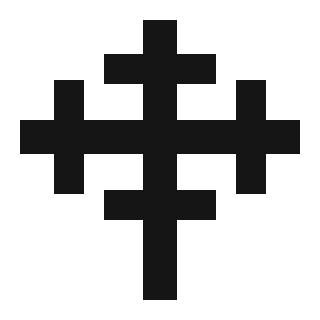 Cross crossletcroix recroisettéeCrossed cross
A cross whose four arms are each crossed again near the end. With its foot pointed it is fitchy, a cross, it is said, that a pilgrim could drive into the ground where he stopped to pray.
WHERE IT IS SEEN The Beauchamp earls of Warwick, a gold fess between six gold cross crosslets on red; many English arms of the crusading families; and the Howards, whose bend lies between six cross crosslets fitchy.
Heraldry often strews small charges across a field: a field semé of cross crosslets is called crusily.
紋章の外装The full achievement6
The shield is the coat of arms; around it a full achievement adds the helm, the crest on its wreath, the supporters, the motto and the coronet.
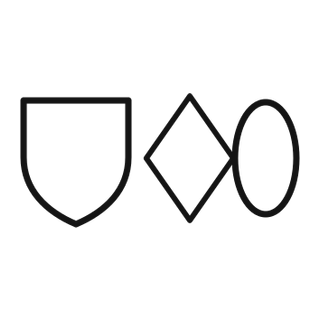 EscutcheonécuShield, lozenge, cartouche
The shield on which the arms are painted, the heart of the whole achievement. Its shape changed with the fashion of armour, from the long kite shield to the short heater shield of the thirteenth century, drawn here first.
WHERE IT IS SEEN The heater shield in England and France; the lozenge, a diamond, on which women in English heraldry bore their arms; and the oval cartouche used by clergy and in Italy.
A small shield set on a larger one is an inescutcheon; to blot one’s escutcheon, to stain the shield, was once to disgrace the family whose arms it bore.
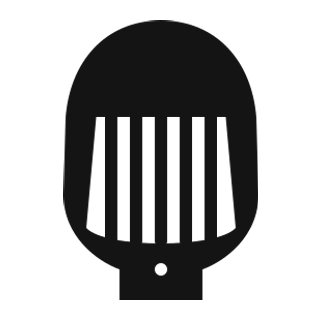 HelmheaumeHelmet
The helmet set above the shield. In British heraldry its metal and its turn show rank: gold and facing out for the sovereign, silver with gold bars for a peer, steel with the visor open for a knight, steel and closed in profile for a gentleman.
WHERE IT IS SEEN Above the shield of almost every full achievement, carrying the wreath and the crest; in continental heraldry, often several helms for several crests.
From the helm hangs the mantling, a cloth slashed into ribbons, said to recall the surcoat that kept the sun off a crusader’s armour and was cut to rags in battle.
 Crest and wreathcimierTorse, crest
The crest is the figure set on top of the helm, here a plume of feathers, standing on a wreath of six twists of cloth, the torse, in the main metal and colour of the arms.
WHERE IT IS SEEN Every full achievement in Britain; and on its own, on signet rings, silver and buttons, where the crest is used without the shield.
In English “family crest” is often used for the whole coat of arms, but the crest is only the figure on the helm. The same English word is used for the Japanese kamon, which is a different thing again.
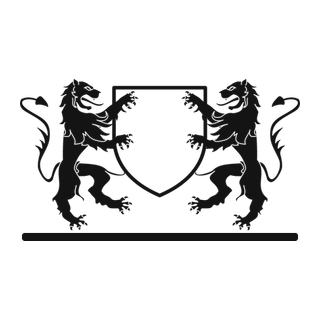 Supporterstenants, supportsBeasts or figures holding the shield
Figures standing either side of the shield and holding it up: beasts, monsters, or people such as wild men and soldiers, often on a grassy mound, the compartment.
WHERE IT IS SEEN The lion and the unicorn of the royal arms of the United Kingdom, the unicorn coming from Scotland with James VI in 1603; and the arms of peers, of knights of the great orders, of cities and companies.
In Britain supporters are a privilege, granted to peers and a few others; in continental heraldry anyone may use them.
 MottodeviseScroll, war cry
A word or phrase on a scroll, usually below the shield in England and above the crest in Scotland. Many began as war cries.
WHERE IT IS SEEN The royal arms of the United Kingdom, Dieu et mon droit, “God and my right”; the Garter, Honi soit qui mal y pense, “Shame on him who thinks evil of it”; and family and school arms everywhere.
In England a motto is not part of the grant and a family may change it; in Scotland it is part of the arms, recorded by the Lord Lyon.
 CoronetcouronneCrest coronet, crown of rank
A small crown, here a circlet with strawberry leaves. Set on the helm it can hold the crest; set above the shield, its form tells the bearer’s rank.
WHERE IT IS SEEN British peers: a duke with eight strawberry leaves, a marquess with leaves and pearls, an earl with pearls on tall points, a viscount and a baron with pearls on the rim; the crowns of counts and barons in continental arms.
The crest coronet, also called a ducal coronet, is a plain charge that anyone granted it may bear, and says nothing about the bearer’s rank.
No term matches. Try the colour (“red”, “gules”), the shape (“diagonal”) or a country (“Scotland”).
Written in our own words from public reference works; each entry lists its sources. Usage differs between countries, and we follow English blazon, with the French term beside it. A coat of arms belongs to a person, not to a surname, and in some countries the arms of states and towns are protected by law: we explain the vocabulary here, and we make a family’s or an organisation’s arms only for those entitled to them.
The drawings are our own, made for this atlas, except the beasts listed below, which are public-domain drawings from Wikimedia Commons redrawn in ink.
- Lion rampant — Syryatsu, Wikimedia Commons, Public domain
- Lion passant guardant — Inductiveload, Wikimedia Commons, Public domain
- Eagle displayed — Madboy74, Wikimedia Commons, Public domain
- Supporters — Syryatsu, Wikimedia Commons, Public domain