
A field guide to Japanese family crests
Nearly 250 crests by motif: what each shows, why families chose it, and who is associated with it. Use it to find the name of your own family’s crest — or to choose a motif we can make for you in brass.
植物・動物・天文・器物・建築・文様・文字の七つに分けて、家紋の由来と主な紋を紹介します。
Each card shows one variant of its crest, named when you open it. Where a drawing is not yet cleared for publication, the crest’s character stands in until we redraw it. The F1 and F2 buttons are a colour preview, not a brooch render.
植物紋Plants82
Plants are the heart of Japanese heraldry: eight of the ten most widely used crests are plants. Families chose them for ties to a shrine (oak, rice, mulberry), for lucky sounds (myōga echoes “divine favour”, omodaka “a face held high”), as a clan’s mark (wisteria for the Fujiwara, tachibana for the Tachibana), or as a stand-in when a motif was restricted.
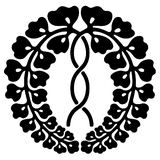 藤紋FujiWisteria
Wisteria is long-lived and spreads vigorously, so it was taken as an auspicious plant. It is the emblem of the Fujiwara clan, though because many families adopted it to claim that connection, a wisteria crest does not necessarily mean Fujiwara descent. It first appears in the written record in the Kenmon Shokamon.
Associated with the Fujiwara clan (the Kujō, Nijō and Ichijō houses), the Katō, Naitō, Ōkubo and Kuroda, and Ishida Mitsunari; the shrine crest of the Kasuga Shrine; about 170 Edo-period samurai houses
One of the ten great crests (traditional list). 5th by share of households (Takasawa 2008). 231 variants recorded.
下り藤・丸に下り藤・上り藤・藤巴(黒田藤巴)・九条藤・一条藤・二条藤・六条藤・内藤藤・加藤藤・安藤藤・大久保藤・那須藤・片倉藤・伊藤藤・遠山藤・柴田藤・本願寺藤・八つ藤・藤輪
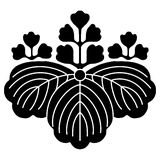 桐紋KiriPaulowniaBROOCH
Rooted in the Chinese idea of the paulownia as the auspicious tree on which the phoenix alights, it became a pattern on the emperor’s kōrozen robe, then a secondary crest of the imperial house, and was granted to the Ashikaga, Oda and Toyotomi. Since the Meiji period it has served as the emblem of the Cabinet. Maru ni Gosan no Kiri accounts for about 70 per cent of paulownia crests in use.
Associated with the imperial house, the Ashikaga shōguns, the Oda, Toyotomi, Yamauchi (Tosa) and Itagaki; also used by the Government of Japan and the University of Tsukuba
One of the ten great crests (traditional list). 6th by share of households (Takasawa 2008). 152 variants recorded.
五三桐・五七桐・丸に五三桐・太閤桐・土佐桐・五三鬼桐・五七鬼桐・光琳桐・乱れ桐・桐菱・桐車・桐揚羽蝶
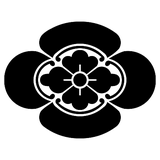 木瓜紋(窠紋)MokkōQuince (nest motif)BROOCH
Not a specific plant: it derives from the nest-shaped ka pattern on Tang-dynasty official robes, read as a wish for many descendants. The name comes from its use on the mokō, the upper border of a palace blind; popular explanations call it a cross-section of a melon or the cut of a flowering quince. It is the sacred crest of the Gion Shrine, and in some areas cucumbers are avoided during the Gion Festival (a taboo the Sekijōshi disputes).
Associated with the Tokudaiji house (first used by Saneyoshi around 1156), the Oda, Asakura (Mitsumori), Takigawa Kazumasu (Maru ni Tate Mokkō), Kudō and Itō (Iori Mokkō), Hotta, Arima and Sagara; Yasaka Shrine, the Gion Shrine, Kōra Taisha and Yabu Shrine Also the Oda, Asakura, Niwa, Hotta, Itō, Arima and Sagara families.
One of the ten great crests (traditional list). 2nd by share of households (Takasawa 2008). 244 variants recorded.
木瓜・竪木瓜・丸に木瓜・織田木瓜(五瓜に唐花)・五つ木瓜・庵木瓜・三つ盛木瓜・堀田木瓜・徳大寺木瓜・四方木瓜・剣木瓜・有馬瓜・大村瓜・六瓜・八瓜・瓜輪・五瓜に唐花・織田瓜・庵に木瓜・六つ瓜に七つ引(相良瓜)
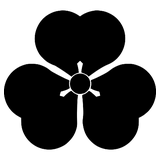 片喰紋(酢漿草紋)KatabamiWood sorrelBROOCH
Wood sorrel spreads so vigorously that it is hard to eradicate, so it came to stand for a house that never dies out; samurai families used it to pray for good fortune and many descendants. It was already used as a carriage crest in the Heian period. By tradition, polishing a mirror with its leaves would reveal the face of one’s beloved.
Associated with the Chōsokabe (Nanatsu Katabami; by tradition, seven leaves floated in a farewell cup), the Sakai (Ken Katabami; by tradition, used in place of the hollyhock), the Ukita, Kamiizumi Nobutsuna, the Ōinomikado and Reizei (court nobles), and Tanaka Kakuei
One of the ten great crests (traditional list). 1st by share of households (Takasawa 2008). 155 variants recorded. Maru ni Ken Katabami topped an online popularity ranking four years running.
片喰・丸に片喰・剣片喰・丸に剣片喰・七つ片喰・庄内片喰・姫路剣片喰・若狭剣片喰・菱に片喰・蔓片喰・八重片喰・七曜片喰・片喰の実
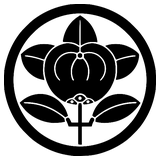 橘紋TachibanaTachibana orangeBROOCH
Called the fruit of Tokoyo, the eternal land, it stood for agelessness and long life. By tradition, Empress Genmei granted Tachibana no Moroe the ‘tachibana floating in the cup’ and bade him take it as his crest; samurai also wrote it as ‘sword flower’ (tachibana). Its first documented use is for the Yakushiji and Kodera in the Kenmon Shokamon.
Associated with the Tachibana clan, the Ii of Hikone (by tradition, their founder Tomoyasu was born beside a tachibana tree by a well), the Yakushiji, Kodera, Kuze and Kuroda; the Nichiren school (Igeta ni Tachibana)
One of the ten great crests (traditional list). 9th by share of households (Takasawa 2008). 119 variants recorded. Used by 90-odd Edo-period hatamoto houses.
橘・丸に橘・三つ橘・丸に三つ橘・三つ葉橘・浮線橘・五つ橘・彦根橘・久世橘・光琳橘・薬師寺橘・黒田橘・井桁に橘
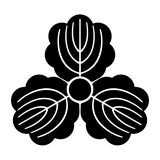 柏紋KashiwaOak leavesBROOCH
In ancient times offerings were served on oak leaves (hence kashiwade, the word for a meal served to the gods), so the oak became a sacred tree and a crest of priestly families. Its old leaves stay on until new buds open, read as a line that never breaks. The Mitsu Kashiwa exists in two lineages, with 21 or 27 leaf veins.
Associated with the Yamauchi (Tosa), Makino (Nagaoka), Senshū (Atsuta Shrine), Ono (Hinomisaki Shrine), Urabe (Yoshida Shrine), Munakata, Kushimoto (Ise), Kasai and Hachisuka; the origin of the Mitsubishi three-diamond mark
One of the ten great crests (traditional list). 4th by share of households (Takasawa 2008). 158 variants recorded. Over 500 oak-leaf designs in all.
三つ柏・丸に三つ柏・抱き柏・違い柏・土佐柏・蔓柏・剣柏・鬼三つ柏・牧野柏・中川柏・結び三つ柏・庵に柏
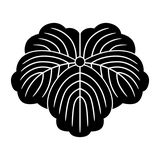 蔦紋TsutaIvy
Ivy climbs and grows thickly, so it signified prosperity; its clinging nature later made it a women’s crest and a geisha crest. It became popular after the Matsudaira houses and Tokugawa Yoshimune took it as an alternate crest, and it is a common ‘rental’ crest (tsūmon). The Kenmon Shokamon records it for the Shiina, Tomita and Takayasu.
Associated with the Tōdō (Tsu domain), the Matsudaira houses (Ogyū, Takiwaki, Matsui), the Rokugō, Matsunaga Hisahide, and Tokugawa Yoshimune (alternate crest)
One of the ten great crests (traditional list). 7th by share of households (Takasawa 2008). 106 variants recorded. Said to exceed 500 variants (unsourced).
蔦・丸に蔦・鬼蔦・藤堂蔦・裏蔦・三河蔦・石州蔦・頭合せ三つ蔦・尻合せ三つ蔦・蔓蔦
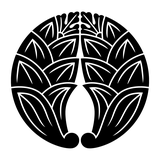 茗荷紋MyōgaMyoga ginger
Its name echoes myōga, divine or Buddhist protection. It is the symbol of Matarajin of the Tendai school, and it spread widely after it was placed on every portable shrine in the festival of Nikkō Tōshōgū. It resembles the gyōyō crest and may have developed from it; it first appears for the Ninomiya in the Kenmon Shokamon.
Associated with the Ninomiya, Inagaki (Toba domain), Hori, Nakane and Ozawa; Nikkō Tōshōgū and Tendai temples
One of the ten great crests (traditional list). 12th by share of households (Takasawa 2008). 125 variants recorded. In practice almost all are Daki Myōga or Maru ni Daki Myōga.
抱き茗荷・丸に抱き茗荷・違い茗荷・三つ茗荷・一つ茗荷巴・茗荷桐・稲垣茗荷・鍋島茗荷・田村茗荷・一関茗荷・花茗荷
 沢瀉紋OmodakaArrowhead
Its leaves resemble arrowheads, earning it the name ‘victory plant’ (kachi-ikusa), and samurai favoured it; omodaka (‘high face’) also suggests keeping one’s honour. By tradition, Mōri Motonari won a battle after seeing a dragonfly alight on an arrowhead plant. It appears on a Koga family ox-carriage in the Nin’an era (recorded in the Kazarishō).
Associated with the Mizuno, the Mōri (secondary crest), Fukushima Masanori, Toyotomi Hidetsugu (battle banner), the Kinoshita, Doi, Okudaira, Sakai, Inagaki and Asano; the Koga house
One of the ten great crests (traditional list). Not in the top 16 by share of households (Takasawa 2008). 105 variants recorded. Used by over 100 Edo shogunal retainer houses.
立ち沢瀉・抱き沢瀉・沢瀉に水・葉沢瀉・花沢瀉・福島沢瀉・水野沢瀉・木下沢瀉・長門沢瀉・大関沢瀉・徳山沢瀉・矢尻沢瀉
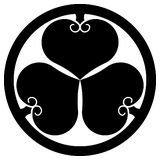 葵紋AoiHollyhock (wild ginger)BROOCH
The two-leaved futaba aoi is the sacred plant and crest of the Kamo shrines, and aoi was read as ‘the day of meeting the gods’. Many Mikawa warriors were parishioners of the Kamo shrines, hence their use of it. In 1723 the Tokugawa restricted its use by other houses, with the Honda as an exception.
Associated with the main Tokugawa line and the Gosanke, the Matsudaira, Honda and Tottori Ikeda; Kamigamo and Shimogamo shrines, Zenkō-ji (Tachi Aoi), the Jōdo school and Kasui-sai
82 variants recorded. A crest of authority.
二葉葵・三つ葉葵(丸に三つ葵・徳川葵)・立ち葵・本多立ち葵・会津葵・紀州葵・尾州葵・水戸六つ葵・丸に三つ裏葵・花立ち葵・水葵・葵巴
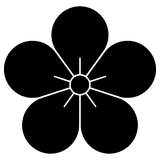 梅紋UmePlum blossom
An auspicious flower of early spring. Sugawara no Michizane loved the plum, so it became the sacred crest of the Tenmangū shrines and spread with the cult of Tenjin. The umebachi, named because its petals resemble drumsticks, is used more than the realistic blossom.
Associated with the Sugawara clan, the Maeda (Kaga), Takatsuji, Higashibōjō, Sagara and Tsutsui Junkei; Kitano Tenmangū (Hoshi Umebachi), Yushima Tenjin (Umebachi), Dazaifu (Baika)
8th by share of households (Takasawa 2008). 170 variants recorded.
梅花・梅鉢・加賀梅鉢・星梅鉢・剣梅鉢・八重梅鉢・裏梅・向う梅・三つ盛り梅・富山梅鉢・大聖寺梅鉢・棚倉梅・光琳梅・梅鶴
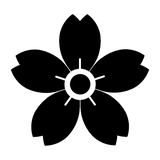 桜紋SakuraCherry blossomBROOCH
The cherry was long taken as the flower that signalled rice-planting time and was regarded as an embodiment of Konohanasakuya-hime. Accounts of its early use differ: Kamon no Iroha says samurai at first avoided it because its falling petals suggested transience, though its graceful design kept it popular, while Japanese Wikipedia notes its use from the Heian period by high-ranking houses, chiefly of Seiwa Genji descent. More than a hundred variants exist. In the Edo period it was borne by daimyō such as the Hosokawa (as an alternate crest) and the Sakurai Matsudaira and Sengoku, and by some twenty shogunal retainer houses. Shrines dedicated to Konohanasakuya-hime use it as a shrine crest, and Shiogama Shrine has its own Shiogama cherry.
Associated with the Hosokawa (alternate crest), the Sakurai Matsudaira, Sengoku, Ōkubo and Oguri; some 20 Edo shogunal retainer houses; the shrine crest of Shiogama Shrine
111 variants recorded.
桜・山桜・八重桜・八重山桜・細川桜・桜井桜・江戸桜・九曜桜・塩竈桜・分銅桜・裏桜
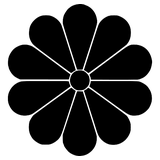 菊紋KikuChrysanthemumBROOCH
Associated with the Double Ninth festival, warding off evil and long life. Retired Emperor Go-Toba favoured it, and the sixteen-petalled double chrysanthemum became the imperial crest; edicts of 1869 and 1871 barred its use outside the imperial family. Kusunoki Masashige, granted the crest, used the ‘chrysanthemum on water’ (kikusui) out of modesty; in the Edo period, as the shogunate kept the court in check, it passed into Japanese sweets and Buddhist altar fittings.
Associated with the emperor, the imperial family and princely houses, the Kusunoki (Kikusui), the Mōri, Date, Kyōgoku, Makino and Sō (by grant), and court nobles such as the Hirohata and Minase; the Tendai school (Santaishō), Shijōnawate Shrine; the Liberal Democratic Party emblem (a shadowed fourteen-petalled chrysanthemum)
188 variants recorded. Naming convention: petal count + single or double (hitoe/yae) + front showing the centre (omote) or back showing the sepals (ura) + design.
十六八重表菊・十六一重表菊(旅券)・十四一重裏菊(宮家)・十二菊・菊水・乱菊・光琳菊・菊菱・割菊・有栖川菊・閑院菊・板倉菊・井桁に菊
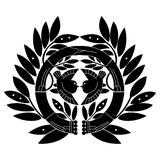 竹紋・笹紋Take / SasaBamboo and bamboo grass
A sacred plant in Shinto rites; the imperial family was called ‘the bamboo garden’ (take no sonō). The carriage crest ‘Shino Maru’ in the Taiyōshō is its first appearance. ‘Bamboo and sparrow’ (take ni suzume) originated with the Rokuhara Tandai and passed to the Kajūji house. There are three groups: sasa (bamboo grass), take (bamboo) and takenoko (shoots).
Associated with the Uesugi, the Date (Sendai Zasa, now a registered trademark), the Kajūji and Kanroji, Takenaka Hanbei (Kyūmai Zasa), the Torii and Mogami; Maru ni Kyūmai Zasa is the most used (Japan Family Crest Research Society)
170 variants recorded.
五枚笹・九枚笹・丸に九枚笹・根笹・篠笹・熊笹・雪持ち笹・切り竹・抱き竹・竹に雀(勧修寺笹・上杉笹・米沢笹・仙台笹・宇和島笹・吉田笹・山口笹)・鳥居笹
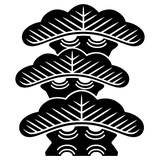 松紋MatsuPine
Evergreen, and so an auspicious tree of long life; the New Year kadomatsu is a resting place for ancestral spirits, and it is linked to the ‘eighteen lords’ (jūhachikō) allusion. It is often used because of a surname.
Associated with the Matsuda (Izumo), the Sangawa, Iida and Hayuka (Sanuki, in the Kenmon Shokamon), the Nagai, Nishio and Amano, and the Hosokawa (alternate crest); Kitano Tenmangū (by tradition, a thousand pines sprang up in a night)
158 variants recorded.
三階松(左・右)・荒枝付き三階松・一つ松・若松・櫛松・三つ笠松・松葉菱・松毬菱・松皮菱
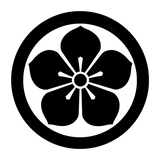 桔梗紋KikyōBellflowerBROOCH
One of the seven flowers of autumn; its name puns on sara ni kichi, ‘ever more fortunate’. It is the representative crest of the Toki clan (one theory links it to the place name Okatoki). It first appears in the Taiheiki as ‘pale-blue helmet badges’; by tradition Toki Mitsuhira won a great victory with a bellflower in his helmet. After Akechi Mitsuhide it was for a time regarded as a traitor’s crest.
Associated with the Toki, Akechi, Ōta Dōkan, Katō Kiyomasa (alongside Ja no Me), the Wakizaka, Tsumaki and Tōyama; the ‘Bellflower League’ of Mino
14th by share of households (Takasawa 2008). 158 variants recorded.
桔梗・丸に桔梗・陰桔梗(明智)・水色桔梗・土岐桔梗・太田桔梗・晴明桔梗・八重桔梗・剣桔梗・光琳桔梗・組合い角に桔梗(坂本龍馬)・三つ割桔梗
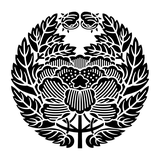 牡丹紋BotanTree peony
Called ‘king of flowers’ and ‘flower of wealth and rank’. It is the principal crest of the Konoe house, and in the Edo period its prestige was second only to the chrysanthemum, paulownia and hollyhock. Other houses avoided it, acquiring it only as kin or through marriage or grant.
Associated with the Konoe, Takatsukasa and Nanba; the Shimazu, Date, Tsugaru, Nabeshima and Nanbu; Kōfuku-ji, Higashi Hongan-ji, Byōdō-in and Kōshō-ji
96 variants recorded. Few households use it today.
近衛牡丹・鷹司牡丹・抱き牡丹・大割り牡丹・杏葉牡丹・裏牡丹・落ち牡丹・獅子牡丹・津軽牡丹・島津牡丹・鍋島牡丹・秋田牡丹・仙台蟹牡丹・本願寺牡丹
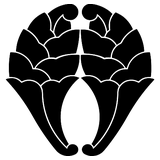 杏葉紋GyōyōApricot-leaf ornament
Not a plant: a Tang-style horse-trapping and armour shoulder ornament named for its apricot-leaf shape, and a Heian court pattern. The Ōtomo used it exclusively and granted it to their ‘crest-sharing retainers’; the Ryūzōji ‘seized’ it after defeating them. It is a temple crest of the Jōdo school (by tradition Hōnen came from an Ōtomo line). Unlike the myōga it has no leaf veins and no flower spike at the tip.
Associated with Ōtomo Sōrin, the Tachibana, Ryūzōji and Nabeshima; the Kan’in, Nakamikado, Jimyōin and Sono (court nobles); Jōdo temples
37 variants recorded.
抱き杏葉・大友杏葉・鍋島杏葉・鍋島花杏葉・立花杏葉・抱き花杏葉・小城花杏葉・藪杏葉・六つ杏葉車・月影杏葉(浄土宗)
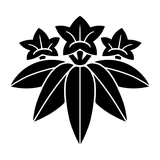 竜胆紋RindōGentian
An elegant autumn flower. It is the representative crest of the Murakami Genji and Uda Genji (not of all Minamoto lines) and is often mistaken for the Minamoto clan crest, though Yoritomo himself had no family crest. It is the emblem of Kamakura City.
Associated with the Koga, Nakanoin, Iwakura, Atago and Rokujō (Murakami Genji), the Itsutsuji, Niwata and Ayanokōji (Uda Genji), the Ishikawa, Kiso, Ikeda, Arima and Bessho; the Sōtō school (Koga Rindō)
47 variants recorded.
笹竜胆・丸に笹竜胆・竜胆車・久我竜胆車・六つ竜胆車・二葉竜胆・三つ葉竜胆・石川竜胆・池田三つ竜胆・慈光寺竜胆
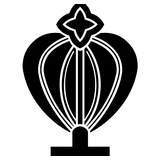 瓜紋(苽紋)UriMelon
Kamon no Iroha notes only that it derives from the melon (uri) and records no families. The design shows the melon itself or its flower, as in the variants uri ni hana and uri no hana. The five-lobed outer frame known as ‘five melons’ (itsutsu uri, or goka) is usually classed with the mokkō crests: Japanese Wikipedia explains that a mokkō frame with five lobes, following the petals of the melon, is called goka, one with six rokka, and that a five-lobed frame left empty in the centre is called uriwa (melon ring).
4 variants recorded.
瓜に花・瓜の花・五瓜
 瓢紋HisagoGourd
A vessel for the gods and a bringer of good luck. Because of Hideyoshi’s ‘thousand gourds’ battle standard it is common among the Kinoshita, Nakamura and Toyotomi names. It is the sacred crest of Minashi Shrine, Hida Ichinomiya (one theory derives hisago from Ifukube), and as kuji it puns on long life.
Associated with the Kinoshita, Nakamura, Fujiyoshi, Toyotomi and Tachikawa; Minashi Shrine
44 variants recorded.
六つ瓢・三つ寄せ瓢・並び瓢・四つ瓢・一つ瓢箪の丸・抱きさかさ瓢箪・千成瓢箪(馬印)
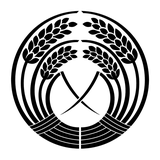 稲紋IneRice
Sheaves of rice offered to the gods, bound into a circle. It is the representative crest of the Hozumi (Suzuki), priests of Kumano — in the Kumano Gongen scroll they offered rice ears and were granted the name Hozumi — and it spread nationwide with the Kumano cult. It is the sacred crest of Fushimi Inari.
Associated with the Suzuki, Hozumi, Kamei, Inō and Saika Magoichi; Fushimi Inari Taisha and Kumano shrines
45 variants recorded. About 50 rice designs in all.
抱き稲・包み抱き稲・稲荷抱き稲・藤白稲・束ね稲・二つ追い稲・左一つ稲丸
 茶の実紋Cha no MiTea seed
It resembles the tachibana crest and may derive from it (it lacks the three backing leaves and the fruit tip splits in three). It reflects the medicinal virtue of tea and long life.
Associated with the Sen, Tsuda, Murata, Ukai, Sōma and Tsuchida
34 variants recorded.
一つ茶の実・丸に一つ茶の実・三つ茶の実・違い茶の実・三つ葉茶の実
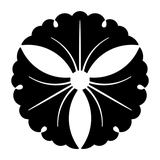 銀杏紋IchōGinkgo
The ginkgo lives a thousand years, resists fire and is full of vitality. Among court nobles only the Asukai used it, graded by rank: sixteen leaves for the head, twelve for the heir and six for younger sons. Numata Raisuke surmised that the Tokugawa used the ginkgo before the hollyhock. The ‘ginkgo crane’ is the crest of the Nakamura-za theatre.
Associated with the Asukai (court nobles), Manabe (Sabae domain), Ōishi, Hijikata, Ōoka, Hayashi and Mori
111 variants recorded.
三つ銀杏・丸に三つ銀杏・六つ銀杏・対い二つ銀杏・銀杏の二葉・銀杏鶴・角切り銀杏
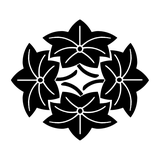 楓紋・紅葉紋Kaede / MomijiMaple
The crest depicts the leaf of the kaede (maple), the plant chosen in heraldry to stand for momiji (autumn leaves). The name is said to come from kaerude, ‘frog’s hand’, after the leaf’s shape. Admired since the Heian period, it was used sparingly as a crest because leaves that redden and fall suggested transience. Its best-known bearer is the court house of Imadegawa (Kikutei), whose ‘three maple leaves in a circle’ is thought to derive from patterns in picture scrolls. Warrior users included the Ichikawa (Seiwa Genji), Takayama (Kanmu Heishi) and Yagi. Parishioners of Akiba Shrine in Hamamatsu and Tatsuta Shrine in Nara used it out of devotion, and Honkoku-ji and Takaosan Yakuō-in use it as temple crests.
Associated with the Imadegawa (Kikutei) house, the Ichikawa, Takayama, Yagi and Endō; the shrine crest of Tatsuta Taisha and the temple crest of Honkoku-ji and Takaosan Yakuō-in
32 variants recorded.
丸に三つ楓(今出川)・一つ楓・違い楓・抱き楓・楓に水・四つ紅葉・折敷に一つ紅葉
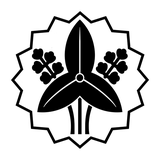 柊紋HiiragiHolly olive
The crest shows the leaf of the hiiragi (holly olive), an evergreen of the olive family. It was long believed to keep out demons: it was planted by gateways as a lucky tree, and on the night of Setsubun a sprig with a sardine head (hiiragi-iwashi) was hung at the door to drive away evil. It entered heraldry as a charm against evil and for the safety of the household. The best-known design is ‘holly with thrown beans’ (hiiragi ni uchimame), combining the leaf with Setsubun beans, the crest of the Ichihashi. The Ōzeki used a ring of holly enclosing water plantain. Sengoku-period bearers included Ichihashi Nagakatsu and Kusakabe Sadayoshi.
Associated with the Ichihashi, Ōzeki, Ai, Koide and Kusakabe
68 variants recorded.
抱き柊・柊に打ち豆(市橋柊)・中野柊・大関柊・柊輪
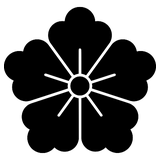 唐花紋KarahanaChinese flower
An imaginary continental flower; the term covers Tang-style flowers and scrolling vines, including lotus, peony and honeysuckle. It already appears on objects in the Shōsōin at Nara and was adapted to Japanese taste in the Heian period. A court pattern, used by priestly families in place of a shrine crest, and one of the common crests (tsūmon).
Associated with the Sanjō house and its branches (Takamatsu, Hanazono, Kazahaya), the Gotō (Fukue), Daitoku-ji, the Yanagisawa, and the Takeda (alternate crest) Also Daitokuji, court nobles such as the Sanjō and Shigenoi, and the Arima, Yanagisawa and Toda families; the Shibata used Gouri ni Karahana as an alternate crest.
49 variants recorded.
唐花・丸に唐花・三つ/五つ/六つ唐花・剣唐花・鬼唐花・有馬唐花・花角・唐花菱・裏唐花・織田唐花・八重唐花・浮線綾唐花・唐花蝶
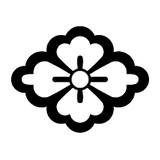 花菱紋HanabishiFlower lozengeBROOCH
An imaginary four-petalled flower in a lozenge shape (one theory traces it to the water-chestnut flower), and a Heian court pattern. The families using it are close to those using the lozenge (hishi) crest, and it is seen as a variant of it.
Associated with the Takeda (alternate crest), the Yanagisawa, Itakura, Gotō, Nanbu, Matsumae, Kobori and Kōno, and Nabeshima Naoshige Also Takeda Shingen and Katsuyori, Baba Nobuharu, Anayama Nobukimi, Nabeshima Naoshige (who used the sword flower diamond before a night attack), and the Yanagisawa, Matsumae, Gotō, Nanbu, Kobori and Ryūzōji families.
172 variants recorded.
花菱・剣花菱・三つ盛り花菱・三条花角・嵯峨花角・滋野井花角・柳沢花菱・郡山花菱・丸に花菱・鬼花菱・竪花菱・利休花菱・有職花菱・三方花菱・蔓花菱・雲形花菱
 蓮紋HasuLotus
The sacred flower of Buddhism; lotus-pattern roof tiles of the Asuka period are the earliest flower used in an emblem-like way. Lotus carvings on gravestone bases are easily confused with family crests, and it is little used as one.
Associated with the Hasumi, Hasuda, Hasunuma and Hasui (from the surname)
5 variants recorded.
蓮の花・蓮の葉
 蕨紋WarabiBracken
A prized food of early spring; its shape was already used on the Nara-period ‘bracken-hilt sword’ (warabite no tachi).
Associated with the Wada, Kadono, Kondō, Chichibu, Koide and Meguro
22 variants recorded.
蕨・抱き蕨・三つ蕨
 芭蕉紋BashōJapanese banana
Kamon no Iroha notes only that it derives from the bashō plant.
14 variants recorded.
折れ芭蕉・芭蕉の葉
 葦紋(芦・蘆)AshiReed
The crest depicts the ashi (reed), a perennial grass of wetlands. Japan was anciently called Ashihara no Kuni, the Land of Reed Plains, and the reed was drawn as a decorative pattern from early times. Because its leaves resemble spear points it was adopted with a martial meaning, and it also spread among families whose surnames contain the character for reed. The ‘Ishikawa reed’ is the crest of the Ishikawa, borne by Ishikawa Kazumasa and Ishikawa Ienari; Niimi Masakatsu is another recorded bearer. Kamon no Iroha notes it is most common in Fukushima, Miyagi and Gifu.
Associated with Ishikawa Kazumasa and Ishikawa Ienari, the Niimi, Ashina and Ashida
19 variants recorded.
石川芦・新見葦・丸に石川葦・葦の丸・違い芦の葉・雪輪に芦に水
 萩紋HagiBush clover
Stands for renewal and many descendants. It is the representative crest of the Sugihara, the family of Nene.
Associated with the Sugihara, Kikkawa and Nonaka
10 variants recorded.
抱き萩・萩の枝丸
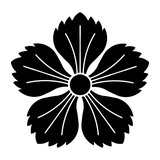 撫子紋NadeshikoFringed pink
The nadeshiko (fringed pink), usually the kawara-nadeshiko of riverbanks, was praised for its delicate beauty in the Man’yōshū and The Pillow Book. It is best known as the representative crest of the Saitō of Mino, of the Fujiwara no Toshihito line; the Hanetsugihara Kassenki records it as their crest, and kinsmen such as the Hikita and Kawai also bore it. The Saitō called their pink tokonatsu (‘everlasting summer’), perhaps as a prayer to flourish like high summer. It was also used by the Inoue, Akai and Yamaguchi of the Seiwa Genji, and the Akizuki’s ‘three pinks’ is said to recall the autumn moon over pinks at their ancestral home. Saitō Dōsan used it.
Associated with Saitō Dōsan, the Hikita, Kawai, Akizuki, Inoue, Akai, Yamaguchi and Shibata; Sumitomo Mitsui Trust
31 variants recorded.
撫子・丸に撫子・三つ撫子(秋月撫子)・三つ割り撫子・江戸撫子・枝付撫子
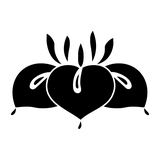 杜若紋(菖蒲紋)KakitsubataIris
The crest group takes in the kakitsubata (rabbit-ear iris) together with the ayame and hanashōbu irises. Its graceful form made it a favourite of the Nara and Heian aristocracy, and warrior houses, which prized martial imagery, hardly used it. It remained chiefly a court crest: the iris lozenge (shōbu-bishi) belongs to the Kazan’in and Nakayama, the shaded version to the Nonomiya, and a circled iris to the Imaki, a Kazan’in branch. It also serves as the shrine crest of Mitsumine Shrine and, as ‘embracing irises’, of Namba Shrine, and as the temple crest of the Izumoji branch of Jōdo Shinshū. Recorded warrior users include Kōriki Kiyonaga and Obama Kagetaka.
Associated with the Kazan’in, Nakayama, Mibu, Nonomiya, Imaki and Ishiyama (court nobles), Kōriki Kiyonaga and Obama Kagetaka; the shrine crest of Mitsumine and Namba shrines
18 variants recorded.
杜若の花・中山杜若・菖蒲菱・菖蒲の花
 朝顔紋AsagaoMorning glory
Kamon no Iroha gives no account of its origin and records no families or region. Japanese Wikipedia lists it simply as a stylised morning glory, with designs including a single flower, a flower in a circle, five flowers, six flowers in a thin ring, and a flower within a bamboo ring.
6 variants recorded.
朝顔・丸に朝顔・五つ朝顔・竹丸に朝顔
 大根紋DaikonDaikon radish
A charm for good health. The forked daikon is the sacred crest of Kangiten and Daikokuten.
Associated with the Honjō, Tomita Kazuhiro, Kakizaki Kageie and the Kaneko
11 variants recorded.
違い大根・本庄大根・割り大根
 茄子紋NasuAubergine
A lucky sign in the first dream of the year (‘first Fuji, second hawk, third aubergine’). A newer crest, from the Edo period on.
Associated with the Yamagata, Fumoto, Murasato, Terakado and Fukasawa
12 variants recorded.
茄子・丸に茄子
唐唐辛紋TōgarashiChilli pepper
Introduced from Portugal in the early modern period. No documented use is known, and it may be a creation of crest painters (uwaeshi).
5 variants recorded.
唐辛子
 栗紋KuriChestnut
Kamon no Iroha gives no account of it beyond noting that it derives from the chestnut, and records no families or region; only a single design is listed.
1 variant recorded.
栗
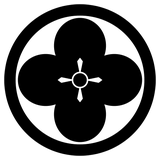 柿紋KakiPersimmon
The design uses the flower of the kaki (persimmon), a fruit tree cultivated in Japan since early times. Because the tree was used in Shinto rites, it was adopted for its religious meaning, and it is also used by families whose surname contains kaki. Japanese Wikipedia records the ‘persimmon flower in a circle’ as the crest of Takechi Hanpeita (Zuizan), leader of the Tosa loyalists in the late Edo period. Kamon no Iroha classes it as a rare crest whose region cannot be identified.
Associated with the Kakihara, Takechi (Takechi Hanpeita), Kushi and Hayasaka
7 variants recorded.
柿の花・丸に柿の花
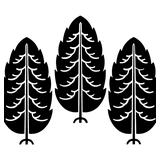 杉紋SugiJapanese cedar
The sacred cedar is the object of worship at Ōmiwa Shrine, and the cedar balls hung outside sake shops led brewing families to use it. It is the representative crest of the Ōmiwa (Miwa) clan, and three cedars are the sacred crest of Takebe Shrine.
Associated with the Ōmiwa, Ogata (Kōan), Honda Tadakatsu, the Niimi, Fujibayashi, Sugiura and Iwase
25 variants recorded.
一本杉(本多一本杉)・二本杉・三本杉・丸に三本杉・抱き割杉
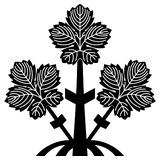 梶紋(梶の葉)KajiPaper mulberry
Its leaves served as vessels for offerings, so it was used by priestly families. It is the sacred crest of Suwa Taisha (four roots for the Upper Shrine’s Suwa Kaji, five for the Lower Shrine’s Myōjin Kaji). It first appears in the Azuma Kagami, where Takeda Nobuyoshi dreams of a warrior in a robe bearing kaji leaves; by tradition the wife of the high priest Atsumitsu dreamed of such a warrior pointing west. Kaji leaves were formerly used at Tanabata.
Associated with the Suwa and Kanasashi clans, the Matsura (Hirado), Abe, Hoshina and Takeda Katsuyori; Suwa Taisha and Suwa shrines nationwide; four Edo-period daimyō and over 40 shogunal retainer houses
56 variants recorded.
立ち梶の葉・丸に立ち梶の葉・鬼梶の葉・諏訪梶の葉・三つ立ち梶の葉・平戸梶の葉・安倍梶の葉・抱き梶の葉
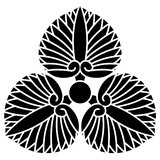 河骨紋KōhoneJapanese pond lily
The crest depicts the leaves or flowers of the kōhone (Japanese pond lily), which grows in shallow ponds and marshes. The name is usually explained as ‘river bone’, from the white rhizome that looks like bleached bone, though Japanese Wikipedia notes another view deriving it from the name koppō recorded in the Honzō Wamyō of 918. The design closely resembles the hollyhock (aoi) crest but has straight stems. After use of the hollyhock was restricted to the shogun’s house in the Edo period, the similar kōhone crest is thought to have become more common. The leaves of the Aizu Matsudaira’s Aizu Aoi resemble pond lily leaves, as did those used by the shoguns Tsunayoshi and Yoshimune.
Associated with the Horie, Ōtaka, Ōura and Fukuoka
16 variants recorded.
丸に一つ河骨・三つ河骨・丸に頭合わせ三つ河骨
 菫紋SumireViolet
A subject of poetry, but rare as a crest.
Associated with the Masuyama, Mōri and Nakamura
6 variants recorded.
増山菫
 蘭紋RanOrchid
Already mentioned in the Nihon Shoki, but rare as a crest because it never became widespread.
Associated with the Tsuji, Mitani and Tokuoka
15 variants recorded.
横見蘭
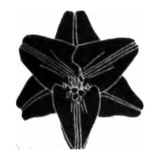 百合紋YuriLily
The lily was admired as an ornamental flower from early times and appears in the Man’yōshū and many later waka, but as a crest it is new, dating from the early modern period. It has no fixed form, and its designs vary freely. Kamon no Iroha classes it as a rare crest whose region cannot be identified.
Associated with the Takeuchi, Yuri and Haga
2 variants recorded.
百合の花
 桃紋MomoPeach
The fruit of long life, with power to ward off evil (as in Momotarō and the Peach Festival).
Associated with the Momoi, Kamio Tadashige and the Mutō
18 variants recorded.
丸に蔓桃・三つ桃
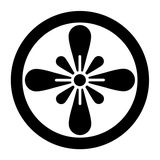 梨紋(柰花・唐梨)NashiPear
Uncertain: it may show a quince flower or a cut pear, but neither the petal count nor the number of seed chambers matches, so it may be an imported pattern later given this name. It is not seen before the Edo period, and is best known through the Nagai, of the Ōe line.
Associated with Nagai Naokatsu, the Tomatsuri and Yoshimi
11 variants recorded.
梨の切り口・丸に梨の切り口・梨の切り口菱・永井奈花
 南天紋NantenHeavenly bamboo
Its name sounds like nanten, ‘turning difficulty’, and so it stands for turning misfortune into good fortune.
Associated with the Kusuhara, Seike, Minami and Jinbo
14 variants recorded.
南天・抱き南天
 棕櫚紋ShuroWindmill palm
A resting place for spirits; the palm-leaf fan (the tengu’s fan) was believed to hold supernatural power, giving it religious meaning.
Associated with the Yonekitsu, Sassa Narimasa, the Fuji and Ōmori
12 variants recorded.
棕櫚・米津棕櫚
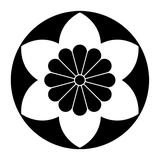 鉄線紋TessenClematis
The tessen (Clematis florida) is a climbing plant native to China that is said to have reached Japan in the Kanbun era. Its name, ‘iron wire’, refers to its thin, strong vines. Admired as a flower for the tea room, it was taken up as a crest, though a relatively new one; designs show five to eight petals. The Kansei Chōshū Shokafu lists it for the Katagiri, Hirata and Kaneko of the Seiwa Genji, the Udagawa and Yabu of Fujiwara descent, and the Nagai of the Ōe line, the Nagai being lords of Takatsuki. A five-petalled tessen marks the grave of Ōmura Masujirō, and Nagai Shrine in Takatsuki uses it as a shrine crest.
Associated with the Nagai, Katagiri, Hirata, Kaneko, Udagawa and Yabu, and Ōmura Masujirō (on his grave); the shrine crest of Nagai Shrine, Takatsuki
25 variants recorded.
鉄線・永井鉄線・八つ鉄線・三つ葉鉄線・花鉄線
 胡桃紋KurumiWalnut
Kamon no Iroha gives no account of it beyond noting that it derives from the walnut, and records no families or region.
4 variants recorded.
胡桃
榊榊紋SakakiSakaki
Kamon no Iroha gives no account of it; the sakaki is the tree whose branches are offered at Shinto shrines (tamagushi).
1 variant recorded.
榊
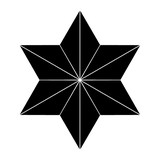 麻紋(麻の葉)AsaHemp leaf
Named for its likeness to a hemp leaf, though it is in fact built from a repeating star-shaped geometric pattern; real hemp leaves have an odd number of lobes, so only the name is borrowed. Variants include the hemp leaf in a circle, shaded and interlocking versions, and a hemp-leaf paulownia. The asa no ha also serves as the municipal emblem of the town of Takahama and the village of Achi. Kamon no Iroha records it chiefly in Chiba, Ibaraki and the Kinki region.
Associated with the Asō, Asada and Asano
19 variants recorded.
麻の葉
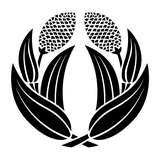 粟紋AwaFoxtail millet
A crest drawn from awa (foxtail millet), shown as ears of grain. No account of its origin is recorded: neither Kamon no Iroha nor Japanese Wikipedia says when it became a crest, why it was chosen or which families used it. The recorded designs include a single ear curled into a ring (hitotsu awa no maru), a ring of millet (awa no maru), and a pair of ears curving towards each other (daki awa, ‘embracing millet’), which also appears inside a circle and crossed.
5 variants recorded.
抱き粟・粟の丸・一つ粟の丸
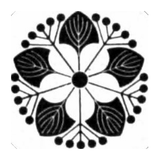 虎杖紋ItadoriJapanese knotweed
A crest drawn from itadori (Japanese knotweed). No account of its origin is recorded, and neither Kamon no Iroha nor Japanese Wikipedia names a family or region that used it. Kamon no Iroha illustrates a single design, the plain itadori; Japanese Wikipedia lists knotweed in a circle (maru ni itadori), a modified knotweed (kawari itadori) and a threefold divided design (mitsuwari itadori).
1 variant recorded.
虎杖・丸に虎杖・三つ割り虎杖
車車前草紋ŌbakoPlantain
No account of its origin is recorded; it belongs to the Tamura line of Mutsu.
Associated with Tamura Chōden
4 variants recorded.
田村車前草・一関車前草
 蕪紋KaburaTurnip
A charm for good health. A relatively new crest, used by few families.
Associated with the Wakana, Tsukahara Masayoshi and the Endō
3 variants recorded.
一つ蕪
 葛紋KuzuKudzu
No account of its origin is recorded.
Associated with Katanohara Matsudaira Ietada
4 variants recorded.
葛の花
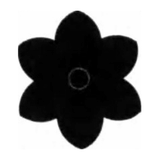 梔子紋KuchinashiGardenia
A crest drawn from kuchinashi (gardenia). No account of its origin is recorded, and Kamon no Iroha names no family or region that used it. The five recorded designs are a single gardenia, the same reversed out of a solid disc (kokumochi jinuki kuchinashi), a threefold divided gardenia (mitsuwari kuchinashi) and its outline version (kage), and three gardenias grouped together (mitsu kuchinashi).
5 variants recorded.
栀子
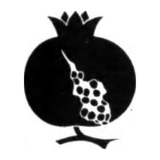 柘榴紋ZakuroPomegranate
Because the pomegranate holds so many seeds, it was long taken as a sign that a family would prosper through many descendants. It is also well known as the fruit held by Kishimojin (Hārītī), the goddess who became a protector of children. Kamon no Iroha suggests it was adopted as a crest for these auspicious associations, but the design is known only from the Heian Monkan crest book, and no family that used it has been identified. Two designs are recorded: the pomegranate fruit and a pair of pomegranate flowers (daki hana zakuro).
2 variants recorded.
柘榴
歯歯朶紋ShidaFern
An auspicious plant used in New Year shimenawa ropes and kagami-mochi decorations.
Associated with the Akutagawa, Hashimoto, Hiraga and Hotta
8 variants recorded.
歯朶・抱き歯朶
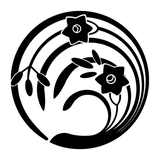 水仙紋SuisenNarcissus
Suisen (narcissus), a perennial of the amaryllis family, is a relatively recent crest. Because it is a flower much used in the tea ceremony, it was taken up as a crest of refined taste by families connected with tea and with ikebana (flower arrangement). Kamon no Iroha records it chiefly in Tochigi, Ibaraki, Fukushima, Miyagi and Aichi. Its ten recorded designs include a narcissus pulled up with its roots (nebiki suisen), paired, bundled and ringed narcissus, a wheel of five blooms (itsutsu suisen guruma), and pairs combined with fish-scale triangles or ginkgo leaves.
Associated with the Mizunuma, Sugawara, Sugano, Nakamura, Hirai and Tarumi families
10 variants recorded.
水仙・水仙丸
薄薄紋SusukiPampas grass
Evokes the autumn moor beneath the moon; usually drawn as withered grass paired with the moon.
Associated with Date Masamune and the Nishio and Asukai families
3 variants recorded.
雪輪に薄(伊達替紋)
芹芹紋SeriJapanese parsley
One of the seven herbs of spring, used both as food and as medicine, and so a wish for long life free of illness.
Associated with the Hijikata and Sonobe families
1 variant recorded.
芹
蒲蒲公英紋TanpopoDandelion
Its meaning is unknown; a new crest that appeared after the Edo period began.
2 variants recorded.
蒲公英
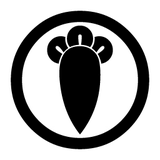 丁字紋(丁子)ChōjiClove
The chōji crest shows the bud of the clove tree, which is native to Indonesia and was used in Japan as a medicine and a fragrance; the dried, unopened bud is the spice. Because the bud resembles a nail, it was named with the character 丁 (nail), giving 丁字 and later 丁子. With about a hundred recorded variants it is a large family of crests: single, paired, crossed and ringed buds, wheels of three to nine, whirling tomoe forms, and versions with sword blades (ken) between the buds. The Yatsu Chōji (eight cloves) belongs to the Sanjōnishi house and the Hana Chōji to the Nagasawa Matsudaira; Sengoku users included Matsudaira (Katahara) Ietada and Shimura Sadamitsu.
Associated with the Oshikōji, Matsudaira (Katahara and Nagasawa lines), Doi, Masaki and Mochizuki families, and the Sanjōnishi house (Yatsu Chōji)
100 variants recorded.
丸に一つ丁子・八つ丁子・丸に五つ丁子・花丁子・抱き丁子
椿椿紋TsubakiCamellia
A sacred tree in the Kojiki. Because the whole flower drops at once, recalling a severed head, samurai houses avoided it; it was mostly taken up for surname reasons.
Associated with the Yamawaki, Tsubaki and Muratsubaki families
9 variants recorded.
椿
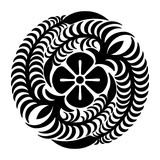 田字草紋DenjisōWater clover
Denjisō (water clover) is a fern whose four leaflets form the character 田 (rice field); it is also called hanakatsumi, and the crest family includes ukikusa (floating weed) designs. The motif was already in use as a pattern in the Heian period and is best known as the exclusive crest of the court noble Shijō house; Japanese Wikipedia lists it for the Shijō, Aburanokōji and other court families of the Shijō line, of which only the Washio used a different crest. Its four-leaf form closely resembles the four-leaf wood-sorrel (yotsuba katabami) crest. A hanakatsumi design serves as the yagō-mon (stage-house crest) of the Yamatoya Bandō kabuki line.
Associated with the Shijō, Hachijō, Nishiōji, Aburanokōji, Yamashina, Kushige and Arai families; Hanakatsumi is the stage-house crest (yagō-mon) of the Yamatoya Bandō line of kabuki actors
12 variants recorded.
四条家田字草・花勝見・浮き草
梛梛紋NagiNagi tree
A sacred tree of the Kumano faith; its name sounds like nagi, a calm sea, so it was revered by seafarers.
Associated with the Suwabe, Suzuki, Hozumi and Kumano families
13 variants recorded.
梛の葉
 薺紋NazunaShepherd’s purse
One of the seven herbs of spring, standing for long life and freedom from illness and misfortune.
Associated with the Hatakeyama, Chō, Tsutsui, Niwa and Asakura families and Date Masamune
9 variants recorded.
五つ薺・六つ薺・八つ薺(伊達替紋)・雪輪に六つ薺
枇枇杷紋BiwaLoquat
No explanation of its meaning is recorded.
1 variant recorded.
枇杷
 葡萄紋BudōGrape
A design that came from the Asian mainland, seen on the canopy at Hōryū-ji and on roof tiles from Oka-dera in Asuka; rare as a family crest.
Associated with the Goi, Kanbara and Yajima families
7 variants recorded.
葡萄
 寓生紋HoyaMistletoe
No explanation of its meaning is recorded.
9 variants recorded.
寓生
 山吹紋YamabukiKerria
Recalls the story of Tachibana no Moroe planting kerria at his villa, and so was used by families of the Tachibana clan.
Associated with the Tachibana, Ide, Yamawaki and Okamoto families
14 variants recorded.
向う山吹・山吹に水
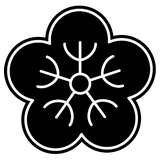 夕顔紋YūgaoBottle-gourd flower
Yūgao, a climbing annual of the gourd family, takes its name from its large white flowers, which open on summer evenings and wither by the next morning; its fruit, the hisago gourd, is the source of kanpyō (dried gourd strips). The brevity of the flower made it the title of a chapter of The Tale of Genji. It is a rare crest, drawn either as the flower alone or as the leaves, and in allusion to the Genji it is often paired with the Genji-guruma (Genji carriage wheel) or a moon. Sengoku-period users included Shinjō Naoyori and Nanjō Mototsugu.
Associated with the Ōta and Watanabe families, Shinjō Naoyori and Nanjō Mototsugu
7 variants recorded.
夕顔の花・夕顔に月・夕顔葉に源氏車
楪楪紋YuzurihaDaphniphyllum
New leaves grow before the old ones fall, ‘yielding’ their place, which made it an auspicious New Year plant. A ‘phantom crest’, used by very few families.
Associated with the Hara family
2 variants recorded.
楪
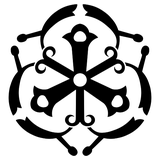 連翹紋RengyōForsythia
Rengyō (forsythia), of the olive family, bears showy yellow flowers in spring. The crest is thought to have developed from the chōji karakusa (clove arabesque) textile pattern and to have been adopted for its beauty. Kamon no Iroha records only four houses using it: the court nobles Ōgimachisanjō and Anegakōji and the warrior Chiba and Toda families. It treats all four as belonging to the Kinsue line of the Northern Fujiwara, and so calls forsythia the representative crest of that line. Sengoku users included Toda Tadatsugu and Toda Yasunaga. Named variants include the Ōgimachi, Toda and Chiba forsythia.
Associated with the Ōgimachisanjō and Anegakōji families, Toda Tadatsugu, Toda Yasunaga and the Chiba family
6 variants recorded.
正親町連翹・戸田連翹・千葉連翹
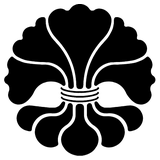 綿紋WataCotton
Wata (cotton), a plant of the mallow family, is extremely rare as a crest. It is known as the crest of Nakaoka Shintarō, an activist of the late Edo period, whose house used a cotton boll in a circle (maru ni wata no mi). A separate and more common group, yuiwata (tied floss), depicts bundled cotton floss rather than the plant; one form, maru ni yuiwata, is the yagō-mon (stage-house crest) of the Hamamuraya Segawa kabuki line.
Associated with the Nakaoka family; the related tied-floss crest (maru ni yuiwata) is the stage-house crest of the Hamamuraya Segawa line of kabuki actors
1 variant recorded.
綿
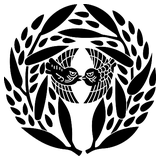 地楡紋WaremokōGreat burnet
Waremokō (great burnet) is a perennial of the rose family, also written 吾亦紅 or 吾木香. The crest is drawn so far from the real plant that it is hard to recognise, and old crest books often filed it under bamboo grass. It is extremely rare and is the exclusive crest of the Yagyū house, known for the Yagyū Shinkage-ryū school of swordsmanship. The Yagyū crest is sometimes called Yagyū-zasa (Yagyū bamboo grass) and grouped with the bamboo-and-sparrow crests, but the Kansei Chōshū Shokafu genealogies record it as waremokō ni suzume (burnet with sparrows): a pair of curving burnet stems enclosing two facing sparrows.
Associated with Yagyū Munenori and the Yagyū family
1 variant recorded.
地楡に対い雀(柳生笹)
青青木紋AokiSpotted laurel
The Kansei Chōshū Shokafu records an ‘aoki leaf’ crest, but its actual form is unknown; used only by the Aoki, a branch line of the Fujiwara.
Associated with the Aoki family
1 variant recorded.
青木の葉
動物紋Animals29
Hawk feathers, butterflies, cranes and wild geese lead this group; hawk feathers are the only crest among the ten great crests that is not a plant. Animals were chosen for martial spirit, as messengers of the gods, as wishes for long life, or for a pun on the family name.
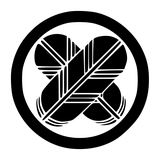 鷹の羽紋Taka no HaHawk feathers
A martial crest: the hawk is brave and clever, and its feathers were used to fletch arrows. Its earliest appearance is the ‘paired hawk feathers’ on the war banner of Kikuchi Takefusa in the Mongol Invasion Scrolls; the Kikuchi genealogy claims use as early as the Hōgen era. By legend (Hokuhi Senshi) it was granted in a dream at the Aso Shrine, whose shrine crest is crossed hawk feathers; it is concentrated in southern Kyushu.
Associated with the Aso Shrine, the Kikuchi, Aso and Kai clans, the Asano (Hiroshima and Akō), Abe, Kuze and Inoue families, Katagiri Katsumoto, Ōtani Yoshitsugu (who later changed to facing butterflies) and the Saigō family
One of the ten great crests (traditional list), and the only one not based on a plant. 3rd by share of households (Takasawa 2008). 133 variants recorded (178 in Hakkō Daiōdō). About 120 Edo-period daimyō and hatamoto houses. More than 60 designs (Wikipedia).
違い鷹の羽・並び鷹の羽・丸に違い鷹の羽(浅野/芸州鷹の羽=羽中有涡)・右違い鷹の羽・井上鷹の羽・久世鷹の羽・高木鷹の羽・福山鷹の羽(阿部氏)・白河鷹の羽・違い割り鷹の羽・抱き鷹の羽(福澤諭吉家)・三つ並び鷹の羽・八つ鷹の羽車・鷹の羽蝶
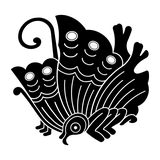 蝶紋ChōButterfly
Found as a design in the Nara period; in the late Heian period it was widely used by the Taira clan and became known as the Heike crest. The change from chrysalis to butterfly symbolises immortality and rebirth. Most common today in Mie Prefecture. The swallowtail is shown in side view with wings folded; the kochō faces front with wings spread.
Associated with the Kanmu Heishi (Taira), the Nishinotōin and Ishii court houses, the Ikeda clan, the Oda clan (as a secondary crest), the Seki, Ise and Later Hōjō clans, and Matsudaira Nobutsuna
119 variants recorded. The swallowtail is one of the common ‘shared’ crests.
揚羽蝶・丸に揚羽蝶・備前蝶・備前蝶菱・因州蝶・池田三つ蝶・織田蝶・対い蝶(伊勢氏)・北条対い蝶・臥せ蝶・浮線蝶・源氏蝶・光琳蝶・胡蝶・鎧揚羽蝶
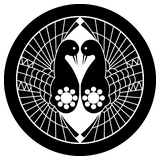 鶴紋TsuruCrane
‘The crane lives a thousand years’: a symbol of long life. It was the crest of the Heian court houses of Hino and Yanagiwara and was also used by Nichiren. A ban on crane crests in 1688 made the Nakamura-za theatre change its crest.
Associated with the Hino and Yanagiwara houses, Nichiren, the Torii, Mori, Suwa, Rokkaku and Nanbu clans, Gamō Ujisato and Kobori Enshū; also Japan Airlines’ Tsurumaru (adopted 1959, dropped 2002, revived 1 April 2011)
45 variants recorded.
鶴の丸(鶴丸)・舞い鶴・飛び鶴・対い鶴・南部鶴・蒲生対い鶴・比翼鶴(蒲池氏)・松喰い対い鶴・鶴亀・折り鶴・光琳鶴・光琳亀甲鶴・鶴菱・森鶴の丸・諏訪鶴の丸・鳥居鶴の丸
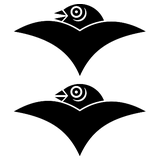 雁金紋(雁紋)KariganeWild goose
A design already present in the Kamakura period. Prized by samurai houses for the goose’s legendary loyalty and the beauty of a flock in flight. The best known is Shibata Katsuie’s ‘two geese’, said by tradition to represent Katsuie and Oichi.
Associated with the Shibata clan (secondary crest: five-melon with Chinese flower), the Sanada, Hanabusa and Masuyama clans and the Akai of Tanba; also the village emblem of Ōkura
65 variants recorded.
雁金・結び雁金(真田替紋)・二つ雁金/丸に二つ雁金(柴田定紋)・三つ雁金・尻合せ三つ雁金(花房氏)・増山雁金・糸巻雁金・五つ雁金車・対い嘴合い雁金
 亀紋KameTortoise
An auspicious sign of long life, usually drawn as the minogame with a long, trailing tail. Relatively new as a family crest, mostly from the Edo period on; the continuous hexagonal tortoise-shell pattern is classed among pattern crests.
Associated with the Okuyama, Ono, Rokkaku, Mori, Hori and Shigyō families
14 variants recorded.
蓬莱亀・真向い亀・一つ亀の丸・三つ追い亀・親子亀・水に亀・光琳亀・浮線亀
 雀紋SuzumeSparrow
The sparrow crest was used by the Saeki clan, because the bird’s chirping (saezuru) echoes the name Saeki. Designs that combine sparrows with bamboo or bamboo grass are classed separately as bamboo crests. Bamboo with sparrows appears as a carriage pattern in the early Kamakura Daiyōshō; according to the Shabunshō it had been used by the Rokuhara Tandai and was taken up by Kajūji Tsunefusa after the fall of the Taira. The Kajūji-line houses created their crest by adding bamboo to an earlier sparrow crest, and the Uesugi version later passed by gift to the Date, becoming the Sendai-zasa. Facing sparrows (mukai suzume) are the stage-house crest of the Kyōya Nakamura kabuki line.
Associated with the Kanroji, Kajūji, Madenokōji, Nakanomikado, Seikanji and Bōjō houses (bamboo-and-sparrow types), the Uesugi and Date clans (Uesugi and Sendai bamboo grass), and the Nakamura family of the Kyōya (stage-house crest)
23 variants recorded.
飛び雀・雀の丸・対い雀・舞雀・張ら雀・三羽飛び雀・雪輪に舞雀・張ら雀菱
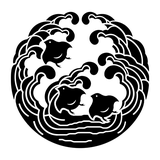 千鳥紋ChidoriPlover
Chidori (plover) is a general name for small birds of shores and rivers, the name being said to come from the way they fly in large flocks. Plovers were drawn as a decorative pattern from the Heian period and appear in many poems of the Man’yōshū and Kokinshū; in haiku they are a seasonal word for winter. As a family crest the plover is surprisingly late, passing from pattern to crest only in the Edo period, when it was chosen for its beauty. Variants include plovers with waves or the moon and the Kanze plover.
Associated with the Horikoshi, Yamakawa, Utsumi, Hama, Isono and Shitara families
11 variants recorded.
千鳥・丸に千鳥・波に千鳥・月に千鳥・陰三つ千鳥・四つ/五つ千鳥・観世千鳥
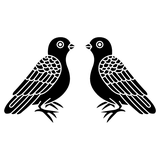 鳩紋HatoDove
Although the dove is a symbol of peace, it was adopted in crests as a symbol of martial valour, because it is the messenger of Hachiman, god of war. The two doves facing each other (mukai bato) are the crest of the Asuke, Kōriki and Yamamoto clans, and the Kutsuki clan used its own design, the Kutsuki-bato. Kamon no Iroha records the crest mainly in Miyagi, Iwate, Akita, Nagano and Hokkaido. Ten designs are recorded, including a parent and young dove (oyako bato), a dove with a staff (tsue bato), a peacock-tailed dove (kujaku bato), and facing doves perched on a torii (shrine gate).
Associated with the Kutsuki, Asuke, Kōriki, Yamamoto, Kumagai, Negishi and Tokunō clans
10 variants recorded.
対い鳩・親子鳩・鳩の丸・孔雀鳩・朽木鳩・鳥居に対い鳩・丸に杖鳩
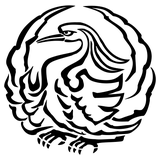 鷺紋SagiHeron
The heron, a graceful bird resembling the crane, was long regarded in its white form (shirasagi) as a messenger of the gods and a sign of good fortune. The night heron (goi-sagi, ‘fifth-rank heron’) carries an anecdote that it was granted the Fifth Court Rank by the emperor; Kamon no Iroha names Emperor Go-Daigo. As a divine messenger the heron is the shrine crest (shinmon) of many shrines, among them the Ikasuri Shrine, and many families took it up through that connection. Recorded designs include a standing heron above water in a circle and a heron paulownia (sagi-giri).
Associated with the Saginomiya, Nozaki and Terada families and the Ikasuri Shrine
2 variants recorded.
丸に立ち鷺に水・坐摩神社鷺
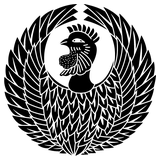 鳳凰紋HōōPhoenix
The hōō is the Chinese fenghuang, a mythical bird. Classical Chinese texts such as the Book of Songs and the Analects call it an auspicious bird that appears only when a sage ruler reigns, and the Book of Rites groups it with the qilin, the divine tortoise and the dragon as the four sacred creatures (shirei). It was said to perch only on the wutong tree, and in Japan this led to its pairing with the paulownia (kiri); the Makura no Sōshi mentions phoenixes carved on paulownia furniture. As a crest it is rare. Designs include the Hōō no Maru (phoenix roundel) of the Kabukiza theatre, and a phoenix with paulownia is recorded for the Kawakatsu family.
Associated with the Kabukiza (phoenix roundel), the Long-Term Credit Bank of Japan (company crest) and the Kawakatsu family
8 variants recorded.
鳳凰の丸・舞い鳳凰の丸・飛び鳳凰の丸・有職鳳凰・乱れ桐に鳳凰・白鳳の丸
 竜紋(龍紋)RyūDragon
A sacred water beast from China, shown coiled or as claws and scales. Also common as a temple crest, such as the Nichiren school’s dragon roundel.
Associated with the Ogata, Mitai, Sakanoue and Kumashiro clans, and Uemura Iemasa
16 variants recorded.
龍の丸・天龍の丸・雨龍の丸・日蓮宗龍の丸・龍の爪・違い龍の爪・龍の鱗・雨龍菱・丸に龍剣に一の字
 兎紋UsagiRabbit
An auspicious animal, the ‘spirit of the moon’, symbolising eternal youth and abundance. Following the Noh play Chikubushima it is often drawn with waves and the moon. The representative crest of the Mitsuhashi clan; common in the San’in region.
Associated with the Mitsuhashi, Inada, Kamio, Terao, Mizushima and Kitamura families
17 variants recorded.
真向き兎・向い兎・三つ兎・月に兎・浪に月に兎・竹生島波兎・花兎・夕波兎
鹿鹿角紋KazunoDeer antlers
The deer is a divine messenger, and Sengoku warlords wore antlers as helmet crests, making this a martial crest. Honda Tadakatsu is famous for his antlered helmet, though the Honda family crest is the Honda hollyhock.
Associated with the Suwa, Kondō (Kondō Hidemochi), Kamo, Kasuga and Honjō families
22 variants recorded.
抱き角・違い抱き角・四つ又抱き角・丸に抱き角・割り角・六つ袋角・角万字
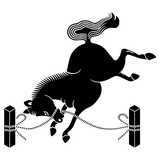 馬紋UmaHorse
The horse crest is best known through the Sōma clan, who by tradition descended from Taira no Masakado; historically their direct ancestor was Sōma Morotsune, a son of Chiba Tsunetane, who took his name from Sōma district in Shimōsa. The clan’s main crest is the kuyō (nine stars), and the tethered horse (Sōma tsunagi-uma) is its other crest. The design is said to come from a legend that when Masakado rose in revolt the seven stars of the sky turned into black horses. Kamon no Iroha suggests a further reason: the Sōma heartland was one of the leading horse-breeding districts. Users are concentrated in Fukushima, Ibaraki and Chiba, mostly among Sōma branch families.
Associated with the Sōma clan (whose main crest is Kuyō; the Sengoku lord Sōma Yoshitane), and the Kanda, Tobari, Shida, Mita and Kurosawa families
3 variants recorded.
相馬繋ぎ馬・左走り馬・片杭覇馬
 蟹紋KaniCrab
Armoured and armed as it charges forward like a warrior, the crab is a martial crest. A design known since the Muromachi period, but very rarely used by families.
Associated with Terasawa Hirotaka and the Kondō, Yashiro and Kani families
4 variants recorded.
蟹・川蟹・海蟹・丸に真向き海蟹
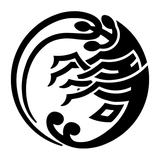 海老紋EbiSpiny lobster
The crest is a stylised Ise-ebi (spiny lobster). The lobster was an indispensable felicitous creature at New Year, used both in decorations and in osechi dishes. Its long feelers and curved tail were likened to a person who lives so long that the back becomes bent, so it was prized from early times as a symbol of long life and an auspicious animal, and it became a crest for that reason. Recorded designs include the lobster roundel, a pair of facing lobsters and two or three lobsters chasing each other in a circle, as well as a kotobuki-ebi (felicitation lobster). Kamon no Iroha places its users chiefly in Okayama, Hyōgo and Aomori.
Associated with the Emi, Ebi, Ebina and Sawa families and Ōhashi Chikashige
5 variants recorded.
海老の丸・対い海老の丸・伊勢海老の丸・三つ追い海老・寿海老
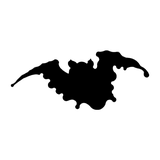 蝙蝠紋KōmoriBat
The crest shows a bat in flight. In Chinese the second character of the word for bat, 蝠 (fu), is identified with 福 (fu), good fortune, so in China the bat was thought to call in luck and stood for fortune and long life; the crest was adopted for this auspicious meaning. It is a rare crest, used by the Yamamoto among others; designs include a Kōrin-style bat and a bat on a moon disc. The bat is also the emblem of Fukuyama City, adopted in 1917 and drawn as the character for mountain. The castle site was once called Kōmoriyama (Bat Hill), and Fukuyama domain troops carried a bat banner in the Hakodate War of the early Meiji era.
Associated with the Yamamoto clan; also the emblem of Fukuyama City
3 variants recorded.
蝙蝠・光琳蝙蝠・月輪に蝙蝠
 蜻蛉紋TonboDragonfly
It flies only forward, never back, so samurai called it the ‘victory insect’ and used it on helmets and armour, from where it became a crest.
Associated with the Kaneko, Tsutsui, Naganuma and Nakamura families
11 variants recorded.
蜻蛉・対い蜻蛉・三つ蜻蛉・丸に対い蜻蛉・中輪に三つ竹蜻蛉
 蛇の目紋(弦巻紋)Ja no MeSnake’s eye
Originally an object: the reel for a spare bowstring, recorded as ‘tsurumaki’ for the Handa family in Kenmon Shokamon. Because it looks like a snake’s eye it was called ja no me from the late Sengoku period (Horie Kagemochi in Asakura Shimatsuki). The snake’s eye on Nanbu Sanenaga’s banner is said to come from the dragon eye of the goddess Shichimen Tennyo, so it was widely used by Nichiren followers.
Associated with Katō Kiyomasa, Katō Yoshiaki, the Hori, Toda, Ishikawa and Kyōgoku clans and Nichiren; also the emblems of JX Metals (formerly Nippon Mining) and Ōzu City
43 variants recorded. Also classed among object crests.
蛇の目・三つ盛蛇の目・蛇の目九曜・七つ蛇の目・蛇の目輪(外框)
 蛤紋HamaguriClam
Linked to the Heian shell-matching game and an auspicious wedding emblem of marital harmony; used by families whose names contain kai, hama, suna or iso (shell, beach, sand, shore).
Associated with the Aoki and Ishiba families
16 variants recorded.
一つ蛤・二つ尻合せ蛤・三つ頭合せ蛤・四つ蛤・蛤胡蝶・三つ蛤に海松
貝貝紋KaiSeashell
Turban shells, conches and other shells; a few appear in the Edo period, and few families used them.
Associated with the Iwanaga, Nakano, Anzai and Hashimoto families
4 variants recorded.
丸に貝・違い貝・三つ貝・兜貝・法螺貝
 板屋貝紋ItayagaiScallop
The most widely used of the shell crests.
13 variants recorded.
丸に板屋貝・三つ板屋貝・板屋貝車・板屋貝蝶・浮線板屋貝
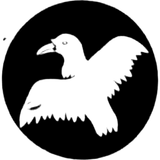 烏紋KarasuCrow
The three-legged Yatagarasu. The Kumano Sanzan shrines regard the crow as the sacred bird of the sun god, and it is the shrine crest of Kumano shrines everywhere; in the Kojiki and Nihon Shoki it guides Emperor Jinmu on his eastern expedition. In the Sengoku period it was the crest of the Suzuki family of the Saika band.
Associated with the Kumano Sanzan shrines, the Suzuki of Saika, and the Enomoto, Ui and Hozumi families; also the badge of the Japan Football Association (1931)
6 variants recorded.
八咫烏・那智烏・飛び烏・糸輪に八咫烏・丸に飛び烏
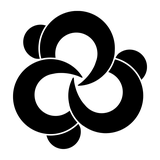 猿紋SaruMonkey
The monkey crest is modelled on the kukurizaru (bound monkey) of the Kōshin faith. In Chinese the monkey can also be written 猴 (hou), which has the same sound as 侯, a word for a lord or castle-holder, and through this association the monkey came to be regarded as sacred in Japan. The crest is found mostly among families whose surname contains the character for monkey, and Kamon no Iroha places its users chiefly in Kyoto and Nara. Nine designs are recorded, among them a single bound monkey, three bound monkeys gathered in a ring or set in a square with cut corners, and the three monkeys (mitsu-zaru).
Associated with the Takenaka, Kitani, Saruta and Saruyama families
9 variants recorded.
括り猿・三つ括り猿・三つ猿・丸に三つ寄せ括り猿
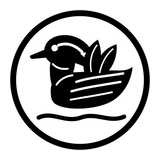 鴛鴦紋OshidoriMandarin duck
The crest is a realistic drawing of the oshidori (mandarin duck). The bird had long been used as a decorative pattern, the best-known early example being the Shōsōin textile with mandarin ducks and arabesques on a red ground. It became a crest for the beauty of the design and as a wish for a loving couple and many descendants. Both the designs and the families using them are very few. The best-known case is the Date Oshidori: Date Masamune is recorded as receiving the mandarin-duck roundel from the Konoe house, and by the mid Edo period the Sendai Date family listed it among seven secondary crests alongside their main bamboo-and-sparrows crest.
Associated with Date Masamune and the Sendai Date family (as a secondary crest, granted by the Konoe house), and the Ōta and Yokomaku families
1 variant recorded.
伊達鴛鴦
 百足紋MukadeCentipede
No account of its origin is recorded.
4 variants recorded.
百足の丸・向い百足の丸・子持ち百足の丸
蟬蟬の上羽紋Semi no AgehaCicada wings
Extremely rare and of unknown origin; the design is a reconstruction by Niwa Motoji.
Associated with the Yuki family
4 variants recorded.
揚羽蝉・対い蝉・丸に対い蝉
獅獅子紋ShishiLion
No explanation of its meaning is recorded.
1 variant recorded.
対い獅子の丸
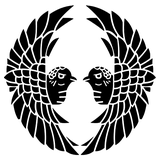 鷲紋WashiEagle
Eagle crests are rare, and Kamon no Iroha records no designs under this heading. Wikipedia’s list of crests (Kamon no Ichiran) gives Washio mukai-washi (facing eagles) for the Washio house, court nobles of the Shijō branch of the Northern Fujiwara, founded in the mid Kamakura period by Washio Takayoshi and named after their residence at Washio in Higashiyama. Other Shijō-line houses used the denjisō (water clover) crest; the Washio alone used the facing eagles. The Akita clan used eagle feathers on a hiōgi (cypress fan), known as the Akita fan, alongside a lion-and-peony crest.
Associated with the Washio house (court nobles) and the Akita clan
鷲尾向かい鷲・檜扇に違い鷲の羽
天文・地象紋Sky & landscape13
Stars lead here — the nine stars of Myōken worship, the three stars of the Ōe line — with the swirling tomoe of Hachiman, the sun rays of the Ryūzōji and the moon. Clouds, snow, mist and waves were mostly chosen for elegance and good omen, and few families use them.
 日紋・日足紋Hi / HiashiSun and sun rays
Rooted in sun worship. The plain sun disc is closely tied to the imperial house, so ordinary families avoided it. The rayed sun is said to have been first used by the Ryūzōji of Hizen in the Sengoku period and was common among samurai of northern Kyushu (Hizen and Higo were called the ‘land of the sun’); the old naval ensign also had sun rays.
Associated with the Ryūzōji, Nabeshima, Ōmura and Kinoshita clans and Kikuchi Yoshitake; also the police badge
43 variants recorded.
日の丸・日輪・五つ~十八日足・十二日足(龍造寺)・八つ日足(木下氏)・鍋島日足・大村日足・木下日足・旭光(警察章)・旭光菱
 月紋TsukiMoon
Full moon (black or white disc), crescent, half moon and hazy moon. The moon has been an object of worship since ancient times, and its waxing and waning carry many meanings. The tale of Yamanaka Shikanosuke praying to the crescent moon is a later storyteller’s embellishment.
Associated with the Chiba clan, the Kuroda clan (Kanbei’s moon over water), and the Ōtawara, Iwaki, Kuki and Itakura clans; also Kao (company crest) and JFE Holdings
84 variants recorded.
三日月(大原氏)・月に星(千葉氏)・月に水(黒田氏)・朧月(大田原氏)・連子に月/岩城櫺子に月・月輪に九曜・月に下三引両・月に北斗星・枡形に月・黒餅(石持ち)
 星紋・曜紋Hoshi / YōStarsBROOCH
Stars are shown as circles, from the worship of heavenly bodies. Kuyō, the nine luminaries, come from Indian astrology (the seven luminaries plus Rāhu and Ketu) and reached Japan through the Sukuyō-kyō. The Chiba moon-and-star and the Sōma Kuyō come from the Myōken faith; the Mochizuki used Kuyō for the sense of ‘full moon’. The character ‘one’ means invincible, and three stars are the general’s stars.
Associated with the Mōri clan (Kenmon Shokamon records ‘three stars under the character kichi’), the Nagai and Ōe clans, the Watanabe, Matsura, Yasuda, Hosokawa, Chiba and Sōma clans, Date Masamune (secondary crest), and the Katakura, Kuki, Tanuma and Hoshina clans; also the Yamatsumi Shrine and Chiba Shrine
15th by share of households, stars and Kuyō together (Takasawa 2008). 173 variants recorded, second among non-plant crests.
一文字三つ星(長門三つ星;大江氏・毛利氏)・渡辺星(三つ星に一の字)・松浦星・三つ星(新発田氏)・六曜・七曜(田沼、九鬼)・八曜・九曜(細川、千葉、相馬、伊達、望月、保科)・離れ九曜=細川九曜(1747 細川宗孝被误杀事件后改图)・角九曜(保科・会津西郷)・九曜に半月(九州千葉)・陰九曜・剣九曜・吉川九曜・十曜~十八曜・北斗七星・三光・銀星
 巴紋TomoeComma swirlBROOCH
One to four comma- or tadpole-shaped swirls arranged in a circle. Its origin is debated: the tomo arm guard of an archer, the magatama bead, a swirl of water (used on eave tiles from the late Heian period to ward off fire), or the thunder god’s drum. The war god Hachiman takes the three-comma tomoe as his shrine crest, and it is one of the earliest recorded family crests (the Saionji house in the Gukanshō). Naming left- and right-turning tomoe is the biggest dispute in crest studies: Numata (1926) followed the drum at Shitennō-ji, while Takasawa (2008) names them by the direction of the tails.
Associated with Hachiman shrines (shrine crest), the Saionji house, the Utsunomiya, Kobayakawa, Yūki, Ogata, Okabe, Naganuma, Kuki, Arima and Itakura clans, the Shō royal house of Ryūkyū and Hijikata Toshizō; Kenmon Shokamon records it for the Soga, Akamatsu, Nagao and Utsunomiya
13th by share of households (Takasawa 2008). 145 variants recorded. About 350 Edo shogunate retainer houses. Also classed among pattern crests.
一つ巴・二つ巴・左三つ巴・右三つ巴・四つ巴・尾長三つ巴(西園寺家)・九曜巴=板倉巴・有馬巴・抜け巴・陰陽勾玉巴・藤巴(黒田氏)・浪巴・雲巴・丁子巴(佐竹)・五つ巴車
 山紋・山形紋Yama / YamagataMountain
From mountain worship and reverence for the bounty of the mountains.
Associated with Aoki Kazushige (Asada domain) and the Yoshida, Ikehara and Furukawa families
34 variants recorded.
三つ山・五つ山・富士(富士市・静岡市章)・富士霞(青木氏、三島市章)・山に霞(吉田氏)・山形に一文字(古河家)・山形に種の字(山崎家)・青木富士の山・山菱(山梨県章)・違い山形
 雲紋KumoCloud
Auspicious clouds: since ancient times good and bad fortune were read from the shape and colour of clouds. Common as a temple crest, rare as a family crest.
Associated with the Soga, Sawaki, Mochizuki and Sakakibara clans, and Tō-ji and Kōshō-ji (temple crests)
22 variants recorded.
一つ雲・瑞雲・東寺雲・興正寺雲・八雲・雲に御幣・雲巴・雲菱・日に雲・半月に雲
霞霞紋KasumiMist
A literary image, mostly used as an accompaniment to other crests.
Associated with the Ichinomiya, Amijima, Aoki and Kita families
9 variants recorded.
霞・春霞・真山霞・丸に霞・丸に三つ霞
 浪紋(波紋)NamiWaves
Covers the seigaiha wave pattern and rising waves. Endless repetition signifies permanence, and rising waves, which advance and retreat like an army, were loved by samurai. Seigaiha marked the sea on ancient Chinese maps, appears on haniwa from Gunma and on Heian court skirts, and takes its name from the Edo lacquerer Seigai Kanshichi.
Associated with Saitō Dōsan, Oguri Tadamasa, Matsuda Masayuki, Soga Naosuke, and the Aoyama and Kōno clans
21 variants recorded.
青海波・立浪・二頭立浪(美濃斎藤氏)・対い浪(青山氏、小栗氏)・浪巴・荒浪の丸・松田浪・渦巻浪・浪の丸に千鳥/兎/燕
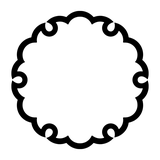 雪紋YukiSnow
Six-petalled crystals and the snow ring. Lying snow was likened to spread rice, an omen of a good harvest. Snow-laden designs appear in the Muromachi period and snow-ring patterns in the Genroku era; the crystal drawings in Doi Toshitsura’s Sekka Zusetsu were also adopted as crests.
Associated with the Nagai clan and the Satō and Yukimura families; also Megmilk Snow Brand (company crest) and the emblem of Higashi Ward, Sapporo
42 variants recorded.
雪・雪輪・外雪輪・雪菱・吹雪・初雪・春風雪・山谷雪・氷柱雪・雪輪菱
 稲妻紋InazumaLightning
Inazuma crests derive from the raimon (thunder pattern), a geometric meander in which a line turns again and again. In China it had been used for more than three thousand years on bronzes, ceramics, lacquer and architecture, and because it stood for the thunderstorms that water the fields it was taken as a sign of good harvests and good fortune. As crests the shapes range from triangular to heptagonal, and 48 designs are recorded. The best known is the inazuma-bishi (lightning lozenge) of the Yamashina, court nobles who from the Nanbokuchō period served as keepers of the imperial wardrobe and made court dress their hereditary art. Among warrior houses the Itō of the Okada domain in Bitchū used it.
Associated with the Yamashina house, the Itō clan (Okada domain, Bitchū; Itō Nagazane), and the Uchida, Mitarai, Ise and Takeda families
48 variants recorded.
平稲妻・隅立て稲妻・稲妻菱(山科家定紋)・伊東稲妻・鱗稲妻・三つ稲妻・稲妻三つ巴・麻型稲妻
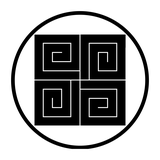 雷紋RaimonThunder fret
The key-fret pattern, used in China on bronzes for more than three thousand years. Thunderstorms that nourish all things make it a sign of good harvests. Used in the badges of the Yokohama Municipal Transportation Bureau and Keifuku Electric Railroad, and on ramen bowls.
Associated with the Yamashina house and the Itō clan; also the Yokohama Municipal Transportation Bureau and Keifuku Electric Railroad
雷紋・細輪に四つ雷紋
 水紋MizuWater
The water crest depicts flowing water. Nearly all the families that use it belong to the Yasuda clan, who devoted themselves to flood control; the Yasuda also took as a crest the ōsunagashi, a device used in river works. Kamon no Iroha places its users chiefly in Aichi, Gifu, Kanagawa and Saitama, and records four designs, all set in a ring or square, among them flowing water and upright water. Water is far more common as an element of combined crests: over thirty are listed, such as the kikusui (chrysanthemum on water) of the Kusunoki clan, the Mizuno omodaka (water plantain) with water, and the Kuroda moon with water.
Associated with the Yasuda, Yasuda (保田), Mizutani and Tanaka families
4 variants recorded.
丸に水・丸に変り流水・丸に竪て水・丸の内に角水流
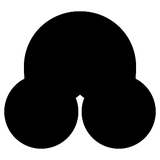 洲浜紋(州浜)SuhamaSandbar
A suhama is an island-shaped sandbar built up at a river mouth, and the crest, also written 州浜, has three rounded lobes. It in fact derives from the suhama-dai, a celebratory stand modelled on that shape, and so became a crest for its auspicious meaning. Its first appearance as a crest is in the Taiheiki, among the Nitta forces surrounding Mount Hiei. Some 58 designs are recorded. The Shishido used the plain suhama and the Hita family the oni-suhama. For the Sanada, the six coins served mainly on battle flags while the bound wild goose and the suhama were used in other settings, and both were kept on as secondary crests.
Associated with the Shishido clan, the Sanada clan (secondary crest; Sanada Masayuki, Nobuyuki and Yukimura), the Nagao clan, the Hita family, Yamamoto Kansuke, Oda Masaharu, and the Ki and Hatta clans
58 variants recorded.
洲浜・丸に洲浜・鬼洲浜(日田家)・宍戸洲浜・光琳洲浜・朧洲浜・花洲浜・秋津洲浜・洲浜団子
器物紋Objects81
The largest group after plants. Weapons and armour, sacred objects such as mirrors, bells and the dharma wheel, lucky puns (a fan opens out like a growing fortune; masu, a measure, sounds like “increase”) and the tools of a trade. The Sanada coins, the Ichikawa measures and the Sumitomo well frame are the best known.
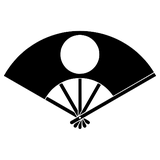 扇紋ŌgiFolding fan
Folding fans and cypress fans. A fan that opens out from a closed point means suehiro, ever-widening good fortune; the cypress fan was chosen for its elegance.
Associated with the Satake clan (main crest: fan with moon), the Ōkōchi, Akita and Yamazaki clans, the Kuriya of Aki, the Asano and Watanabe clans, Nasu Sukeharu and Imai Sōkyū; also Tōan-ji
144 variants recorded.
日の丸扇・五本骨扇に月丸=佐竹扇・三つ扇・五本骨扇(大河内氏)・七本骨扇・重ね扇に抱き柏(音羽屋尾上家)・二階扇(島原扇)・三つ雁木扇(高崎扇)・波に日の丸扇(屋島扇)・浅野扇・渡辺扇・那須扇・立花扇・檜扇・檜扇に違い鷲の羽(秋田扇)・山崎扇・丹羽扇・扇蝶
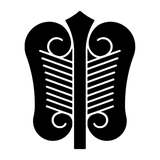 団扇紋UchiwaRound fan
Round fans, feather fans and war fans. In Daoism, Zhongli Quan of the Eight Immortals carries a fan that revives the dead, making it auspicious; the war fan signifies martial valour. The Chinese fan of the Kodama band is the prototype of the family crest.
Associated with the Okudaira clan, the Matsudaira (Okudaira Matsudaira and Obata), the Naitō and Kurushima clans and the Kodama band
41 variants recorded.
団扇・羽団扇・棕櫚団扇(富士氏)・米津羽団扇・唐団扇/軍配団扇・奥平団扇・中津団扇・桑名団扇・小幡団扇・内藤団扇
 地紙紋JigamiFan paper
Jigami is the paper leaf pasted onto the ribs of a folding fan, and the crest shows that leaf on its own. In the Edo period fan papers were so common that peddlers went about selling them in summer. The crest branched off from the fan crest, and like the fan its shape widens towards the end (suehiro), an auspicious form also used at celebrations and weddings. Some 106 designs are recorded, many of them a fan paper carrying another crest such as plum, katabami, bellflower, paulownia or the Takeda lozenge, or two or three papers overlapped. Kamon no Iroha places its users chiefly in Kōchi, Fukuoka and western Japan.
Associated with the Kasagi, Ajiki, Amano, Yamaoka, Tokunaga and Sobue families, Suminokura Ryōi and Tokuyama Norihide
106 variants recorded.
地紙・丸に地紙・日の丸地紙・地紙に梅/片喰/桔梗
 銭紋ZeniCoinsBROOCH
Coins, shown either with an inscription such as Eiraku Tsūhō or as a plain outline. The coin stands for wealth, and the six coins paid as fare across the Sanzu River in Jizō belief gave rise to the six-coin crest (rokurenzen). The Sanada six coins began as a wartime banner emblem and came to be regarded as the Sanada family crest through Edo-period storytelling.
Associated with the Sanada (whose Edo-period crest was the six coins), the Unno and the Shigeno clan, Oda Nobunaga, and the Sengoku (Eiraku coin as a secondary crest), Kuroda, Mizuno, Aoyama and Kuki families
41 variants recorded.
永楽銭(織田・水野・仙石・黒田)・寛永銭(福島氏)・文久銭・天保銭・裏銭(九鬼・青山)・青山銭・三連銭(渡辺氏)・六連銭/六文銭(海野・真田・根津・望月・白鳥・安部・中村)・真田銭・安部銭・銭九曜/長谷部銭・八連銭
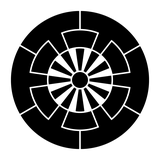 車紋KurumaCarriage wheelBROOCH
The crest is the wheel of the gosho-guruma, the ox-drawn carriage used by the Heian court nobility, and was adopted for its beauty. The carriage is also called Genji-guruma, which gives the crest its usual name. It is the representative crest of the Satō of the Fujiwara no Hidesato line, and so the crest of Satō, Japan’s most common surname. About 53 designs are recorded, with four to twelve spokes, as a plain rim (Genji-wa) enclosing other motifs, or as named versions such as the Sakakibara eight-spoked wheel, the Ikoma wheel and the Kinoshita wheel. The Sakakibara of Mikawa, fudai daimyō under the Tokugawa, used the Genji-guruma, and Iō-ji in Fukushima has it as its temple crest.
Associated with the Satō, Sakakibara (Sakakibara Yasumasa), Ikoma (Ikoma Chikamasa), Ueda, Kinoshita, Miyake, Tachibana and Kawamura families, and Iō-ji temple
53 variants recorded.
源氏車(四~十二本骨)・榊原源氏車(八本骨)・生駒車・源氏輪(作外框)・木下車・鍋島車・風車・重ね浪切り車
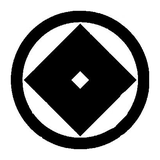 釘抜紋KuginukiNail-puller washer
Despite its name, the crest shows the zagane, a square plate pierced with a hole. Old nails were L-shaped, and so that they could be drawn out later a zagane was laid beneath them; to remove the nail a lever was slipped into the plate and the nail came out easily. The crest is hard to tell apart from the Hitotsu Meyui (single tie-dye eye), but the hole of the kuginuki is slightly larger. Some 92 designs are recorded, including versions with the lever (teko) and the Hitotsuyanagi kuginuki. Users are found in Tōhoku, Aichi, Gifu, Shiga and Tokyo, and Sengoku users included Hori Hidemasa, Hitotsuyanagi Naomori and Ōtawara Sukekiyo.
Associated with the Hitotsuyanagi, Mikami, Ōgyū Matsudaira, Hirose, Hori (Hori Hidemasa), Kawakatsu, Mori, Ōtawara, Suganuma and Satake (Maru ni Kuginuki) families, and Tanaka Yoshimasa
92 variants recorded.
釘抜・丸に釘抜・違い釘抜・折れ釘抜・釘抜菱・丸に梃子釘抜菱
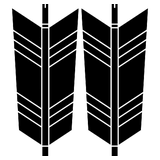 矢紋・矢筈紋YaArrows and nocksBROOCH
An arrow has four parts: the head (yajiri), the shaft (yagara), the fletching (yabane) and the nock (yahazu) that fits the bowstring. As a weapon it became a crest for both martial and religious reasons. Designs show the head, fletching or nock alone, or the whole arrow, and some 93 are recorded, from a single arrow and paired or crossed arrows to wheels of six, seven or eight arrows. Paired arrows are the crest of the Sakō family and the shrine crest of Goryō Shrine in Fujisawa; the six-arrow wheel belongs to the Hattori and Yabe; the Saeki Mōri used a nock in a ring; and four arrowheads in a ring form the emblem of Akita City.
Associated with the Hattori (Hattori Hanzō), Yabe, Sakō, Saeki Mōri (Mōri Takamasa), Nose (Nose Yoritsugu), Katagiri (Katagiri Katsumoto) and Ōta families; Goryō Shrine and Manpuku-ji; the city emblem of Akita
93 variants recorded.
一つ矢・並び矢/二つ矢(酒匂氏、御霊神社神紋)・違い矢・丸に違い矢・矢筈・違い矢筈・丸に矢筈(佐伯毛利家)・三つ矢・六つ矢車(服部氏・矢部氏)・七つ矢車・矢筈十字・片桐違い矢
 弦巻紋/蛇の目紋TsurumakiBowstring reel
A bowstring reel, whose ring form is also called ja no me, ‘snake’s eye’. The Kansei-era genealogies (Kansei Fu) record it for the Hosokawa of Hitachi, Toda of Shimotsuke, Matsudaira of Tōtōmi, Ishikawa of Ise, Kyōgoku of Tango and Katō of Iyo.
Associated with Katō Kiyomasa, Katō Yoshiaki and the Hori, Kyōgoku, Ishikawa and Toda families; the JX Metals company emblem and the city emblems of Ōzu and Maebashi
43 variants recorded.
蛇の目・三つ盛蛇の目・蛇の目九曜・七つ蛇の目・蛇の目に三つ鱗/桔梗
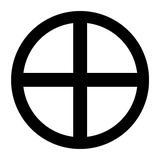 轡紋KutsuwaHorse bit
A horse’s bit, drawn as a cross within a ring. Essential for riding, it expresses martial spirit; its cross shape also let hidden Christians use it, and the Shimazu ‘cross in a circle’ is often confused with it.
Associated with the Ōkusa, Kuze, Asai and Shimazaki families; Shimadzu Corporation (trade crest); the Kansei Fu gives the Shimazu crest as ‘kutsuwa jūji’
40 variants recorded.
轡・持合轡・花轡・角轡・八角轡・万字轡・鍵轡・轡に陰五つ星
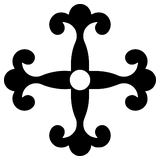 久留子紋(十字架)KurusuChristian cross
The Christian cross, used by believers as a sign of faith. After Hideyoshi’s ban it was disguised as other crests (the St Andrew’s cross became Gion Mamori, the cross pattée Nakagawa Kurusu, the flowered cross Hana Kutsuwa, the Maltese cross Yahazu Jūji), and after the Shimabara Rebellion such crests were renamed kutsuwa or ‘character ten’ (jū no ji) crests. It was common in Settsu.
Associated with the Nakagawa (Nakagawa Kiyohide), Uchida, Ikeda and Tachibana families, and Tsuji Kyūkichi
27 variants recorded.
十字久留子・花久留子・中川久留子・頭合わせ三つ久留子・パテル久留子・切り竹久留子・内田久留子・堀久留子
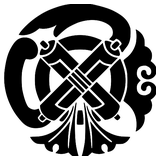 祇園守紋Gion MamoriGion amulet
The crest depicts the amulet issued by Yasaka Shrine in Kyoto, also simply called mamori (charm). Gion is short for Gion Shōja (Jetavana), whose guardian deity Gozu Tennō was worshipped at the Gion shrine from the Heian period as a god who wards off epidemics and disaster; the crest arose from that faith. The scrolls crossing at its centre were likened to a cross, so hidden Christians also used it. Some 27 designs are recorded. The Tachibana of Yanagawa took the Yanagawa mamori as their crest, the Ikeda the Inshū mamori, and Konishi Yukinaga a version tied at the centre, while the Narikomaya Nakamura line of kabuki actors has its own Gion mamori.
Associated with the Tachibana (Yanagawa domain; Tachibana Muneshige), Ikeda (Ikeda Terumasa), Ōtomo, Nabeshima, Nakagawa and Itami families, Konishi Yukinaga, and the Narikomaya Nakamura line of kabuki actors
27 variants recorded.
祇園守・丸に祇園守・中結祇園守(小西行長)・柳川守/立花守・因州守/池田守・銀杏守・筒守・成駒屋祇園守(歌舞伎中村家)・七本骨扇に祇園守(立花扇)
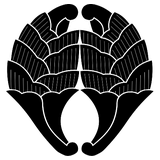 杏葉紋GyōyōLeaf-shaped pendant
A leaf-shaped ornament used on horse harness and on armour shoulders, known as a pattern in the Heian period and used by the Kan’in and Nakamikado court families in the Kamakura period. The Ōtomo used it and granted it to their commanders (the go-dōmon-shū, ‘shared-crest group’), and the Ryūzōji and Nabeshima later took it over. The Kenmon Shoka Mon records it for Ōtomo Chikashige.
Associated with Ōtomo Sōrin, Tachibana Dōsetsu and Muneshige, Takahashi Jōun, Nabeshima Naoshige (who changed from Ken Hanabishi to gyōyō after a night attack), the Ryūzōji, and the Nakamikado, Jimyōin and Mibu court families
37 variants recorded. Also listed among plant crests.
抱き杏葉・抱き花杏葉・鍋島筋杏葉(鍋島宗家定紋)・鍋島花杏葉・一の関杏葉・稲垣杏葉・三つ盛り杏葉(目賀田氏)・小城花杏葉
 井筒紋・井桁紋IzutsuWell frame
A well curb: the square form is called izutsu and the diamond form igeta. It is best known as a crest of the Ii family (whose main crest is the Hikone tachibana, with izutsu as a secondary crest), is common among surnames containing the character for ‘well’ (井), and served as the Sumitomo Izumiya trademark from 1590.
Associated with the Ii, Mitsui and Imai families and the Sumitomo Group; the city emblem of Gifu
109 variants recorded. Classed under buildings on Wikipedia.
井桁(住友電工)・太井桁(住友家・井筒屋)・丸に井桁・丸に井桁に三の字(三井家)・井桁に渡辺星・井桁唐花菱(今井氏)・井筒・平井筒・彦根井筒(井伊氏)・業平井筒(在原業平定紋)・重ね井筒(河内屋實川家)・隅立て井筒・組み井筒
 鍵紋KagiKey
A key.
6 variants recorded.
丸に鍵・丸に違い鍵・丸に房付鍵・鍵桐・二つ鍵菱
 鏡紋KagamiMirror
A mirror, one of the Three Sacred Treasures (the Yata no Kagami). The mirror was seen as a gateway to the gods and used in Shinto ritual, and the crest is widely used by families connected with shrines.
Associated with the Nie, Suzuki, Yoshimura and Chikamatsu families
9 variants recorded.
御鏡・八咫鏡・三種神器・日月鏡・吊り鏡・丸に三つ鏡
 鈴紋SuzuBell
A bell, including kagura dance bells and post-station bells. Its mysterious sound was thought to ward off evil and it was used in Shinto ritual; the crest is used by priestly families and by surnames containing ‘suzu’ (鈴).
Associated with the Suzuki, Kamei, Hozumi and Suzumura families
13 variants recorded.
一つ鈴・五つ鈴・八つ鈴・神楽鈴・十曜鈴・鈴御幣(三河鈴木氏)・駅鈴
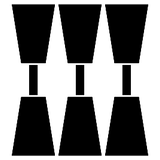 杵紋KinePestle
A hand pestle, a tool for threshing grain and milling flour, best known today for pounding mochi (rice cake). The crest shows the tegine (‘hand pestle’), a straight pestle with a head at each end. Its other name, kachi-gine (‘pounding pestle’), sounds like kachi, ‘victory’, so warrior houses favoured it. Among Sengoku-period warriors it was used by members of the Orii and Komagine families. The crest is found mainly in Nagano, Niigata, Fukushima and Tokyo.
Associated with the Orii, Komagine, Itō, Kondō, Matsukura, Katsuragawa and Kine families
13 variants recorded.
手杵・並び杵・違い杵・十字杵・丸に一つ杵・杵菱・月に杵
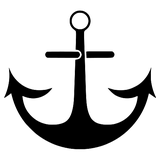 錨紋(碇)IkariAnchor
An anchor, the weight that holds a ship in place. Because anchors themselves were made in many shapes, the crest is drawn in many different forms: modern designs such as the navy anchor and the steamship anchor, anchors with rope attached, split and multiple anchors, anchors combined with paulownia or cherry, and the older wooden anchor (ki-ikari), written with a different character. The crest is found mainly in Kagawa, Ehime and Hyōgo.
Associated with the Itami, Mitani, Yano, Akiyama, Namioka, Murata, Takizawa, Sasamori, Matsuoka and Togawa families
17 variants recorded.
錨・海軍錨・汽船錨・四つ錨・錨桐・錨桜・丸に二つ木碇
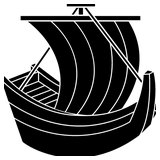 船紋FuneShip
Ships: sailing boats, treasure ships and leaf boats. The sailing boat appears in war chronicles of the Northern and Southern Courts period, and tradition says Emperor Go-Daigo granted it to the Nawa family; the treasure ship is auspicious. Tradition also traces the Chōsokabe sailing boat to the Hata clan’s crossing to Japan.
Associated with the Nawa (main crest: sailing boat), the Chōsokabe (secondary crest; Morichika wore sailing-boat hakama at his death), and the Murakami, Izuno and Kaetsu families
8 variants recorded.
帆掛船・丸に帆掛船(長宗我部氏)・木の葉船・真向き帆掛船に轡
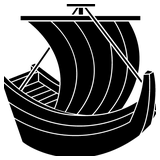 帆紋HoSail
A sail, the cloth that drives a ship with the wind. Kamon no Iroha derives the word ho from a homophone meaning ‘to hold’, since a sail moves a boat by holding the wind. The crest developed from the hokakebune (sailing-boat) crest, and most families are thought to have adopted it to commemorate a connection with shipping. Designs include single sails, rings of two to five sails, sails in a hexagon, and sails over mist or water. It is found mainly in Tottori, Shimane, Kumamoto, Saga and Nagasaki.
Associated with the Murakami, Kaetsu, Fuse, Mitani, Ōi, Uchikawa, Hoashi, Funato and Funamura families
27 variants recorded.
一つ帆・二つ~五つ帆の丸・抱き帆・三つ寄せ帆・六角帆・霞に帆
 枡紋MasuMeasuring box
A square wooden measure. In the Edo period masu was heard as masu, ‘to increase’, making it auspicious, and it also punned on the characters for increase (増) and profit (益). Some designs add a diagonal line to show the measure clearly, or pair it with the masukaki, the stick used to level off rice. It is used by surnames containing masu (枡, 増, 益), such as Masuda and Masui. Historical users included Masuda Nagamori, one of Toyotomi Hideyoshi’s five commissioners, the Masuyama family of the shogun Ietsuna’s maternal grandfather, and the Masuda of Iwami, senior retainers of the Mōri. The Ichikawa Danjūrō line of kabuki actors uses mimasu (three nested measures) as its main crest.
Associated with the Ichikawa Danjūrō line of kabuki actors (main crest mimasu, secondary crest gyōyō botan), the Masuda, Masuyama and Masuzawa families, and the Iwata, Hattori, Kaneko, Koshiba and Okonogi families
27 variants recorded.
一つ枡・入れ子枡・三つ入子枡(成田屋市川家=「三升」)・重ね枡・違い枡・三階斗枡
 兜紋KabutoHelmet
A warrior’s helmet, the symbol of the samurai, expressing martial spirit.
Associated with the Hirose, Kabuto, Kosaka, Komatsu and Musha families
26 variants recorded.
鍬形兜・加藤兜・諏訪兜・諏訪法性兜・新田兜・関ヶ原家康兜・龍頭兜・鳥兜・八幡兜
 鍬形紋KuwagataHelmet horns
The kuwagata, the horn-like front ornament of a helmet.
9 variants recorded.
星付き鍬形・三つ鍬形・鍬形菱・紀州鍬形
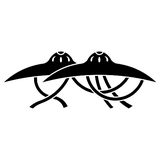 笠紋KasaWoven hat
A woven hat worn on the head, as opposed to an umbrella. There were many kinds, including the ichime-gasa (women’s travelling hat), jingasa (soldier’s hat) and sugegasa (sedge hat), so the crest has many variants. It was adopted from respect for headwear and for its shape, and is closely linked with samurai. It is a representative crest of the Takahashi; one explanation is that the characters for ‘raising bamboo’, done to welcome the gods, combine to write kasa (笠). The Yagyū used the Yagyū-gasa as a secondary crest; Munenori is recorded as receiving the two-tiered hat crest from Sakazaki Dewa-no-kami. A three-hat design of the Muku, priests of Wakasahiko Shrine, appears in the Kenmon Shokamon.
Associated with the Takahashi (a representative crest), Yagyū (Sekishūsai and Munenori; secondary crest), Takebe and Muku families, Kondō Hidemochi and Gamō Ujisato
27 variants recorded.
笠・柳生笠・建部笠・陣笠・足軽笠・三階笠・頭合せ三つ笠・五つ市女笠・神宮笠
傘傘紋KasaUmbrella
A Japanese umbrella.
6 variants recorded.
三本傘・花傘・糸輪に蛇の目傘・開き傘
 分銅紋FundōCounterweight
A metal weight used for measuring, developed for weighing gold and silver accurately. According to Kamon no Iroha it was administered from the Tenbun era by the Gotō family of the gold mint (kinza), and Wikipedia notes that only the Gotō Shirobei house was permitted to make such weights. The shape, said to be modelled on a silkworm cocoon, came to signify treasure and good fortune. Money-changers hung signboards in this shape, and it survives as the map symbol for a bank. The Horio family used the fundō as both crest and banner emblem.
Associated with Horio Yoshiharu and the Matsudaira, Kubota, Kamachi, Yasuda, Ishibashi, Ōnuki and Kondō families; the city emblem of Kitami
24 variants recorded.
分銅・花分銅・宝分銅・並び分銅・三つ重ね分銅・分銅桜・分銅菱・安田分銅(安田家)・分銅熨斗
 鐶紋KanRing handle
A ring-shaped metal pull, as on a chest of drawers; also called the nabetsuri (pot-hanger) crest. One theory holds that it developed from the outer frame of the mokkō crest; warrior houses seldom used it.
Associated with the Matsunami family
65 variants recorded.
鐶・三つ鐶・四つ鐶・外四つ鐶・鐶木瓜・外鐶菱・梅形五つ鐶
 槌紋TsuchiMallet
A mallet: either a large wooden mallet or the small magic mallet (uchide no kozuchi). The large mallet expresses martial spirit, the small one prosperity for descendants and good fortune; the crest resembles the waterwheel crest.
Associated with Inaba Ittetsu and the Tazawa, Kagami and Nanjō families
8 variants recorded.
槌・木目槌・三つ横槌・六つ槌車・五つ槌
 鋏紋HasamiScissors
Spring-handled scissors (nigiri-basami). Absent from early documents, it is a newer crest of the early modern period.
4 variants recorded.
丸に一つ鋏・丸に並び鋏・丸に違い鋏
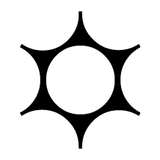 鞠挟紋・鞠紋MaribasamiKemari ball holder
The holder for a kemari football: a board-like device in which kemari balls were stored so that they kept their shape. It was chosen for its pleasing shape, and its central circle often carries another crest, such as crossed hawk feathers or umebachi. The Itakura used it as a secondary crest alongside their main tomoe crest; Itakura Katsushige is among the warriors recorded with it. The crest is found mainly in western Japan.
Associated with the Itakura (secondary crest), Nishio, Matsudaira, Amemiya, Okuyama, Kondō, Sugiura and Wakabayashi families
19 variants recorded.
鞠挟・違い鞠挟・三つ盛り鞠挟・鞠挟に違い鷹の羽/梅鉢・絹手鞠
 琴柱紋KotojiKoto bridge
The movable bridge of a koto. It already appears in the Kamakura-period illustrated life of the monk Ippen (Ippen Shōnin Eden).
Associated with Ido Yoshihiro and the Akima and Gotō families
16 variants recorded.
丸に琴柱・並び琴柱・三つ組み琴柱・琴柱菱
 熨斗紋NoshiDried abalone strip
Noshi, the strip of dried abalone attached to ceremonial gifts. As an emblem of ritual and celebration it is auspicious.
Associated with the Kōno, Nasa, Sannomiya and Ushigome families
69 variants recorded.
抱き熨斗・結び熨斗・束ね熨斗・一束熨斗・熨斗の丸・違い熨斗・分銅熨斗
 鼓紋TsuzumiHand drum
A tsuzumi hand drum.
Associated with the Higashi, Kataoka, Negishi and Ukita families
10 variants recorded.
真向き鼓・置き鼓・三つ鼓・違い鼓胴・調べ鼓
 羽子板紋・羽根紋HagoitaBattledore
A battledore and shuttlecock, a New Year game that came from China in the Muromachi period and was regarded as a charm against evil. It is used by surnames containing ‘ha’ (羽, feather).
Associated with the Hanekawa, Hayama and Haneda families
18 variants recorded.
羽子板・並び羽子板・三つ羽子板・八つ羽子板車・羽根・三つ羽根・羽根桐
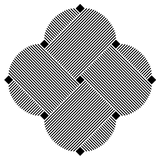 糸巻紋ItomakiThread reel
A thread reel, the frame on which thread is wound. The design already appears in the ‘Takekawa’ scene of the Heian-period Tale of Genji picture scrolls, and its long thread signifies long life, which made it an auspicious crest. Variants include the framed reel, the reel board and three stacked reel boards. Tsuda Hidemasa is recorded among Sengoku-period users. The crest is found mainly in Aichi, Kyoto, Hyōgo and Okayama.
Associated with Tsuda Hidemasa and the Kofuji, Kotō, Nakajima, Kurihara, Akashi, Nagata, Sugimoto and Toda families
12 variants recorded.
糸巻・枠糸巻・糸巻板・組み糸巻・三つ盛り糸巻板
 瓶子紋HeishiSake flask
A flask for offering sacred sake. As a vessel set before the gods, it expresses faith.
Associated with Usami Sadamitsu and the Shimada, Kawagoe and Hanawa families
18 variants recorded.
瓶子・並び瓶子・三つ盛り瓶子・丸に神社瓶子・房付き瓶子
筆筆紋FudeWriting brush
A writing brush, often shown thrown aside (nagefude). It suggests refinement, and the discarded brush signifies giving up letters for arms.
Associated with the Tsuruta, Mochizuki and Fudezuka families
5 variants recorded.
抛筆・対い筆・違い筆・抛筆車
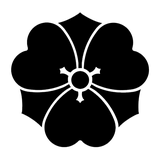 剣紋KenSword
An ancient double-edged sword (tsurugi), not the single-edged katana. The Kusanagi sword is one of the Three Sacred Treasures, and swords were revered as implements in the worship of the gods, so the crest expresses martial spirit. It is rarely used alone and is usually combined with another crest, as in ken-katabami (sword and wood sorrel) or ken-umebachi; other forms include crossed swords, groups of three to five swords and the ken-bishi lozenge. Hikosaka Mitsumasa is recorded among Sengoku-period users.
Associated with the Mori, Shirai, Hikosaka, Okitsu, Matsunami, Hayakawa and Iwaki families
36 variants recorded.
剣菱・違い剣・三つ剣・四つ剣・五つ剣・鍬形剣
的的紋MatoTarget
The square target of yabusame mounted archery. It is used by surnames containing ‘mato’ (的) or ‘ya’ (矢, arrow), and since an arrow striking the target suggests a business that ‘hits’ (ataru), it is auspicious for merchants.
Associated with the Matoba, Yano and Yabuki families
5 variants recorded.
的・的に当り矢・丸に的
 独楽紋KomaSpinning top
A spinning top. It is often confused with the sake-cup crest, and very few families use it.
Associated with the Kinoshita and Satomura families
4 variants recorded.
丸に一つ独楽・紐付き独楽・二つ独楽
 鎌紋KamaSickle
A sickle, the sacred object and ritual implement of the Suwa deity (Suwa Myōjin), invoking good harvests. It is not found before the Edo period.
Associated with Kobayakawa Hideaki (listed by Iroha as a user, though its place among the Kobayakawa crests is unclear) and the Suwa, Kamata and Tsubouchi families
18 variants recorded.
鎌・違い鎌・抱き鎌・三つ組み鎌・四つ鎌車・鎖鎌・万字鎌
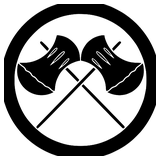 鉞紋(斧)MasakariBattle-axe
A large battle-axe. In ancient China the axe symbolised military and absolute authority; Wikipedia notes that the character for king (王) is said to derive from an axe with its blade turned down, and rulers handed axes to those they delegated power to. The Nihon Shoki records the emperor giving an axe to Yamato Takeru before his campaign against the eastern provinces, so as a crest it expresses martial spirit. Axes traditionally bear three grooves on one face and four on the other, making ‘seven’ (nanatsume); this is variously explained as a charm against evil or accidents, or as offerings to the mountain before felling.
Associated with the Akutagawa, Arao, Sawa, Minobe, Nagai, Kurata, Uno and Kurihara families
14 variants recorded.
違い鉞・並び鉞・三つ鉞・五つ鉞車・鉞菱
 玉紋・宝珠紋TamaSacred jewel
The wish-granting jewel (hōju, in full nyoi-hōju), an auspicious motif from the takara-zukushi (‘treasures’) group. In Buddhism it is a jewel of boundless value that grants whatever is wished for. In Japan it is usually drawn round at the base and rising to a point, and one form wraps three stacked jewels in a single flame. From the Heian period it entered Shintō worship: Ukanomitama, deity of abundance worshipped at Inari shrines, came to be shown holding it. The giboshi finials on bridge railings are said to imitate it. Crest variants include the single jewel, the flaming jewel, the Kōrin-style jewel and three jewels.
Associated with the Warashina, Maejima, Funabashi, Kuramochi, Tamai, Yoshioka and Nonaka families
10 variants recorded.
一つ宝珠・焔宝珠・光琳宝珠・三つ宝珠・宝珠桐
 算木紋SangiCounting rods
Sangi were counting rods: Japanese Wikipedia describes them as rods used in arithmetic, and the crest groups them with other wooden-bar designs. Wikipedia notes the sangi crest as a design similar to mitsubiki, the three-bar hikiryō crest, though it does not say the two share an origin. The variant list includes a circle containing the eight trigrams (hakke). Kamon no Iroha lists users from several lineages, including the Imamura of the Fujiwara Hidesato line, the Hoshiai of the Murakami Genji, the Takigawa of the Takeda line and the Katō of the Fujiwara Toshihito line, as well as Ōtomo Sōrin.
Associated with the Imamura, Hoshiai, Takigawa, Katō, Imagawa and Miura families and Ōtomo Sōrin
21 variants recorded.
丸に一つ~二つ算木・丸に八卦・三つ組木・九字木菱・違い木
 将棋駒紋Shōgi GomaShōgi piece
A shōgi (Japanese chess) piece; a newer crest not found before the Edo period.
Associated with the Komagata, Nasu and Takano families
10 variants recorded.
駒・並び将棋駒・三つ将棋駒・成駒
 折敷紋OshikiOffering tray
A square offering tray. In ancient times leaves such as oak were folded and laid down (oru, shiku) to serve as dishes for offerings to the gods; later the tray was made of thin bent cypress, and the crest shows it from above, often with corners cut so that it appears octagonal. It usually frames another motif. Ōyamazumi Shrine on Ōmishima in Iyo uses the ‘character three on a tray’, hence its use by the Ochi clan and its branches. By tradition Kōno Michinobu received the design from Yoritomo after sitting third at a banquet founding the Kamakura shogunate, a slip marked ‘three’ lying on his tray. Ippen’s Yugyō-ji temple also uses it.
Associated with the Kōno, Inaba (main crest), Ochi, Kurushima, Hitotsuyanagi, Tokunō, Befu and Doi families; Ōyamazumi Shrine, Mishima Shrine (Shizuoka) and Yugyō-ji
35 variants recorded.
折敷に三文字・折敷に縮み三文字・隅切折敷縮三文字(大山祇神社社紋)・折敷に二文字・折敷に十文字(板垣退助)
 幣紋HeiGohei wand
The gohei, a wand of paper streamers that serves as a dwelling for a deity; it expresses faith.
Associated with the Hozumi, Suzuki, Kamei and Ui families
8 variants recorded.
御祓幣・神宮幣・祭礼幣帛・鈴御幣(三河鈴木氏)・違い幣
 輪宝紋RinbōDharma wheel
The wheel of the Buddhist law, a symbol of temples, expressing faith.
Associated with Tsugaru Tamenobu, Miyake Yasusada, Kasuga Kagesada and the Kanō family; temple crest of the Shingon and Tendai schools
16 variants recorded.
輪宝・行者輪宝・三宅輪宝・津軽輪宝・天台宗輪宝・大日輪宝・三つ又輪宝
 独鈷紋TokkoVajra
The tokko, a ritual implement of Esoteric Buddhism; its meaning is religious.
Associated with the Kasuga, Kinebuchi and Kongō families
4 variants recorded.
羯磨・違い三鈷杵・十字三鈷杵・真言宗独鈷
錫錫杖紋ShakujōMonk’s staff
A monk’s ringed staff. Tradition says Sakanoue no Tamuramaro first used it in camp; it later became a crest used only by the Tsugaru.
Associated with Tsugaru Tamenobu
1 variant recorded.
錫杖
 五徳紋GotokuTrivet
A three-legged trivet set in the ash of a brazier or hearth to hold a pot. Kamon no Iroha says it was once used ring-up as the kudoko, and when turned upside down for the tea-ceremony hearth the name was reversed to gotoku; Wikipedia instead derives the word from ko (fire) plus toko (place) or kudoko (‘fire place’). The written name, ‘five virtues’, is explained as the Buddhist ‘six virtues’ with jizai removed, because the trivet replaced the jizai-kagi pot hook. Wikipedia treats it as a phonetic spelling that recalls the Confucian five virtues; it also evokes the five virtues of military science. Shogunal bannermen (hatamoto) such as the Hikita, Kamata and Hirano used it.
Associated with Hikita Masatsugu and the Sassa, Kino, Kamata, Kawada and Hirano families
18 variants recorded.
五徳・真向い五徳・据え五徳・五徳菱
 金輪紋KanawaMetal rings
The metal rings on the head of a monk’s staff, shaken to ward off evil. They are drawn thinner than the interlocking-rings crest (wachigai) and are easily confused with kamashiki.
Associated with the Kojima, Ryūzaki and Tomii families
10 variants recorded.
三つ金輪・四つ金輪・五つ金輪・金輪崩し
 釜敷紋KamashikiKettle mat
A mat for setting down a tea kettle. A new design from after the mid-Edo period, used by few families.
Associated with the Kojima, Kaburagi and Ninomiya families
12 variants recorded.
釜敷七曜・七つ結び釜敷・釜敷桜・釜敷梅鉢・日向釜敷
 輪鼓紋RyūgoDiabolo
A diabolo-like spinning toy. The Muromachi war chronicle Hanetsugihara Kassen-ki records it as the crest of the Naitō family; it was chosen for its beauty.
Associated with the Naitō (Naitō Joan), Taki and Tanaka families
48 variants recorded.
輪鼓・丸に輪鼓・中陰輪鼓・花形輪鼓・立鼓
 打板紋ChōbanSignal board
A board struck to mark the time in Zen temples, of religious meaning. It was the crest of the Andō family, senior retainers of the Kii Tokugawa.
Associated with Andō Naotsugu, Kosuge Masayoshi and the Sugihara family
34 variants recorded.
打板・安藤打板・小菅打板・釣り打板・打板菱
赤赤鳥紋AkatoriHorse comb
Used by Imagawa Yoshimoto. According to Takasawa and others, akatori was originally a saddle cloth for women riders and the Imagawa helmet badge, and was later confused with a horse comb; it was mostly used as a secondary crest.
Associated with the Imagawa, Sena, Abe and Nishio families
4 variants recorded.
今川赤鳥・丸に赤鳥・赤鳥菱
 烏帽子紋EboshiCourt cap
The eboshi cap, in court and warrior styles.
5 variants recorded.
公家烏帽子・立烏帽子・武家烏帽子・大将烏帽子
 櫂紋KaiOar
An oar. Not found before the Edo period, it is used by families connected with sea and river transport.
Associated with Konishi Yukinaga and the Yamamoto and Sugai families
15 variants recorded.
違い櫂・三つ組み櫂・五つ組み櫂・櫂井桁
 舵紋KajiRudder
A ship’s rudder.
2 variants recorded.
丸に一つ舵・三つ舵
網網紋AmiNet
A fishing net hung up to dry. From the phrase ichimō dajin (‘catching everything in one cast of the net’) it signifies victory; a Muromachi saying held that ‘the net is the mark of the Sugai band’.
Associated with the Sugai (須賀井, 菅井 and 須貝) and Suga families
7 variants recorded.
丸に二つ干網・糸輪に三つ干網・四つ網目
 筏紋IkadaRaft
A raft, often a flower raft (hana-ikada). It was a Muromachi-period pattern, seen on the altar dais of Kōdai-ji, and became a family crest in the Edo period.
Associated with the Honda, Takigawa and Hayashi families
7 variants recorded.
筏・花筏・丸に重ね花筏
 羽箒紋HabōkiFeather brush
A feather brush used in the tea ceremony.
Associated with Obata Toramori
8 variants recorded.
羽箒・並び羽箒・違い羽箒・羽箒の丸
 半鐘紋(釣り鐘)HanshōAlarm bell
A bell used for signalling on the battlefield and for fire alarms. It passed from banners into family crests and expresses martial spirit.
Associated with Katakura Kagetsuna (the Katakura ‘hanging bell’) and the Ozaki and Terakado families
5 variants recorded.
半鐘・櫓半鐘・黒釣鐘
 笄紋KōgaiHairpin
A kōgai hairpin.
6 variants recorded.
丸に笄・三つ笄・八つ笄車
 杯紋SakazukiSake cup
A sake cup.
2 variants recorded.
杯・三つ杯
三三味駒紋ShamigomaShamisen bridge
The bridge (koma) of the shamisen. It does not appear in documents before the Edo period and is a comparatively recent crest.
Associated with the Komai, Komada and Komazaki families.
11 variants recorded.
三味駒・対い三味駒・三つ盛り三味駒
頭頭巾紋ZukinHood
A cloth hood or head covering. The sources give no account of its origin.
4 variants recorded.
丸に一つ頭巾・三つ頭巾・六つ頭巾
 炭紋・墨紋SumiCharcoal and ink stick
Cut charcoal (炭) or, in a related form, a folded ink stick (墨). Linked with the tea ceremony; very rare.
Associated with the Kuroyama, Nosaka and Haiyama families; the folded-ink-stick form (Orizumi) with Katō Kiyomasa.
2 + 1 variants recorded.
炭の切口・三つ盛り炭の切り口;折墨
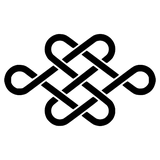 宝結び紋Takara MusubiTreasure knot
An ornamental knot belonging to the takara-zukushi, the assemblage of auspicious treasures. The crest family is small: the treasure knot itself, a squared version, a knot combined with kuwagata (helmet horns) and the keman-musubi, the knot of a Buddhist hanging ornament. It is found mainly in Saitama, Gunma, Chiba, Miyagi and Ibaraki.
Associated with the Niwa, Ōrui, Ijichi, Nakazato, Gotō, Ōta, Yoshida and Nakagawa families
7 variants recorded.
宝結び・角宝結び・鍬形宝結び・華蔓結び
 団子紋DangoSkewered dumplings
Rice dumplings (dango) threaded on a skewer. Kamon no Iroha traces the crest to the uma-jirushi (battle standards) of samurai: heads taken in battle and impaled on a spear were said to look like dumplings on a stick. The motif was much used on standards, and many families later turned it into a crest. The Nonomura family’s tradition holds that before the Battle of Okehazama Oda Nobunaga handed Nonomura Yukimasa dango and told him to take the enemy like this; the three-dumpling Inaba dango is said to commemorate the gift. The Tosa Yamauchi house record Gokachū Meiyo tells the same story of a Yamauchi Yukimasa, probably the same man. The circled three dumplings belonged to the hatamoto Fuseya, Ueda and Nakayama families.
Associated with the Nonomura, Fuseya, Ueda, Nakayama, Toyohara and Mino families; used by Nonomura Yukimasa and Fuseya Tamenaga.
7 variants recorded.
因幡団子・丸に三つ団子・洲浜団子・七曜串団子
 旗紋HataFlag
Few families used it. The Hinomaru flag crest was devised after the Meiji period.
Associated with the Iwata and Sakamoto families.
8 variants recorded.
丸に旗・二つ国旗・四半幟・六つ旗車
 袋紋FukuroTreasure bag
A bag for gold dust, one of the takara-zukushi treasures and therefore auspicious.
Associated with the Seyakuin, Tominaga and Usami families.
9 variants recorded.
袋・宝袋・三つ袋・丸に丸袋
 文紋FumiLetter
A folded letter. The sources give no account of its origin.
8 variants recorded.
結び文・恋文・丸に文車・開き文
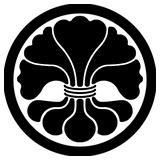 結綿紋YuiwataTied silk floss
A bundle of floss (wata) tied together; in the standard crest five strands are bound with three cords and opened out at the top like a flower. Such bundles were offered before the gods and given as presents at weddings and other celebrations, and Kamon no Iroha suggests the crest was adopted for this auspicious association. It is best known as the crest of the Edo-period kabuki actor Segawa Kikunojō, and Japanese Wikipedia lists the circled yuiwata as the yagō (stage-house) crest of the Hamamuraya Segawa line. In the Edo period ‘yuiwata’ was also the name of a hairstyle worn by unmarried women. The crest is used mainly in the Kantō region, in 15 recorded variants.
Associated with the Segawa acting family (Hamamuraya) and the Satomi, Ishiwata, Tai, Ōhashi, Sano and Watanuki families.
15 variants recorded.
結綿・丸に結綿(濱村屋瀬川家)・結綿菱
 蝋燭紋RōsokuCandle
From the late Edo period, candle makers and sellers used it to show their family trade.
Associated with the Katō family.
8 variants recorded.
丸に一つ蝋燭・三つ割り蝋燭
 鉸具紋KakoStirrup buckle
Kako is a fitting from horse tack: the slim metal piece inside the buckle-like iron ring at the head of the stirrup (abumi), through which the stirrup leather (chikaragawa) is passed and fastened to the stirrup strap (mizuo). The crest is simpler than the real object. It shows a round ring at the top, the tongue (sasuga) that goes through the hole in the leather, and the square part joined to the stirrup. As riding gear it was adopted for its martial associations. It is rare, with three recorded variants: the plain buckle, one enclosing a left-turning triple tomoe, and one enclosing a flying goose (karigane), the last recorded for the Iio family.
Associated with the Miyoshi, Iio, Sawa and Sakai families.
3 variants recorded.
鉸具・鉸具に左三つ巴・鉸具に雁金
 桛紋KaseYarn reel
A cross-shaped frame for winding thread. After Christianity was banned it served as a substitute for the cross.
4 variants recorded.
桛・角桛・丸桛
 滕紋・千切紋ChikiriLoom beam
Chikiri, written 滕 or 千切, is the beam of a loom on which woven cloth is wound. Neither Kamon no Iroha nor Japanese Wikipedia gives any account of how it came to be used as a crest or where it was used. Kamon no Iroha records 12 variants, among them the shaded chikiri, the chikiri lozenge, the knotted chikiri and three chikiri gathered together, and names the Sengoku commander Saitō Tomonobu as a user of the plain form. Japanese Wikipedia gives the chikiri as the crest of the Ōkuni family, formerly the Oguni.
Associated with Saitō Tomonobu and the Ōkuni (formerly Oguni) family.
12 variants recorded.
滕・滕菱・結び滕・千切り巴(大国氏)
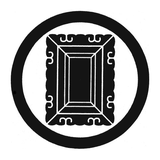 額紋GakuFramed tablet
A framed name tablet of the kind hung above a gate or hall; Japanese Wikipedia describes the crest simply as a stylised frame. Only two forms are recorded. The Koide gaku, also called the ‘upright tablet with the characters two and eight’ or the Sonobe gaku, shows the characters for two and eight inside the tablet and was the main crest (jōmon) of the Koide lords of the Sonobe domain in Tanba, associated with Koide Hidemasa and Koide Yoshimasa. The circled tablet (maru ni gaku) was used by a hatamoto Koide family; Japanese Wikipedia assigns the two-and-eight form to a branch line of the Koide.
Associated with the Koide family (Koide Hidemasa and Yoshimasa), lords of the Sonobe domain in Tanba.
2 variants recorded.
丸に額・小出額・額に二八文字(小出氏支流)
豆豆藏紋MamezōTumbler doll
A weighted, self-righting toy doll. The sources give no account of its origin.
5 variants recorded.
一つ豆造・三つ豆造・豆造菱
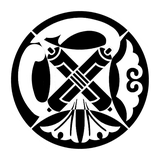 守紋(お守り)MamoriAmulet
Mamori crests stylise a protective amulet (o-mamori). This entry covers the forms other than the Gion amulet (Gion mamori), which is treated separately. Japanese Wikipedia lists the Yanagawa amulet, also called the Tachibana amulet, and the Shimotedo amulet as crests of the Tachibana family, and the Inshū amulet as a crest of the Ikeda family. It also records a ginkgo amulet, known as the Gion ginkgo, and a broken-up Gion amulet (Gion mamori kuzushi).
Associated with the Tachibana and Ikeda families.
柳川守・下手渡守・因州守・銀杏守・祇園守崩し
建築紋Structures9
A small group, and nearly all of it doubles as a frame — a hermitage roof, a well curb, a tray, a fence — with any other motif set inside. That is why so many variants exist.
 鳥居紋ToriiShrine gate
The torii, the gate at the entrance to a Shinto shrine, marks the boundary between sacred ground and the everyday world, and it was adopted as a crest for its religious meaning; some families, such as the Torii, used it because of their surname. Crest forms follow two kinds of gate: the myōjin torii, whose top beam (kasagi) curves up at both ends, and the jingū torii built of four logs. By the Kansei Chōshū Shokafu’s account, the family founder Torii Shigeuji, a priest of Kumano, took the name after erecting a torii there, and that genealogy illustrates a torii as the family crest. Japanese Wikipedia’s summary gives Torii Sasa as the family crest. The Torii were later lords of Mibu in Shimotsuke.
Associated with the Torii family (Torii Mototada; lords of Mibu in Shimotsuke) and the Miyazaki, Inden, Ōkubo, Utsunomiya and Asaoka families.
9 variants recorded.
鳥居・神宮鳥居・神明鳥居・明神鳥居・鳥居に垣に巴・鳥居の上に対い鳩・鳥居に大文字
 井桁紋・井筒紋Igeta / IzutsuWell frame
The wooden frame round the mouth of a well. In real wells a frame shaped like the character 井 is called igeta and a round one izutsu, but in heraldry the square form is called izutsu and the diamond form igeta. It is best known as the crest of the Ii family, for whom Japanese Wikipedia lists the Hikone izutsu, and many other families with 井 in their surname also adopted it. Japanese Wikipedia also gives the Narihira izutsu as the crest of Ariwara no Narihira, the thick igeta of the Sumitomo house and the circled igeta with the character three of the Mitsui. Kamon no Iroha records 109 variants, used mainly in Shizuoka, Kagoshima, Nara, Kōchi and Gunma.
Associated with the Ii family (Ii Naomasa), the Inoue, Sakai, Hirai, Mizoguchi and Kai families, the Sumitomo house and the Mitsui.
109 variants recorded.
 庵紋IoriHermitage
A thatched hut, often framing another crest inside it. In the medieval period it was the retreat of those who had taken religious vows, and also a thing of refined taste. It is the representative crest of the Kudō and Itō families of the southern Fujiwara line.
Associated with the Itō family (Itō Suketaka), the Kudō family, and the Kawazu, Kanō, Soga, Nikaidō and Usami families.
25 variants recorded.
庵・庵に木瓜(工藤・伊東)・庵に二つ木瓜(海老名氏)・利休庵・大草庵・花形庵・庵に鶴の丸/左三つ巴/抱き杏葉
 石畳紋(石紋・市松)IshidatamiPaving stones
A chequer of square stones, also called ishi-mon or arare-mon (hail pattern). Combined with the ka roundel, it was the representative pattern of the outer trousers worn by Heian-period men in formal dress. The corners are always right angles, which distinguishes it from the diamond (hishi).
Associated with Tsuchiya Masatsune and the Yakushiji, Irie, Kajiwara and Hondō families.
71 variants recorded.
三つ石・四つ石・丸に四つ石・五つ石・立て三つ石・三つ輪の上の輪の内甃(入江氏)・石車・六つ積み石
 垣紋KakiFence
Fences of several kinds: the shrine fence (tamagaki), bamboo fence and cypress fence. The sources give no account of its origin.
Associated with the Ōoka family.
7 variants recorded.
玉垣(大岡氏)・常磐垣・竹垣・唐檜垣・玉垣に轡
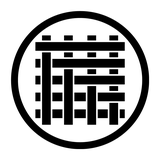 直違紋(筋違・違い棒)SujikaiCross brace
A diagonal brace set in an X between pillars to stop a building falling in earthquakes or wind. By extension it stood for protecting house and castle, and so it was adopted for its martial associations. The Niwa sujikai was the crest of the Niwa family of Niwa Nagahide and Nagashige. The Tōyama of Mino used a nine-line (kuji) form, said by some to come from the kuji protective spell drawn as five horizontal and four vertical strokes; the Tōyama family record instead says it represents the latticed shutters of the imperial palace, honouring ancestral service at court. The Kenmon Shokamon (c. 1460s) shows a forerunner, kuji with two bars, for the Akechi Tōyama. From the Edo period the senior Tōyama lines used it as a secondary crest.
Associated with Niwa Nagahide and Nagashige, Matsuda Norihide, the Tōyama family (Tōyama Kagetō and Toshikage) and the Hatano family.
35 variants recorded.
直違・丹羽直違(丹羽氏定紋)・丸に直違・組み直違・九字直違(遠山氏)・九字菱直違
澪澪標紋MiotsukushiChannel marker
A post marking the navigable channel; the Ruijū Kokushi records that such markers were first set up in the inlet of Naniwa. The name echoes mi o tsukusu, “to give oneself entirely”, a phrase of love poetry, and as an image of loyal devotion it was taken up by warrior houses.
Associated with the Togawa, Hara, Hatanaka, Abe and Tatsuke families.
6 variants recorded.
澪標・一つ浪に澪標・丸に澪標
 水車紋MizugurumaWater wheel
Water wheels came from the continent in the Asuka period, and the design was in use as a pattern by the Heian period; it was chosen for its beauty. It resembles the mallet crest (tsuchi).
Associated with Doi Toshikatsu and the Shibayama and Takimura families.
6 variants recorded.
六つ水車(土井氏)・八つ水車・八つ柄杓車・丸に水車に水
欄欄干紋RankanBalustrade
Very rare; used only by the Machino family of the Miyoshi line.
Associated with the Machino family.
1 variant recorded.
欄干丸に鷹の羽
文様・幾何紋Patterns15
Home of the great warrior houses: the bars of the Ashikaga and Nitta, the diamonds of the Takeda and Ogasawara, the knotted squares of the Sasaki, the scales of the Hōjō, the tortoise shell of Izumo Taisha. Most began as court textile patterns.
 引両紋HikiryōHorizontal bars
One to eight parallel bars, of unsettled origin: Arai Hakuseki saw a camp curtain of five panels with the second and fourth dyed black, while Numata Raisuke linked the bars to the dragon. The earliest written mention is a cloak marked with two bars in the Heike Monogatari. The Ashikaga two-bar crest became a symbol of shogunal authority, listed beside the 5-7 paulownia in the Kenmon Shokamon.
Associated with the Ashikaga shogunal house and its branches (Hosokawa, Shiba, Hatakeyama, Kira, Imagawa, Isshiki, Kitsuregawa); the Nitta and related lines (Satomi, Yamana, Tokugawa, Nukado); the Miura and Wada; the Date, Kikkawa, Mogami, Matsura, Wakebe, Manabe and Tōyama families; and Kondō Isami. Also the emblem of Ōta City and the trade crest of Tokyo Theatres.
142 variants recorded.
一つ引:大中黒・新田一つ引・丸に竪一つ引(田村・岩城);二つ引:足利二つ引・丸に二つ引(足利・今川・最上・赤松)・丸の内に二つ引(畠山)・丸に竪二つ引(黒川・神保)・七つ割丸に二引(松嶋屋片岡家);三つ引:三浦三つ引・丸に三つ引(三浦・間部・近藤勇)・丸の内に三つ引(佐久間・吉川)・丸の内に竪三つ引(伊達氏)・分部三つ引;五つ引・食い違い七つ引(安藤氏)・九字に二つ引(遠山)・六つ瓜に七つ引(相良瓜)・月に下三引両
 菱紋HishiDiamondBROOCH
Usually said to come from the fruit or leaf of the water chestnut (hishi), though its simple shape leaves the origin uncertain; the form already appears on Jōmon pottery. As a family crest it was taken from woven diamond patterns and is recorded from about 1370, in the Taiheiki and in a 1392 record of the Shōkokuji pagoda dedication. It is the representative crest of the Yoshimitsu line of the Seiwa Genji.
Associated with the Takeda family (said to derive from the split diamond on the sleeve of the Tatenashi armour, though Takasawa and others suggest it may have been a flower diamond), and the Ogasawara, Ōuchi, Matsumae, Shibata, Mizoguchi, Yanagisawa, Miyoshi and Kitabatake families; also the Mitsubishi Group and the Yamanashi Prefectural Police.
11th by share of households (Takasawa 2008). 121 variants recorded.
割り菱/四つ割り菱≒武田菱・丸に割菱(松前氏)・三階菱(小笠原氏;本为加賀美氏之纹)・変わり三階菱(新発田氏)・重ね三階菱(岩崎家)・松皮菱・松葉菱(小笠原)・寄せ三つ菱=スリーダイヤ・三つ盛り菱・幸菱・大内菱・五階菱・溝口菱・葉菱(柳沢氏创)・菱の実(米倉氏创)・違い菱・二階菱・建部菱・西菱
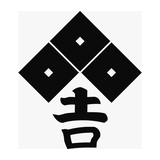 目結紋MeyuiTie-dye squares
The square spots of kanoko shibori tie-dyeing, much used on arms and armour and so a sign of martial spirit. It is the crest of the Sasaki family of the Uda Genji (the Ōmi Genji). The Kansei Chōshū Shokafu lists over 110 shogunal retainer houses using it, 77 of which claimed Sasaki descent.
Associated with the Sasaki, Rokkaku, Kyōgoku, Amago, Sō, Kutsuki, Kamei, Nose and Honma families and Sassa Narimasa; also the Sasaki Shrine.
10th by share of households (Takasawa 2008). 114 variants recorded. Sumitate Yotsume and Maru ni Sumitate Yotsume are the most common (Japan Family Crest Research Society).
一つ目(能勢氏)・三つ目(菅沼・飯田・二松)・三つ目結に吉の字(肥後竹崎氏)・四つ目(『見聞諸家紋』佐々木・椎屋・竹腰)・隅立て四つ目(佐々木・六角・宗氏・朽木氏)・平四つ目(京極氏・尼子氏)・丸に隅立て四つ目・七つ目・九つ目(斉藤・本庄)・十二目結(能勢氏)・十六目結(本間氏)・寄懸目結(武藤氏)・二重四つ目・四つ目菱
 鱗紋UrokoScales
Triangles, single or stacked, already seen in Kofun-period tomb paintings and named for the scales of fish, snakes and dragons; they were thought to ward off evil. Tradition holds that when Hōjō Tokimasa prayed at Enoshima, the goddess Benzaiten turned into a serpent and left behind three scales.
Associated with the Hōjō regents, the Later Hōjō, the Ogata and Tanegashima families and Ōno Harunaga; also Meidi-ya, Mitsuuroko and Tōei.
52 variants recorded.
一つ鱗(東映商号紋)・三つ鱗(北条氏、種子島氏、佐伯氏)・北条鱗(後北条氏,压低的三つ鱗)・丸に三つ鱗(肥前石井氏)・対い鱗・六つ鱗・五つ鱗車・剣三つ鱗・種子島鱗・赤埴鱗
 亀甲紋KikkōTortoise shellBROOCH
A regular hexagon, often enclosing a flower diamond. A repeating pattern from the continent found in fifth-century tombs, it became a Heian court pattern; valued for its geometric beauty and for the tortoise’s long life, it is an auspicious crest.
Associated with Izumo Taisha, Azai Nagamasa, Naoe Kanetsugu, Hori Hidemasa, Katagiri Katsumoto, Kanamori Nagachika and the Nikaidō, Rokugō and Sōma families; also Kikkoman.
145 variants recorded.
亀甲・一重亀甲(キッコーマン、札幌市章)・子持ち亀甲・二重亀甲に剣花菱(出雲大社神紋)・亀甲に花菱・三つ盛亀甲に唐花菱(浅井氏・堀氏)・三つ盛亀甲に剣唐花菱・三つ盛亀甲に七曜(六郷氏)・三つ盛亀甲に三つ葉(直江氏)・三つ盛亀甲に五三の桐(櫛田神社)・毘沙門亀甲・相馬亀甲・亀甲に卍(堀氏)・亀甲に小の字(小出氏替紋)・乃木亀甲・重ね亀甲に五三の桐(大石寺寺紋)
 七宝紋ShippōInterlocking circles
Taken from the continuous court pattern of overlapping rings and used on carriages in the Heian period. According to the Japan Family Crest Research Society it was once called shihō-dasuki, “shihō” later becoming “shippō”. Its endless chain suggests peace, harmony and many descendants.
Associated with the Ōoka family (Ōoka Tadakatsu), the Akizuki (as an alternate crest), the Matsura, Sasaki, Kō and En’ya families, Kobori Enshū, Amago Tsunehisa, Tachibana Muneshige and Takahashi Jōun; also the former emblem of Ōta City.
50 variants recorded.
七宝・七宝に花角=花輪違(出雲源氏佐々木義清后裔:隠岐・塩冶・富田・高岡・佐世;高師直、城氏;小堀遠州代起小堀家家纹)・持ち合い三つ七宝・四つ七宝・花七宝・鳥襷・破れ七宝・星七宝・大岡七宝(大岡氏定紋)・秋月七宝
 輪違い紋WachigaiInterlocked rings
Two to ten interlocking rings, loved since the Heian period for their beauty and found by the Nanboku-chō period. From the Edo period the name refers specifically to two linked rings; the kanawa crest has the same form drawn in a thinner line.
Associated with Wakisaka Yasuharu and the En’ya, Takaoka, Sase, Tomita, Takashina, Jō and Akizuki families.
62 variants recorded.
輪違い(脇坂氏定紋;損害保険ジャパン商号紋)・重ね輪違い・三つ輪違い・四つ輪違い・四つ輪・花輪違い・違い丸と角
 角紋KakuAngular frame
A frame of four to eight sides. It is normally used not on its own but as an outer border around another motif, so a frame drawn alone is a crest whose inner motif has been left out. Variations include frames with curved sides (sori), swollen sides (mukumi), cut corners (sumikiri) and indented corners (sumiiri), as well as crossed (chigai) and interlocking (kumiai) frames. Kamon no Iroha records 58 variants and names the Sengoku commander Shima Sakon among its users. The crest researcher Takasawa Hitoshi, cited by Japanese Wikipedia, classes rings and frames placed around a motif as ‘addition’ (fuka), one of the ways a basic crest is varied.
Associated with Shima Sakon.
58 variants recorded.
隅立て角・隅切り角・隅入り角・鉄砲角・垂れ角・六角・八角・平角
 輪紋WaRing
A round frame, used mainly as an outer border to distinguish main and branch houses and to balance the design; the simplest ring enclosing another crest is called maru. It is very rarely used alone, and Japanese Wikipedia names the Suita and Ōi families as users of the plain ring. Rings range from the hair-thin itowa through the narrow, middle and thick rings, and decorative forms include the snow ring (yukiwa), the wisteria ring and the Genji-wheel ring. Japanese Wikipedia notes that crests enclosed in a ring are thought to have multiplied in the Genroku era, when crests generally became more ornamental. Kamon no Iroha records 34 variants.
Associated with the Suita, Ōi, Ibi, Wada, Ushikubo, Handa and Kagawa families.
34 variants recorded.
糸輪・細輪・中輪・丸輪・中太輪・厚輪・二分輪・石持ち(黒餅=黒田氏替紋)・雪輪・源氏車輪・藤輪・唐草輪・雁木輪
 村濃紋MuragoShaded dye
Murago, also written 斑濃, is colouring in graded shades of a single hue. It was fashionable in the Heian period for the colours of layered garments and for the lacing of armour. As a crest it is extremely rare, but it is known, as the Heike Monogatari shows, as the crest of Hatakeyama Shigetada, a commander of the Genpei War. His form, the komon murago, is a tall rectangle with lines joining its corners and three dots, and is also given for the kanrei Hatakeyama house. The Nikaidō murago, or yamagata murago, cuts a W-shaped band from a wide rectangle; it was the crest of the Nikaidō and of the hatamoto Ide family, descendants of the Nikaidō.
Associated with the Hatakeyama, Nikaidō and Ide families.
2 variants recorded.
小紋村濃・二階堂村濃
 籠目紋KagomeBasket weave
Kagome is the mesh of a basket woven from bamboo or similar material, the basic weave being the six-sided mutsume-ami. Because the continuous pattern forms a chain of six-pointed stars, it has long been said to ward off evil, and the stone lanterns at Ise Shrine are carved with both the chrysanthemum crest and the kagome (hexagram). The kagome crest is a section cut from the continuous pattern and is used as the plain kagome and the circled kagome. In the Edo period it was used by the Komiya and Magaribuchi families.
Associated with the Komiya and Magaribuchi families (Edo period).
籠目・丸に籠目・籠目釜敷
 十字紋JūjiCross
A cross, best known through the Shimazu. The jūmonji crest stylises the character 十 (ten), in forms such as the circled cross and the Shimazu, Hioki and Ikai crosses. The oldest surviving example is the cross marked on the armour of Shimazu Tadahisa in the early Kamakura period, and it was used chiefly by the Shimazu and related clans. A record states that Francis Xavier, arriving in Kagoshima to preach, was surprised to find the Shimazu using a ‘white cross’. It is often confused with the kurusu (Christian cross) crest, and the Shimazu circled cross with the horse-bit (kutsuwa) crest. After the Tokugawa ban on Christianity it was sometimes used, like the kutsuwa and Gion amulet crests, as a substitute for the kurusu.
Associated with the Shimazu family and related clans.
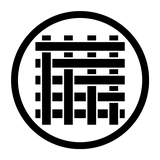 九字紋KujiNine-character grid
A grid of five horizontal and four vertical lines, after the nine-character spell of the Hōbokushi (Baopuzi), used in Shingon, Shugendō and ninja protective rites. By tradition the Tōyama family genealogy says it commemorates an ancestor’s service at the imperial palace, turning the palace lattice shutters into a crest; Takasawa and others suggest it may instead have evolved from the Katō bowstring-reel crest.
Associated with the Tōyama family.
九字・石持ちに九字(遠山・伊丹氏)・九字直違・九字に二つ引両
 源氏香紋GenjikōGenji incense
Five vertical lines joined across the top; each of the 52 figures used in the incense game bears a chapter title from The Tale of Genji. Highly artistic, the figures were used on kimono and as crests, though only eight are confirmed as family crests.
Associated with the Satake (one of their seven crests), Sassa and Hotta families.
82 variants recorded.
桐壺・帚木・空蝉・夕顔・若紫・花散里(佐竹氏)・関屋(2023 IMO 日本大会 logo)
 太極図紋TaikyokuzuYin-yang symbol
The taikyokuzu is the diagram of the Great Ultimate (taikyoku), an ancient Chinese conception of the cosmos. It sets out in a picture the idea that all things arise from the yin and yang of the Book of Changes together with the five phases of wood, fire, earth, metal and water. The diagram reached Japan with Daoism and Confucianism, and its mysterious and auspicious form made it a crest for families of scholars and physicians, though it is rare. The variant in’yō magatama tomoe, two comma shapes, one light and one dark, joined from either side, is also said to signify marital harmony and is the shrine crest of Oiwa Inari Tamiya Shrine.
Associated with the Yasuoka, Majima, Kawamoto, Higo, Iga, Tamiya and Naruko families; the shrine crest of Oiwa Inari Tamiya Shrine.
7 variants recorded.
太極図・陰陽勾玉巴・雲に太極図五行
文字紋Characters15
The most personal group: numerals, a character from the family name, lucky words, religious signs such as the manji and the cross, and mottos such as daiichi daiman daikichi.
 一文字紋IchimonjiCharacter “one”BROOCH
A single brushed stroke for the character 一 (one), adopted for its auspicious and martial associations. It was the representative crest of the Nagaie and Nasu branches of the Fujiwara, and of the Sudō. Maru ni Ichimonji, the stroke in a ring, is credited to Nasu no Yoichi and is the shrine crest of Futarasan Shrine in Tochigi. Yamauchi Ichimonji stacks two strokes, the upper drawn plain and the lower in reverse to stand for yin and yang, said to mean ‘no enemy in either’. It was the crest of the Yamauchi Sudō and an alternate crest of the Tosa Yamauchi, who claimed descent from them and whose main crest was three oak leaves.
Associated with the Sudō, Nasu, Yamauchi (Yamauchi Kazutoyo) and Itō of Obi families; the shrine crest of Futarasan Shrine (Tochigi); the emblem of Inuyama City; also SoftBank Group (trade crest).
Counted among the 211 character crests.
一文字・丸に一文字(那須氏、犬山市章)・山内一文字・陰陽一文字・角一文字・一文字に久文字・出山形に一文字
 二文字・三文字紋Nimonji / SanmonjiCharacters “two” and “three”
The characters 二 (two) and 三 (three), the second read as standing for a pair, the third as an auspicious number. Set on an oshiki (a square ceremonial tray), the ‘three’ is the crest of Ōyamazumi Shrine on Ōmishima and so of the Ochi clan and their descendants the Kōno. By tradition, at a banquet when the Kamakura shogunate was founded, Kōno Michinobu was seated third after Minamoto no Yoritomo and Hōjō Tokimasa, and a slip marked 三 was placed on his tray; he is said to have taken the tray-and-three crest from Yoritomo. The Ji sect, founded by his grandson Ippen, uses it as its emblem.
Associated with the Kōno, Ochi, Inaba, Kurushima, Hitotsuyanagi and Murakami families; the shrine crest of Ōyamazumi Shrine; the emblem of the Ji sect.
折敷に三文字・縮み三文字・揺れ三文字・丸に三文字・折敷に二文字・丸に二文字
 八文字紋HachimonjiCharacter “eight”
The character 八 (eight) drawn with a brush. It was considered lucky because its shape widens towards the bottom (suehirogari, spreading out like an opening fan), and it also served as the initial of Hachiman, the god of war, so it carried both auspicious and devotional meaning. Maru ni Hachi no Ji, the character in a ring, is listed for the Owari Tokugawa, whose principal crest was a version of the hollyhock, and in the same form it became the emblem of Nagoya City, adopted on 30 October 1907. Other users recorded include the Kojima, Orii, Kōda, Nagano, Yanagisawa, Yamada, Mizutani and Fukatsu families.
Associated with the Owari Tokugawa, Kojima, Yanagisawa, Mizutani and Fukatsu families, and Nagoya City.
八文字・丸に八の字・丸にハの字
 十文字紋JūmonjiCross
A cross drawn as a brush character, in a ring, or as a bit-ring cross; the oldest surviving example is on the armour of Shimazu Tadahisa in the early Kamakura period. Its origin is variously explained as two dragons, two chopsticks given by Yoritomo, or a charm against evil. Francis Xavier was astonished by the Shimazu “white cross”, and after Christianity was banned the crest stood in for the Christian cross.
Associated with the Shimazu, Ijūin, Akashi and Moriya families and Itagaki Taisuke (Inui family); also the emblem of Kagoshima City (adopted 1926).
丸に十文字・丸に十字・島津十文字(『蒙古襲来絵詞』『見聞諸家紋』)・轡十字(『寛政譜』薩摩島津家定紋)・榧の内十文字・日置十の字・北郷十字・明石十文字・折敷に十文字(板垣退助)・丸に左十字(守矢氏社家)・猪飼十文字
 卍紋・万字紋ManjiBuddhist swastika
An auspicious Buddhist sign, the oldest example being on the central Buddha of Yakushiji in Nara; hidden Christians also used it in place of the cross. From the late Heian period the Yokoyama of the Musashi Seven Bands used it, and later it was borne by the Ōgyū Matsudaira, Takagi, Tsugaru and Hachisuka daimyo and by about 60 shogunal retainer houses in the Kansei Chōshū Shokafu.
Associated with the Yokoyama, Tsugaru, Hachisuka, Ōgyū Matsudaira and Takagi families, Kobori Enshū and Shimizu Muneharu; also the temple crests of Yakuōji in Awa and Kannonji in Sanuki.
33 variants recorded.
左万字・右万字・丸に左万字・五つ割万字・万字菱・捻じ万字・亀甲に万字・蜂須賀万字・万字轡・角万字
 上文字紋UemonjiCharacter “above”
The character 上 (above), taken from the Murakami surname and also read as a wish to rise above others and prosper. It was the representative crest of the Murakami of the Seiwa Genji Yorikiyo line in Shinano, whose crest was Maru ni Ue no Ji, the character in a ring. That ringed form is the most common version; it is also called Marujō or Sagejō, because the dot of 上 is turned downward, and it is found mostly in the Kōshin’etsu region and around the Inland Sea. Together with the tray and ‘three’, it was a leading crest of the Murakami pirate fleets of the Geiyo islands. Users included Murakami Yoshikiyo, Murakami Takeyoshi and Yashiro Masakuni.
Associated with the Murakami (Murakami Yoshikiyo and Murakami Takeyoshi), Yashiro, Amemiya and Muroga families.
上文字・丸に上文字・上の字菱
 大文字紋DaimonjiCharacter “great”
The character 大 (great), drawn with a vigorous brush and chosen for its sense of strength and breadth. Mitsu Dai no Ji, three 大 characters set head to head, is the house crest of the Bandō Mitsugorō line of kabuki actors (Yamatoya), whose alternate crest is the hana-katsumi flower; it was also used by the hatamoto Ōsawa. The Ōkubo used their own ‘great’ character: Ōkubo Dai no Ji takes the archaic form of 大 drawn inside the Ōkubo wisteria and sets it in a ring, and it was the main crest of the Ōkubo of the Ogino-Yamanaka domain. Single-character versions are recorded for the Ōzu, Ōtaki, Kaneko and Takahashi families.
Associated with the Bandō Mitsugorō acting family, the Ōkubo of Ogino-Yamanaka, and the Ōsawa, Kaneko and Takahashi families.
大文字・丸に大の字・三つ大の字・角大文字・剣大文字・大の字菱
 大一大万大吉Daiichi Daiman DaikichiGreat one, great fortune
Later read as “one for all, all for one”. Ishida Mitsunari’s own main crest is unknown; this design appears on armour he lent to foot soldiers and on the formal dress in his portrait. Takasawa (2021) notes it originally belonged only to the Yamauchi Sudō clan and was first linked to the Ishida in the Edo period; it is absent from early Edo sources.
Associated with Ishida Mitsunari (as a banner) and the Yamauchi Sudō clan.
大一大万大吉・大吉大一大万
 児文字紋Jimonji / KomonjiCharacter “child”
The character 兒 (child), reversed out of a suhama (sandbar-shaped) ground, hence the name Shimagata ni Jimonji. It was the representative crest of the Miyake of Bizen, who are said to have drawn their home district of Kojima as an island and set its first character inside. The Ukita, regarded as a Miyake branch, had the sword wood sorrel as their main crest, but they made much use of this character, possibly because the rival Mimura of Bitchū had long used the sorrel. Tradition says three princes of Paekche drifted ashore at Kojima under a banner bearing 兒, giving the island its name. It was also an alternate crest of the Miyake of Tahara in Mikawa.
Associated with Ukita Naoie and the Miyake (Miyake Yasusada) and Kojima families.
児文字・石持ち地抜き児文字
 本文字紋HonmonjiCharacter “hon”
Maru ni Hon no Ji is an alternate crest of the Honda, whose main crest is the Honda hollyhock.
Associated with the Honda family (Honda Tadakatsu).
本の字・丸に本の字・細輪に本の字
 無文字紋MumonjiCharacter “nothing”
The character 無 (nothing), written in cursive script. 無 carries great weight in Zen Buddhism, and the crest was taken up for that religious meaning. It is best known as a banner device of Oda Nobunaga and of Sengoku Gonbei Hidehisa. Mu no Ji is the main crest of the Sengoku family, with the Eiraku coin as its other crest, although the Eiraku coin is also described as the family’s main crest, said to have been granted by Nobunaga. Hidehisa’s portrait shows a ringed 無, and at the siege of Odawara in 1590 he is said to have led the vanguard behind a standard bearing a white 無 on a navy ground.
Associated with the Sengoku family (Sengoku Hidehisa) and Oda Nobunaga (banner).
無文字・丸に無の字
 利文字紋RimonjiCharacter “profit”
The character 利 (profit, advantage) in a ring. It was the main crest of the Katanohara Matsudaira, later lords of the Tanba Kameyama domain. The family story holds that Matsudaira Ienobu killed an enemy commander at the battle of Komaki and Nagakute while his back-banner bore the words 利即是, and that he replaced the family’s hollyhock crest with the ringed 利 to commemorate it. Today many companies use it as a trade crest, among them Kumagai Gumi, Kongō Gumi and Tōyoko Inn, and it is the emblem of Kanbe town in Gifu, adopted in 1963.
Associated with the Katanohara Matsudaira (Matsudaira Ienobu), Kumagai Gumi, Kongō Gumi and Tōyoko Inn; the emblem of Kanbe town.
丸に利の字
 山文字紋YamamonjiCharacter “mountain”
Examples include the “mountain” character of the Sanbōin temple; it is related to the mountain-shape crests.
Associated with the Sanbōin.
山文字・山の字丸・三宝院山の字・剣持ち山の字・三階山の字・鎹山
 角字紋KakujiSquare script
A kind of character crest: angular script drawn without curves and fitted to a square, so that each character fills a square frame. Examples include Kaku Ichimonji, the character 一 bent into a square, which is recorded for the Yasuda family, and Itowa ni Tomoe no Kakuji, the character 巴 in square script within a fine ring.
140 variants recorded.
間・青・赤・安・伊・上・江・岡・吉・金・熊・北・元・高・清・仙 等各字角字
 假名・罗马字紋Kana / RōmajiKana and Latin letters
Crests built from kana or Latin letters are common among modern trade crests. Older examples include I-bishi, the katakana イ arranged as a lozenge, which is the main crest of the Narikomaya line of Nakamura Ganjirō kabuki actors, whose alternate crest is a butterfly-and-flower lozenge. The emblem of Fukushima City is made of nine katakana フ and four マ. Maru ni I no Ji, the hiragana い in a ring, is recorded for the Yoshii and Nakane families, and Ya no Ji for Yamasa Kamaboko. Latin letters appear in the trade crests of Bandai, Bridgestone, Marubeni, Nippon Life, Recruit, Suzuki and Uniqlo, and two letters form the emblem of Minami-Alps City.
Associated with the Nakamura Ganjirō line of the Narikomaya acting family, Fukushima City, Minami-Alps City and various companies.
イ菱(成駒屋中村家)・フの字九つにマの字四つ(福島市章)・ヤの字(ヤマサ蒲鉾)・丸にいの字;ローマ字(バンダイ、ブリヂストン、丸紅、日本生命、日本郵政、リクルート、スズキ、ユニクロ 商号紋)
No crest matches. Try the English motif (“oak”), the romanised name (“kashiwa”) or the kanji (柏).
Compiled from public reference works and rewritten in our own words; each entry lists its sources. The main ones are the Sekai Daihyakka Jiten and Nihon Daihyakka Zensho (via Kotobank), Japanese Wikipedia, Kamon no Iroha, Takasawa Hitoshi’s Kamon no Jiten (2008) and the Heian Monkan (1936). Families named are historical associations — many families have shared the same crest.
Public-domain and CC0 drawings come from Wikimedia Commons and the Heian Monkan (1936, National Diet Library), and a few simple geometric crests are our own drawings. The rest are listed below with their authors and licences. We have redrawn them in black on a transparent ground; those adaptations are shared under the same licence.
- Kiri — Kazukiokumura, Wikimedia Commons, CC BY-SA 3.0
- Mokkō — Mukai, Wikimedia Commons, CC BY-SA 3.0
- Katabami — Mukai, Wikimedia Commons, CC BY-SA 3.0
- Tachibana — Mukai, Wikimedia Commons, CC BY-SA 3.0
- Kashiwa — Kashiwamon, Wikimedia Commons, CC BY-SA 4.0
- Tsuta — Hakko-daiodo, Wikimedia Commons, CC BY-SA 4.0
- Myōga — Hakko-daiodo, Wikimedia Commons, CC BY-SA 4.0
- Aoi — Mukai, Wikimedia Commons, CC BY-SA 3.0
- Ume — Mukai, Wikimedia Commons, CC BY-SA 3.0
- Kiku — Mukai, Wikimedia Commons, CC BY-SA 3.0
- Matsu — Hakko-daiodo, Wikimedia Commons, CC BY-SA 4.0
- Kikyō — Japan photo up, Wikimedia Commons, CC BY-SA 3.0
- Gyōyō — Mukai, Wikimedia Commons, CC BY-SA 3.0
- Uri — MLFU5BrYMJ2, Wikimedia Commons, CC BY-SA 4.0
- Ine — NoR, Wikimedia Commons, CC BY-SA 4.0
- Karahana — Mukai, Wikimedia Commons, CC BY-SA 3.0
- Hanabishi — KAMON, Wikimedia Commons, CC BY-SA 3.0
- Ashi — NoR, Wikimedia Commons, CC BY-SA 4.0
- Asagao — NoR, Wikimedia Commons, CC BY-SA 4.0
- Kaki — J6nYAXJy, Wikimedia Commons, CC BY-SA 4.0
- Sugi — MLFU5BrYMJ2, Wikimedia Commons, CC BY-SA 4.0
- Kaji — Mukai and Senu, Wikimedia Commons, CC BY-SA 4.0
- Kōhone — Mukai, Wikimedia Commons, CC BY-SA 3.0
- Momo — Ppp55516, Wikimedia Commons, CC BY-SA 4.0
- Nashi — Kashiwamon, Wikimedia Commons, CC BY-SA 4.0
- Tessen — Kashiwamon, Wikimedia Commons, CC BY-SA 4.0
- Asa — NoR, Wikimedia Commons, CC BY-SA 4.0
- Awa — NoR, Wikimedia Commons, CC BY-SA 4.0
- Chōji — 家紋の和市場, Wikimedia Commons, CC BY-SA 4.0
- Yūgao — Gameposo/Pitke, Wikimedia Commons, CC BY-SA 4.0
- Waremokō — Mukai, Wikimedia Commons, CC BY-SA 3.0
- Taka no Ha — Kubo Michal, Wikimedia Commons, CC BY-SA 2.5
- Tsuru — Mukai, Wikimedia Commons, CC BY-SA 3.0
- Karigane — Mukai, Wikimedia Commons, CC BY-SA 3.0
- Hato — MLFU5BrYMJ2, Wikimedia Commons, CC BY-SA 4.0
- Sagi — 赤口利之助三郎, Wikimedia Commons, CC BY-SA 4.0
- Hōō — KfskzsuRPkwt, Wikimedia Commons, CC BY-SA 4.0
- Washi — MLFU5BrYMJ2, Wikimedia Commons, CC BY-SA 4.0
- Hoshi / Yō — Mukai, Wikimedia Commons, CC BY-SA 3.0
- Tomoe — Mukai, Wikimedia Commons, CC BY-SA 3.0
- Yama / Yamagata — Mukai, Wikimedia Commons, CC BY-SA 3.0
- Kumo — McSugeorgia, Wikimedia Commons, CC BY-SA 4.0
- Nami — Gameposo, vectorised by Marnanel, Wikimedia Commons, CC BY-SA 4.0
- Inazuma — Sanmosa, Wikimedia Commons, CC BY-SA 4.0
- Mizu — Mukai, Wikimedia Commons, CC BY-SA 4.0
- Ōgi — Mukai, Wikimedia Commons, CC BY-SA 3.0
- Jigami — Mukai, Wikimedia Commons, CC BY-SA 3.0
- Zeni — Mukai, Wikimedia Commons, CC BY-SA 3.0
- Kuruma — Kashiwamon, Wikimedia Commons, CC BY-SA 4.0
- Ya — Mukai, Wikimedia Commons, CC BY-SA 3.0
- Kurusu — Mukai, Wikimedia Commons, CC BY-SA 3.0
- Gyōyō — Mukai, Wikimedia Commons, CC BY-SA 3.0
- Izutsu — KfskzsuRPkwt, Wikimedia Commons, CC BY-SA 4.0
- Kine — Goodluck2468, Wikimedia Commons, CC BY-SA 4.0
- Ikari — Gameposo, vectorised by Marnanel, Wikimedia Commons, CC BY-SA 4.0
- Fune — MLFU5BrYMJ2, Wikimedia Commons, CC BY-SA 4.0
- Ho — MLFU5BrYMJ2, Wikimedia Commons, CC BY-SA 4.0
- Kasa — Mukai, Wikimedia Commons, CC BY-SA 3.0
- Masakari — Gameposo, vectorised by Marnanel, Wikimedia Commons, CC BY-SA 4.0
- Sangi — Japan photo up, Wikimedia Commons, CC BY-SA 3.0
- Oshiki — Japan photo up, Wikimedia Commons, CC BY-SA 3.0
- Gotoku — Mukai, Wikimedia Commons, CC BY-SA 3.0
- Takara Musubi — Gameposo, vectorised by Marnanel, Wikimedia Commons, CC BY-SA 4.0
- Kako — MLFU5BrYMJ2, Wikimedia Commons, CC BY-SA 4.0
- Chikiri — MLFU5BrYMJ2, Wikimedia Commons, CC BY-SA 4.0
- Gaku — Fraxinus2, Wikimedia Commons, CC BY-SA 4.0
- Torii — Mukai, Wikimedia Commons, CC BY-SA 3.0
- Igeta / Izutsu — KfskzsuRPkwt, Wikimedia Commons, CC BY-SA 4.0
- Iori — Mukai, Wikimedia Commons, CC BY-SA 3.0
- Sujikai — Quark Logo, Wikimedia Commons, CC BY-SA 4.0
- Hishi — Mukai, Wikimedia Commons, CC BY-SA 3.0
- Meyui — KfskzsuRPkwt, Wikimedia Commons, CC BY-SA 4.0
- Jūji — Mukai, Wikimedia Commons, CC BY-SA 3.0
- Kuji — Quark Logo, Wikimedia Commons, CC BY-SA 4.0
- Ichimonji — Kashiwamon, Wikimedia Commons, CC BY-SA 4.0
- Nimonji / Sanmonji — Blueknight611jp, Wikimedia Commons, CC BY-SA 4.0
- Hachimonji — Fraxinus2, Wikimedia Commons, CC BY-SA 4.0
- Jūmonji — Japan photo up, Wikimedia Commons, CC BY-SA 3.0
- Manji — RootOfAllLight, Wikimedia Commons, CC BY-SA 3.0
- Uemonji — Taihoku, Wikimedia Commons, CC BY-SA 3.0
- Daiichi Daiman Daikichi — Gameposo, vectorised by Marnanel, Wikimedia Commons, CC BY-SA 3.0
- Jimonji / Komonji — Ansei Bukan, CODH, CC BY-SA 4.0
- Mumonji — Ansei Bukan, CODH, CC BY-SA 4.0
- Rimonji — Ansei Bukan, CODH, CC BY-SA 4.0