洲浜紋(州浜) Suhama
MEANING
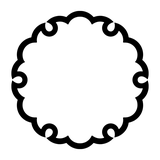
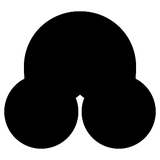
A suhama is an island-shaped sandbar built up at a river mouth, and the crest, also written 州浜, has three rounded lobes. It in fact derives from the suhama-dai, a celebratory stand modelled on that shape, and so became a crest for its auspicious meaning. Its first appearance as a crest is in the Taiheiki, among the Nitta forces surrounding Mount Hiei. Some 58 designs are recorded. The Shishido used the plain suhama and the Hita family the oni-suhama. For the Sanada, the six coins served mainly on battle flags while the bound wild goose and the suhama were used in other settings, and both were kept on as secondary crests.
FAMILIES
Associated with the Shishido clan, the Sanada clan (secondary crest; Sanada Masayuki, Nobuyuki and Yukimura), the Nagao clan, the Hita family, Yamamoto Kansuke, Oda Masaharu, and the Ki and Hatta clans
NOTES
58 variants recorded.
洲浜・丸に洲浜・鬼洲浜(日田家)・宍戸洲浜・光琳洲浜・朧洲浜・花洲浜・秋津洲浜・洲浜団子