
Ancient Egyptian symbols and their meanings
Egyptian symbols were words before they were ornaments. Each began as a hieroglyph, and worn on the body it became an amulet: a word that went on working for whoever carried it.
In hieroglyphic writing a picture could stand for a thing, for a sound, or for both. The ankh is written for ankh, “life”; the djed for djed, “stable.” So when an Egyptian hung an ankh at the throat, it was not a decoration with a meaning attached. It was the word itself, said over and over for as long as it was worn. The living wore amulets in faience, stone and gold; the dead were wrapped with dozens of them between the linen bands, and the Book of the Dead gives the spells to be spoken over some of them.
Here are the signs we draw for brass, in the order they appear on the Ancient Egypt page.
The ankh · life
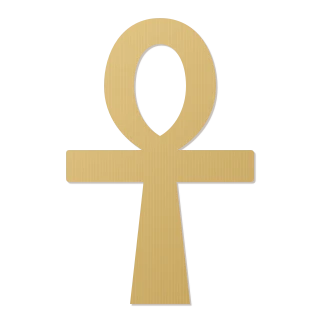
The most famous of all Egyptian signs is a cross with a loop for its upper arm. No one knows for certain what object it first pictured; the Egyptologist Alan Gardiner thought it was a sandal strap, and others have suggested a knot of cloth. Its meaning is clear, though. In temple and tomb reliefs the gods hold the ankh by its loop and offer it to the king’s nose: the breath of life, given by the gods. Mirrors, which held a person’s living image, were sometimes made in its shape.
The sign outlived the old religion. Egypt’s Christians, the Copts, took it up as a form of the cross, the crux ansata, and it appears on early Coptic textiles and stelae. Today it is the most widely worn Egyptian sign, a simple wish for life and health.
The eye of Horus · wholeness and protection
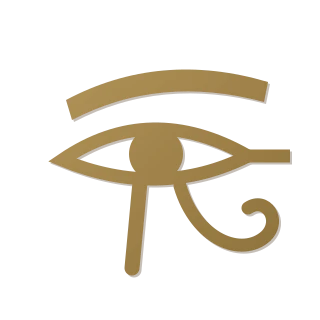
In the myth, the falcon god Horus lost his eye fighting his uncle Seth for the throne of Osiris, and it was made whole again, by Thoth or by Hathor in different tellings. Its name, wedjat, means “the sound one,” the eye restored. The marking below it is the cheek pattern of a falcon. It was one of the most common of all amulets, worn by the living for protection and laid with the dead for healing and rebirth, and it was painted on the prows of boats and the sides of coffins so that their owners could see out.
A popular modern idea holds that each part of the eye stood for a fraction, adding up to almost one; it first appeared in the early twentieth century, and most Egyptologists now doubt it. The eye’s own story is enough: something broken, made whole again.
The scarab · coming into being
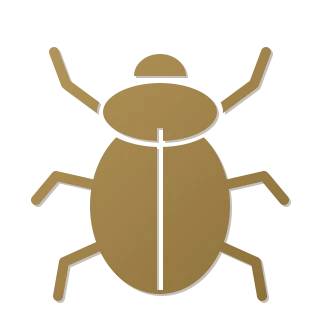
The dung beetle rolls a ball of dung across the ground, and the Egyptians saw in it the god Khepri rolling the sun across the sky each morning. The beetle’s name, kheper, was also the verb “to come into being,” so the scarab stood for creation, renewal and the rising sun. Scarabs carved from stone or moulded in faience were made by the hundred thousand, with names, titles and good wishes cut on their flat undersides, and were used as seals and charms. Amenhotep III issued large scarabs to announce events of his reign, among them his marriage to Queen Tiye and his lion hunts.
A larger heart scarab was laid on the chest of a mummy, carved with a spell from the Book of the Dead asking the heart not to speak against its owner at the judgement.
The djed and the knot of Isis
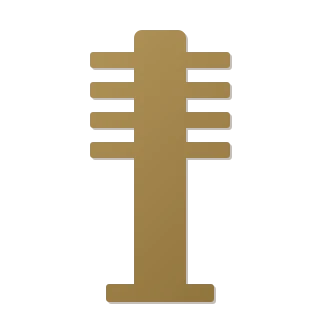
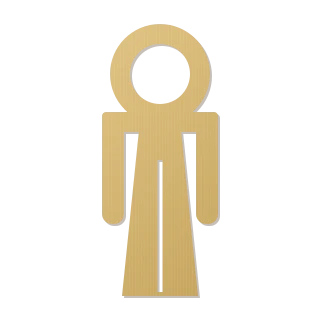
The djed is a column with four bars at its top, read as stability and endurance and, from the New Kingdom, as the backbone of Osiris. At a festival the king himself raised a djed pillar upright with ropes, a sign that Osiris and the kingdom would stand. The tyet, or knot of Isis, looks like an ankh with its arms hanging down, and was linked with the goddess and her protecting power. The two are often set side by side in friezes on temple walls, and the Book of the Dead gives a spell for each: a djed of gold and a tyet of red jasper, to be placed on the throat of the dead.
Signs of kingship
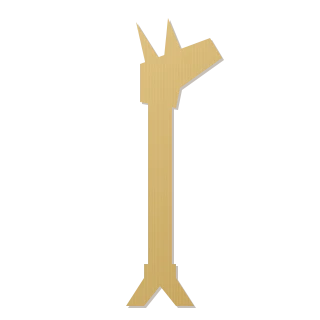
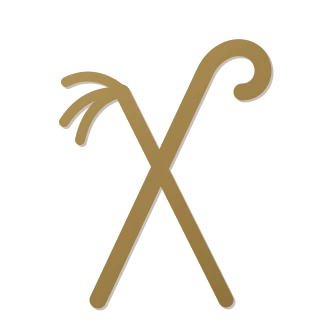
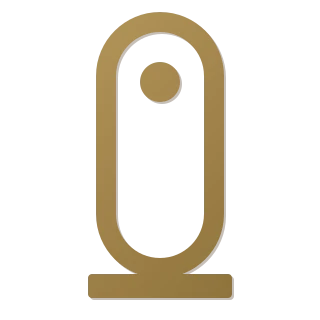
The was sceptre, a long staff with a forked foot and an animal’s head, meant power and dominion and is held by gods in countless reliefs. The crook and flail, held crossed over the chest by Osiris and by kings, were the shepherd’s tools: the ruler who guides his people and provides for them. Tutankhamun’s coffins show him holding them, and a real pair was found in his tomb.
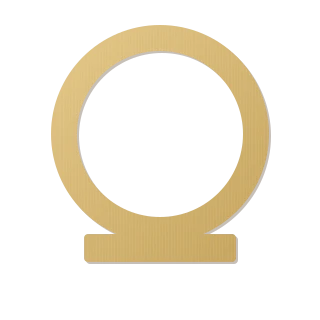
The shen ring is a loop of rope tied off at the bottom, with no beginning and no end, for eternity and protection; falcons and vultures hold it in their claws above the king. Stretched long enough to hold a name, it becomes the cartouche, drawn around the names of kings and queens to keep them safe for ever. The name is French: soldiers of Napoleon’s expedition thought it looked like a gun cartridge. A cartouche with your own name in hieroglyphs is one of the pieces we are most often asked to make.
The sun and the horizon
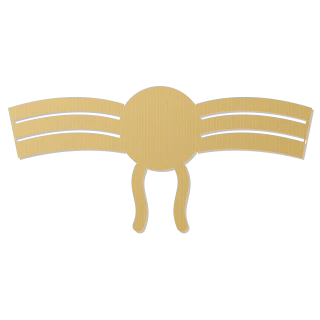
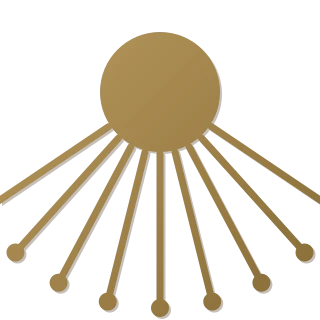
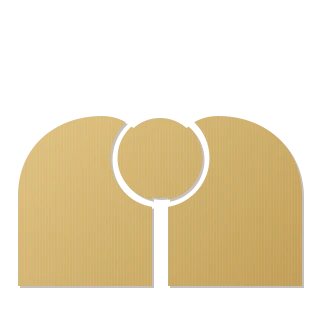
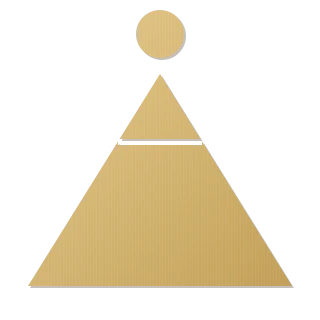
The winged sun disk spread over temple doorways and the tops of stelae is Horus of Behdet, the sun with a falcon’s wings and two cobras, guarding the way in. The Aten is the disk of the sun with its rays ending in small hands; around 1350 BC the king Akhenaten made it the one god of his reign, and in reliefs from his city the hands hold ankhs to the faces of the royal family. The horizon, the sun between two hills, was where it rose and set each day; the Great Sphinx was called Horemakhet, “Horus in the horizon.” The benben was the first mound of land to rise from the waters at creation, the shape remembered in the capstone of a pyramid and the tip of an obelisk.
Truth, the heart and the judgement
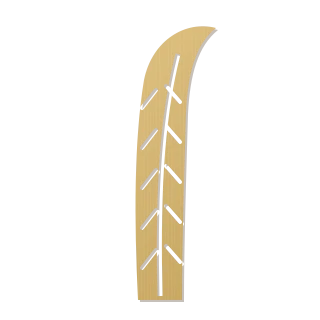
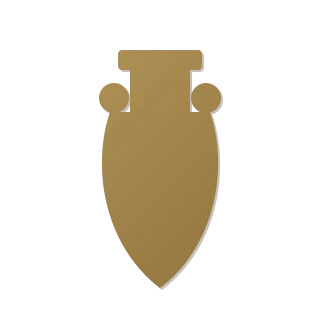
To the Egyptians the heart, not the brain, held thought, memory and conscience, and so it was left in the body when everything else was removed for mummification. In the judgement of the dead shown in the Book of the Dead, the heart was weighed on a scale against the feather of Maat, goddess of truth, justice and the right order of the world. A heart in balance with the feather passed on to the life to come; a heavy one was eaten by the monster Ammit. The feather and the heart together make a quiet sign of an honest life.
Gods and creatures
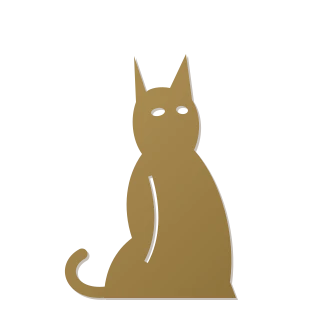
Bastet began as a lioness and became the cat: guardian of the home, of women and children. Her temple at Bubastis drew huge festivals, and the cats of her cult were mummified and buried in great cemeteries. The bee stood for Lower Egypt, and with the sedge of Upper Egypt it spelled one of the king’s titles; honey was food, medicine and an offering to the gods. The ouroboros, a serpent with its tail in its mouth, appears on a gilded shrine from the tomb of Tutankhamun, one of the earliest known, for the endless round of time.
Which sign to choose
- For health, or a new life: the ankh, or the heart.
- For protection: the eye of Horus, the most worn amulet of all.
- For a new beginning: the scarab, or the horizon with its rising sun.
- For strength through hard times: the djed.
- For a love of cats: Bastet.
- For your own name: a cartouche.
Every sign is drawn for our solid-brass round frame and made to order, in brushed brass or in antique bronze. Gold was the flesh of the Egyptian gods, a metal that never tarnished, and polished brass is the nearest everyday thing to it. See all twenty-one on the Ancient Egypt page, with thirteen more signs that are too fine to carve at brooch size.