
Samurai clan crests: the kamon of fifteen Sengoku warlords
In the Sengoku period (1467–1603) a crest on a banner told an army who was friend and who was foe. These are the crests of fifteen warlords whose names are still known to every Japanese schoolchild.
Warriors had carried crests on flags and armour since the Kamakura period, when every army flew white banners and needed another way to tell its men apart. In the Sengoku period, as retainers overthrew their lords, new crests multiplied. Many warlords used several at once: a main crest, secondary crests, crests granted by a superior, and banners with characters or symbols. Here is the crest each is best known by, with the others where they matter.
Oda Nobunaga · Oda mokkō
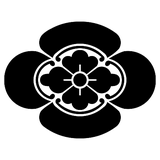

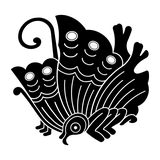
The five-lobed mokkō was the Oda family’s main crest. Despite the name (“quince”), the shape probably comes from a bird’s-nest pattern on Chinese silks, a wish for a prospering house. Nobunaga also used a butterfly as a secondary crest, a coin on his banners, and the paulownia granted to him by the shogun Ashikaga Yoshiaki. We make the Oda crest as the Oda Mokkō brooch.
Toyotomi Hideyoshi · Paulownia
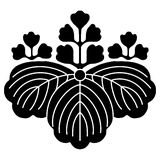
The paulownia was the tree on which the phoenix alights in Chinese legend, and a crest of the imperial house. It passed in a chain of grants from the emperor to the Ashikaga, to Nobunaga, and to Hideyoshi, who gave it freely to his own retainers. The gourd is linked to him as well. Today a paulownia is the emblem of the Japanese government. See our Go-san no Kiri brooch.
Tokugawa Ieyasu · Three hollyhock leaves
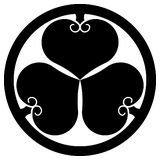
The aoi is the sacred plant of the Kamo shrines of Kyoto, and many warriors of Mikawa, Ieyasu’s home province, were parishioners of those shrines. The Tokugawa drew three leaves turned toward one another in a circle. In 1723 the shogunate restricted its use by other houses, which only made it more powerful as a sign. See the Maru ni Mitsuba Aoi brooch.
Takeda Shingen · Takeda diamonds

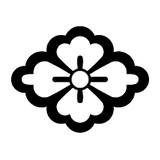
Four lozenges set together as one large diamond, the representative crest of the Yoshimitsu line of the Seiwa Genji, from which the Takeda descend. Tradition derives it from the split diamond on the sleeve of the family’s heirloom armour, Tatenashi. Shingen carried it beside his banner quoting Sun Tzu: swift as wind, quiet as forest, fierce as fire, unmoving as the mountain. The Takeda also used the flowered diamond. See the Takeda Bishi brooch.
Uesugi Kenshin · Bamboo and sparrows
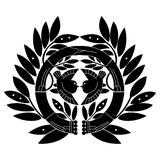

Two sparrows inside a ring of bamboo leaves. The design began with the Kajūji court house; the Uesugi took it up, and through them it reached the Date. On the battlefield Kenshin is remembered as much for his banner bearing the single character bi, for Bishamonten, the god of war he worshipped.
Date Masamune · Sendai bamboo

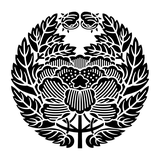
The Date of Sendai used a version of the bamboo-and-sparrow crest so distinctive that “Sendai zasa” is now a registered trademark. Masamune, the one-eyed dragon of the north, had several others as well, including the nine stars and the peony. The number of crests a lord could show was itself a mark of standing.
Sanada Yukimura · Six coins
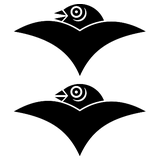
Six coins, the ferry fare across the Sanzu River to the next world in Buddhist belief: a crest that says its wearer is ready to die. The Sanada of Shinano also used wild geese. Yukimura’s last charge at Osaka in 1615, which reached Tokugawa Ieyasu’s own headquarters, made the six coins a byword for courage. See the Rokumonsen brooch.
Mōri Motonari · One stroke over three stars
The three stars are the belt of Orion, the “General’s Stars” linked to victory; the stroke above is the character for “one”. Motonari grew the Mōri from a small house in Aki into the masters of western Japan, and is remembered for his lesson of the three arrows. See the Ichimonji ni Mitsuboshi brooch.
The Shimazu · Cross in a circle

A cross in a ring, borne by the Shimazu of Satsuma since at least the Kamakura period, centuries before Christianity reached Japan. When Francis Xavier landed in Kagoshima in 1549 he is said to have been astonished to see it. It is still the emblem of Kagoshima City. Read more in our guide to hidden Christian crests.
Akechi Mitsuhide · Bellflower
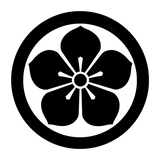
The five-pointed bellflower of the Toki clan of Mino and its branches. Mitsuhide is said to have carried a pale-blue bellflower on his banners when he turned on Nobunaga at Honnō-ji in 1582; he was defeated within two weeks. See the Akechi Kikyō brooch.
Ishida Mitsunari · Daiichi daiman daikichi
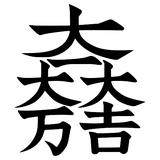
Not a picture but a motto: “great one, great ten thousand, great fortune”, usually explained as one for all and all for one, bringing good fortune to the realm. Mitsunari used it on his banner; he organised the western army that lost at Sekigahara in 1600.
Katō Kiyomasa · Snake’s eye

A plain ring within a ring, the snake’s eye, which also recalls a reel of spare bowstring. Kiyomasa, famous for his castle at Kumamoto and his tall helmet, used it alongside the bellflower.
Kuroda Kanbei · Wisteria tomoe
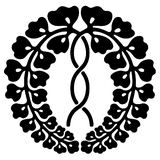

The Kuroda of Fukuoka used a wisteria curled into a tomoe, known as Kuroda fujidomoe. Kanbei, Hideyoshi’s strategist, is also associated with a moon over water.
The Hōjō · Three scales
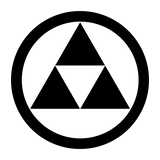
Three triangles stacked as scales. Legend says that when Hōjō Tokimasa prayed at Enoshima, the goddess Benzaiten turned into a serpent and left three scales behind. The Kamakura regents used it, and the Later Hōjō of Odawara took it up again in the Sengoku period.
Ii Naomasa · Tachibana and the well frame
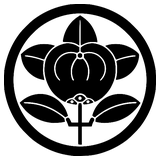

The Ii of Hikone are associated with the tachibana orange and the well frame: by tradition their founder was born beside a tachibana tree by a well. Naomasa’s troops in red-lacquered armour were known as the Red Devils. See the Maru ni Tachibana brooch.
Wearing a warlord’s crest
In Japan today, a warlord’s crest is worn by descendants, by people from the domain he ruled, and by anyone who admires him, much as people abroad wear a sports team’s emblem. Our Kamon Series includes most of the crests above, each with its history, and the Kamon Atlas lists nearly 250 more.