
How to find your Japanese family crest
Most Japanese families have a crest, and many people no longer know theirs. It is rarely lost, though. It is usually carved, dyed or painted on something the family still owns.
A kamon belongs to a household rather than to a surname, and there is no official register of them: the Japanese family register (koseki) records names, births and marriages, but not crests. So the search starts at home, with the objects a family keeps for funerals, weddings and the dead.
1. Look at the family grave
The single most reliable place is the family grave. Japanese graves are shared by the household, and the crest is usually carved into the stone, often near the top of the main stone, on the base, or on the water basin and lanterns in front. If you cannot visit, ask whoever tends the grave to send a photo. Older graves in Japanese cemeteries abroad, in Hawaii, California or Brazil, sometimes carry crests as well.
2. Find a formal black kimono
The most formal Japanese clothes carry the family crest in white: five crests on a man’s black montsuki or a woman’s black tomesode, one at the back of the neck, one on the back of each sleeve and two on the chest. Mourning kimono carry them too. If a grandparent married in kimono or kept mourning clothes, the crest is on them. Our guide to kimono crests explains where to look.
One caution: rental and ready-made kimono are often sold with a general-purpose crest such as the paulownia so that anyone can wear them. A paulownia on a kimono does not prove it is your family’s crest.
3. Check the altar, the lanterns and old photographs
The household Buddhist altar (butsudan) and its fittings, the paper lanterns brought out for Obon, lacquer boxes and trays, wedding gifts and wrapping cloths (furoshiki) often carry the crest. So do old photographs: zoom in on the chest of anyone wearing formal kimono at a wedding or funeral.
4. Ask the right relatives
The crest normally passes down the main line of the family, so the relatives who keep the grave and the altar are the ones most likely to know it. Branch families sometimes use a variant: the same motif in a different frame, or drawn in outline instead of solid.
In some regions, especially western Japan, women traditionally wore a crest inherited from their mother’s side (onna-mon, “women’s crest”). A grandmother’s kimono may therefore carry a different crest from the family grave. Both are part of your family’s history.
5. Ask the family temple
The temple that holds the family grave (bodaiji) often knows the families in its care. If you live outside Japan and know where your family came from, the koseki gives the registered home address (honseki); direct descendants can request copies from the town office, and from the town you can usually find the temple.
Why your surname alone won’t tell you
Websites that match surnames to crests can only give you the crest most often associated with a name. One surname may be used with dozens of crests, and one crest by hundreds of surnames. The wisteria is the emblem of the Fujiwara, but about 170 samurai houses of the Edo period used it, many simply to claim the connection. Treat a surname match as a lead, not an answer.
Identifying a crest from a photo
Once you have a photo, read the crest the way a crest name is built: frame, arrangement, motif. Is the motif enclosed in a ring (maru ni, “in a circle”)? Is it one motif, two crossed, or three in a mound? Is it drawn solid or in outline? Then name the motif itself: a plant, an animal, an object, a pattern or a character. Our page on how to read a crest name shows each step with drawings.
If you have to guess, start with the crests most families use. In Takasawa Hitoshi’s count of household shares, these ten come first:
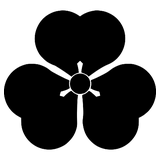
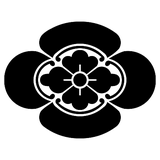
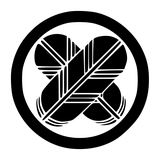
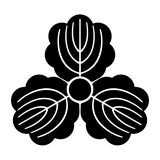
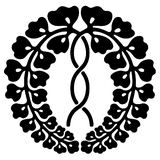
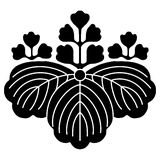
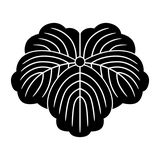
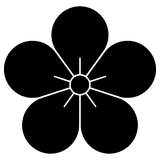
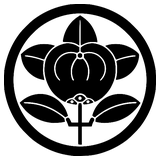
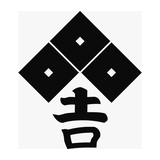
From there, search the Kamon Atlas by motif. It lists nearly 250 crests with their meaning and the families associated with them. If you are still unsure, email us the photo and we will help you narrow it down.
If no one remembers
Sometimes the crest really is gone: the grave was moved, the kimono sold, the last person who knew has died. That is less of a break with tradition than it sounds. Many families only settled on a crest in the Meiji era, when every household had to register a surname, and they chose one they liked. You can do the same: choose a crest from your family’s region, one tied to your family’s temple or shrine, or a motif whose meaning speaks to you, and start wearing it.
Whichever crest you find or choose, we can make it in solid brass. Look through the Kamon Series, or send us your crest for a custom brooch.