
Hidden crosses: Christian crests in Japanese family kamon
For about ninety years in the sixteenth and seventeenth centuries, the cross was an open part of Japanese heraldry. For the two and a half centuries after that, it survived inside other crests.
The cross that was already there

When Francis Xavier landed at Kagoshima in 1549, the ruling Shimazu family already bore a white cross in a circle as their crest. Xavier is said to have been astonished. The Shimazu cross had nothing to do with Christianity: the oldest surviving example is on the armour of Shimazu Tadahisa in the early Kamakura period, three centuries before any missionary arrived, and its origin is variously explained as two dragons, a pair of chopsticks or a charm against evil. But it is a reminder that a cross in a circle was a familiar shape in Japan from the start.
The Christian century
Within a generation of Xavier’s arrival, Christianity had spread from Kyushu to Kyoto. Several warlords were baptised: Ōmura Sumitada in 1563, the first of them; Ōtomo Sōrin of Bungo; Arima Harunobu; Konishi Yukinaga; and Takayama Ukon, who would later choose exile in Manila rather than give up his faith. Their retainers and their peasants often followed.
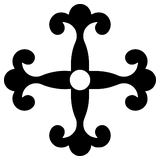
Some families put the cross itself into their crest. It was called kurusu, from the Portuguese cruz, and appears in many forms: a plain cross, a flowered cross, crosses grouped in threes. The kurusu crests were especially common in Settsu, the province around Osaka, and are associated with the Nakagawa, Uchida, Ikeda and Tachibana families.
The ban
In 1587 Toyotomi Hideyoshi ordered the missionaries out of Japan. The Tokugawa banned Christianity outright in 1614, and after the Shimabara Rebellion of 1637–38, a revolt of largely Christian peasants, the ban was enforced with full severity. In Nagasaki and other regions people were made each year to step on a sacred image (fumie) to prove they were not Christian, and every household had to register with a Buddhist temple.
A family crest could not simply be dropped: it was on the graves, the clothes, the household goods. So crosses were renamed and redrawn as something else. The St Andrew’s cross became the Gion mamori, the cross pattée the Nakagawa kurusu, the flowered cross the “flowered horse’s bit”, the Maltese cross the “arrow-notch cross”. After Shimabara, cross-shaped crests in general were renamed “horse’s bit” (kutsuwa) or “character ten” (jū no ji) crests.
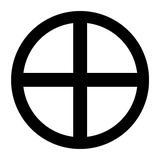
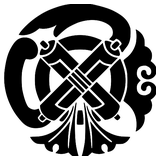
The horse’s bit was a natural cover: it really was drawn as a cross within a ring, and it stood for martial spirit. The Gion mamori was an amulet of the god Gozu Tennō, protector against epidemics; its crossed centre let it pass for a charm at a Shinto shrine. Konishi Yukinaga is among those associated with it.
Two hundred and fifty years in hiding
In villages around Nagasaki and on the islands of the Gotō archipelago, families kept their faith in secret, passing prayers down by memory and praying before statues of the Buddhist goddess Kannon that they understood as the Virgin Mary. In 1865, soon after a church was built for foreigners at Ōura in Nagasaki, a group of villagers came to tell the French priest that they shared his faith. The notices banning Christianity were taken down in 1873. Some communities stayed apart even then, keeping the faith in the form their ancestors had handed down, and in 2018 the Hidden Christian Sites in the Nagasaki Region were listed as World Heritage.
Is my family crest a hidden cross?
Probably not, and a crest alone cannot tell you. Most horse’s-bit and cross crests have no Christian history at all; the Shimazu cross, the most famous of them, is older than Christianity in Japan. If your family comes from Nagasaki, the Gotō islands, Amakusa or another region where hidden Christians lived, the family’s own stories and its temple records will tell you more than the shape of the crest.
A cross in the kamon circle today
This history is why our Sacred Series sets Christian symbols in the same round brass frame as Japanese family crests. A cross inside a kamon circle is not a modern fusion; Japanese Christians wore one four hundred years ago. If your family has its own Christian crest, or a crest it kept through the years of the ban, we can make it in brass.