
The Egyptian gods and their sacred animals
A falcon’s head on a man’s body is not a monster. It is a way of saying what a god is like: swift and high-seeing, or watchful in the dark, or fierce in defence of its own.
The Egyptians could show the same god as an animal, as a person, or as a person with an animal’s head, sometimes on a single wall. The animal was not the god itself but one of its forms: a picture of a quality the god had and the creature shared. The falcon flies higher than any other bird and sees everything below; the jackal prowls the edge of the desert, where the cemeteries were; the cat keeps snakes and mice from the granary. Choosing an animal was choosing a character.
In the last centuries before Christ this grew into vast animal cults. Pilgrims paid for animals to be mummified and buried as offerings to their god, and the catacombs at Saqqara and Tuna el-Gebel hold millions of mummified ibises, falcons, cats and dogs. A single bull, the Apis, was chosen at Memphis as the living image of the god Ptah, and buried at his death in a great stone coffin in the galleries of the Serapeum.
Horus · the falcon
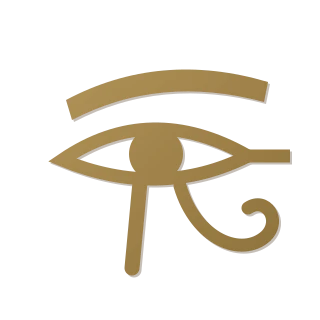
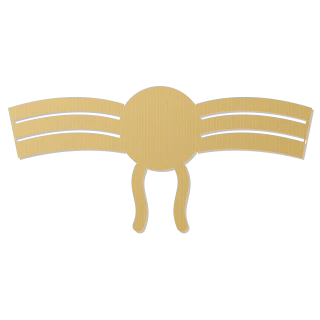
Horus was the sky, his eyes the sun and the moon. As the son of Osiris and Isis he fought his uncle Seth for his father’s throne and won it, and so every king of Egypt ruled as “the living Horus.” His wounded eye, made whole again, became the wedjat, the most worn of all amulets, and as the winged sun disk he spreads his wings over temple doorways. His great temple stands at Edfu, where a granite falcon wearing the double crown still guards the gate.
Anubis · the jackal
Jackals and wild dogs haunted the desert cemeteries, and the Egyptians made one of them the guardian of the dead. Anubis presided over embalming, and priests who wrapped the body may have worn his mask. He is painted black, not as a jackal is but as the fertile silt of the Nile is, and as the embalmed body became: the colour of rebirth. In the Book of the Dead he leads the dead to the scale and checks the balance as the heart is weighed against the feather of Maat. Our Anubis pin shows his head in profile.
Bastet and Sekhmet · the cat and the lioness
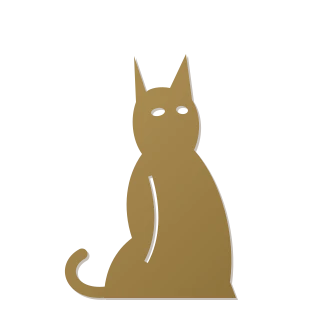
Bastet began as a lioness and over the centuries became a cat: the guardian of the home, of women, of children and of joy. Her city, Bubastis in the Delta, held one of the great festivals of Egypt; Herodotus, visiting in the fifth century BC, wrote of boats crowded with singing pilgrims and of more wine drunk in those days than in all the rest of the year. Cats sacred to her were mummified and buried there by the thousand.
Her fierce sister is Sekhmet, the lioness, “the powerful one,” whose breath was the hot desert wind. Sent out by the sun god to punish humankind, she could also turn plague away, and her priests were physicians. King Amenhotep III set up hundreds of granite statues of her at Thebes, and many are now in the museums of the world. See our Bastet pin and the Anubis and Bastet medallion.
Thoth · the ibis and the baboon
Thoth, the god of writing, of reckoning and of the moon, appears as an ibis with its long curved beak, or as a seated baboon. He invented hieroglyphs, kept the records of the gods and wrote down the verdict when a heart was weighed, and scribes are said to have poured a drop from their water pot for him before they began to write. His city was Hermopolis, and its burial ground at Tuna el-Gebel is one of the places where the mummified ibises lie in their millions.
Khepri · the scarab
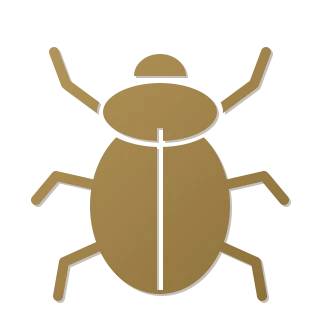
The dung beetle rolls its ball across the ground, and the Egyptians saw the god Khepri rolling the sun into the sky each morning. His name comes from kheper, “to come into being,” and the scarab became the most common amulet and seal of Egypt: a sign of every new beginning.
Wadjet and Nekhbet · the cobra and the vulture
Two goddesses guarded the king. Wadjet, the cobra of Lower Egypt, rears on his brow as the uraeus, ready to spit fire at his enemies; Nekhbet, the vulture of Upper Egypt, spreads her wings over him. Together they were the “Two Ladies,” and on Tutankhamun’s gold mask they sit side by side above his forehead. Both are too fine to carve at brooch size, though two cobras hang from the sun of our winged sun disk.
Hathor, Sobek and the gods of the home
Hathor, shown as a cow, as a woman with cow’s ears, or wearing a sun disk between horns, was the goddess of love, music and motherhood; her temple at Dendera is among the best preserved in Egypt, and her rattle, the sistrum, was shaken in her honour. Sobek the crocodile ruled the river and the marshes of the Fayum, and live crocodiles were kept and fed in his temples at Kom Ombo and Crocodilopolis. In ordinary houses two humbler figures did the work of protection: Taweret, a pregnant hippopotamus goddess who watched over childbirth, and Bes, a lion-maned dwarf who scared off snakes and bad dreams.
Which to wear
- For protection: the eye of Horus.
- For a love of cats, or for a home: Bastet.
- In memory of someone: Anubis, who guides the dead, or the feather of Maat.
- For a writer, a student or a scholar: Thoth would be the god; his ibis is too fine for brass, so many choose the cartouche or the scarab instead.
- For a new start: the scarab of Khepri.
The signs on our Ancient Egypt page are drawn for the solid-brass round frame and made to order. The full figures of the gods, the falcon, the ibis, the cobra and the vulture, are too detailed to read at brooch size, so we list them there among the signs we do not carve; our enamel pins carry Anubis and Bastet instead.