
Christian symbols and their meanings
Long before churches had steeples, Christians marked their faith with a few simple signs. Ten of them are still worn today, and each has a story, most of them beginning in the first centuries of the Church.
For its first three centuries Christianity was often a persecuted faith, and its earliest symbols were chosen to be understood by believers and overlooked by everyone else: a fish, an anchor, a pair of Greek letters. The cross itself, the sign of a Roman execution, came into open use only later. Here are the ten symbols of our Sacred Series, in roughly the order the Church took them up.
The anchor · hope
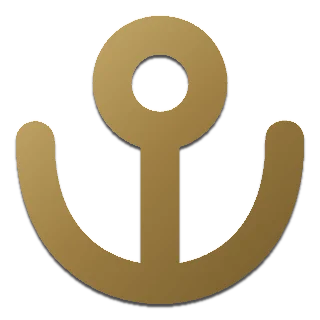
“Which hope we have as an anchor of the soul, both sure and stedfast” (Hebrews 6:19). The anchor is one of the oldest Christian symbols. It is carved on tombs in the Roman catacombs from the second and third centuries, often beside a fish, and its crossbar let believers show a cross without seeming to. Around the year 200, Clement of Alexandria advised Christians that a dove, a fish, a ship, a lyre or an anchor were fitting images for a signet ring.
Today the anchor stands for hope that holds in hard times. Sailors and naval families choose it, as do churches by the sea, and it is a common gift for someone going through illness or loss.
The ichthys · the fish
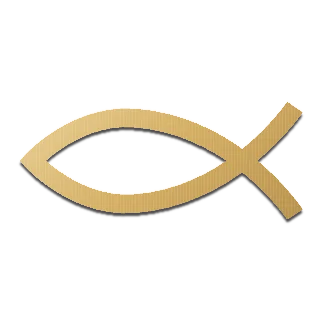
The Greek word for fish, ΙΧΘΥΣ (ichthys), spells out the initials of Iēsous Christos Theou Hyios Sōtēr: “Jesus Christ, Son of God, Saviour.” The fish also recalled the Gospels, from the disciples who were fishermen to the feeding of the five thousand. The North African writer Tertullian, around 200, called Christians “little fishes” born in the water of baptism. A familiar story says that one believer would draw a single arc in the dust and a stranger who completed the fish showed himself a fellow Christian; it is a tradition rather than a recorded fact, but it captures how the sign was used.
Today the two-arc fish is best known from its revival in the 1970s, when it became one of the most recognisable signs of evangelical faith.
The Chi-Rho · the name of Christ
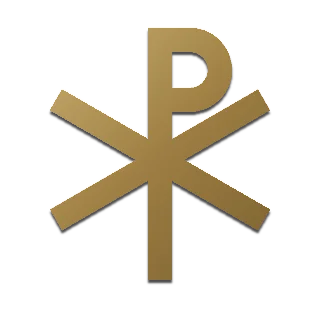
The Greek letters Χ (chi) and Ρ (rho) are the first two letters of ΧΡΙΣΤΟΣ, Christos, laid over one another. Before the Battle of the Milvian Bridge in 312, the emperor Constantine is said to have had the sign put on his soldiers’ shields; after his victory it appeared on his standard, the labarum, and on Roman coins, sarcophagi and mosaics. It is often flanked by alpha and omega, “the beginning and the ending” (Revelation 1:8).
Today it appears on altar cloths, vestments and church doors, especially at Christmas and Easter. The X in “Xmas” is the same Greek chi, an abbreviation for Christ used by scribes for centuries, not a way of leaving Christ out.
Alpha and Omega · the beginning and the end
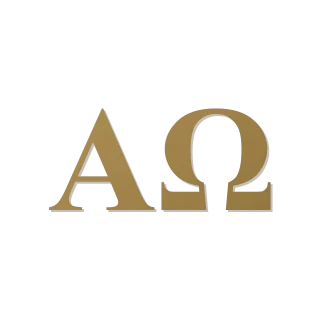
“I am Alpha and Omega, the beginning and the end, the first and the last” (Revelation 22:13). Alpha and omega are the first and last letters of the Greek alphabet, and in the Book of Revelation God, and then Christ, take them as a title. In the catacombs and on early Christian tombs the two letters hang from the arms of the Chi-Rho, and in the fourth century the same pairing appears on Roman coins.
Today the priest traces them on the new Paschal candle at the Easter Vigil, beside the cross and the numbers of the year. They are chosen for memorials and funerals, and for baptisms at Easter, when that candle is first lit.
The cross · the empty Latin cross
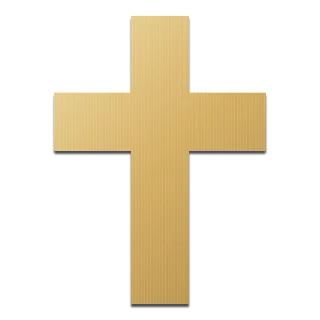
The cross only became the central Christian symbol after the faith was legal: among the earliest surviving images of the Crucifixion is a small panel on the wooden doors of Santa Sabina in Rome, carved around 430. The Latin cross, with its longer lower arm, is traditionally taken as the shape of the cross on which Jesus died. A crucifix shows the body of Christ upon it and is the usual form in Catholic and Orthodox churches; the plain, empty cross, the usual form in most Protestant churches, points to the Resurrection, the work finished and the tomb empty.
Today it is the one symbol every Christian tradition shares, which makes it the simplest gift for a baptism or a confirmation whatever a family’s church.
The dove · the Holy Spirit
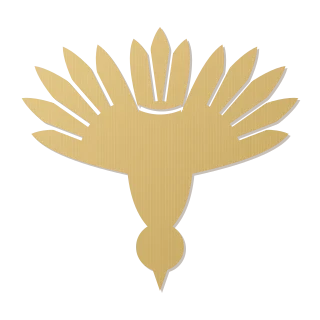
All four Gospels tell how, when Jesus was baptised in the Jordan, the Spirit of God came down upon him like a dove: “And the Holy Ghost descended in a bodily shape like a dove upon him” (Luke 3:22). From then on the descending dove, head down and wings raised, has stood for the Holy Spirit. It is painted over baptismal fonts, and in Bernini’s window above the Chair of Saint Peter in Rome it shines at the centre of a burst of golden rays.
Today it is the sign of confirmation and of Pentecost, and many Pentecostal and charismatic churches take it as their emblem. A dove with an olive branch is a different bird, the one Noah sent out from the ark, and a sign of peace.
The Trinity knot · three in one
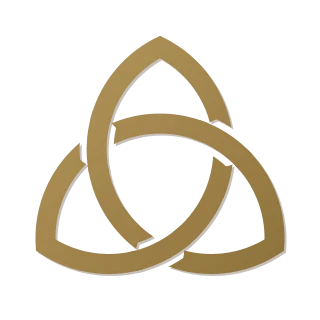
The triquetra, “three-cornered,” is three pointed loops drawn as one unbroken line. The knot is older than its Christian meaning: it is found in Germanic and Celtic art before the conversion. In the Christian art of Ireland and Northumbria it became part of the interlace that fills books such as the Book of Kells, made around 800, and in time it was read as the Trinity: three Persons who are one God, as three loops are one line.
Today it is above all an Irish and Scottish sign, beloved since the Celtic revival of the nineteenth century. It is often chosen for weddings, and by families with Irish roots.
The IHS · the name of Jesus
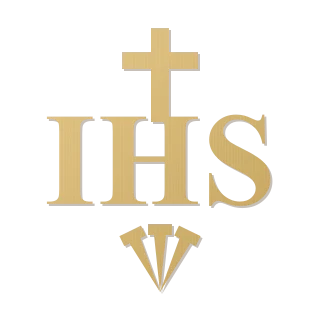
IHS is the name of Jesus in Greek, ΙΗΣΟΥΣ, shortened to its first three letters, iota, eta and sigma, and written in Latin letters. Scribes used it as an abbreviation from early on. In the fifteenth century the Franciscan preacher Bernardino of Siena made it a devotion, holding up a board painted with IHS in a golden sun, and when Ignatius of Loyola founded the Society of Jesus in 1540 he put the letters on its seal, with a cross rising from the H and three nails beneath. Later the letters were read as Iesus Hominum Salvator, “Jesus, Saviour of mankind,” but that is a reading, not where they came from.
Today the IHS is carved on altars, chalices and church doors, and it is the mark of Jesuit schools and parishes around the world.
The Luther rose · the seal of the Reformation
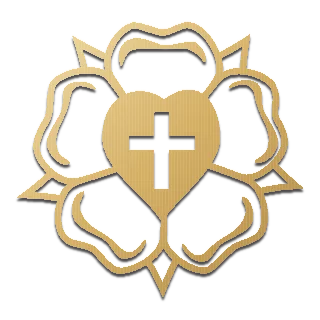
In 1530 Martin Luther was given a seal with this design, and in a letter that July to his friend Lazarus Spengler he explained each part of it. The black cross stands for faith in the crucified Christ; it sits in a red heart, because faith comes from the heart. The heart rests on a white rose, for the joy, comfort and peace that faith gives, white because that is the colour of spirits and angels. Around it is a sky-blue field, the joy of heaven to come, and around that a golden ring, because that joy has no end and is more precious than anything.
Today it is the emblem of Lutheran churches around the world, worn especially on Reformation Day, 31 October, the anniversary of Luther’s Ninety-five Theses in 1517, and at Lutheran confirmations. In brass it is carved in a single colour, so the cross, heart, rose and ring are read by their shapes.
The Marian cross · Mary at the cross
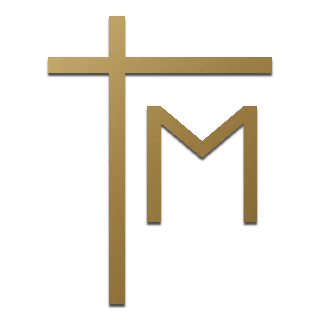
A cross with the letter M beneath one arm recalls Mary standing at the foot of the cross, where Jesus entrusted his mother to the beloved disciple (John 19:25–27). A cross over an M is also on the back of the Miraculous Medal, made after the visions of Catherine Labouré in Paris in 1830. Pope John Paul II placed the Marian cross on his coat of arms in 1978 with the motto Totus Tuus, “totally yours”, his dedication to Mary.
Today it is chosen mainly by Catholics, often for a first communion or a confirmation, and by those with a devotion to Mary.
Scripture verses
Alongside the ten symbols we make verse brooches with no image at all, only a reference carved in raised letters: John 3:16, Philippians 4:13, Jeremiah 29:11 and Isaiah 40:31. A reference is the quietest sign of the lot, readable only by someone who knows the verse.
Which symbol to give
- Baptism or christening: the empty cross, for any tradition; the anchor, for hope for a whole life.
- First communion or confirmation: the dove, the sign of the Spirit given at confirmation; the Marian cross or the IHS in Catholic families, the Luther rose for Lutheran confirmands, the cross or the Chi-Rho for any church.
- Ordination or a church anniversary: the Chi-Rho or the IHS, or your church’s own emblem made for the whole congregation.
- A wedding: the Trinity knot, three loops in one line.
- A memorial: the Alpha and Omega, the beginning and the end, or the anchor.
- Hard times: the anchor, or a verse such as Isaiah 40:31.
- Every day: the ichthys or a verse, for something quiet and personal.
Why in a Japanese crest frame?
All ten are set in the same round brass frame as our Japanese family crests. That is not as unlikely a pairing as it looks: four hundred years ago Japanese Christian families carried the cross in their own crests, and kept it there in disguise through two and a half centuries of persecution. Read that story in Hidden crosses: Christian crests in Japanese family kamon, see the whole Sacred Series, or send us your church’s emblem for a custom brooch.