
Shrine and temple crests: the kamon of Japan’s gods and Buddhist schools
Families are not the only ones with crests. Japanese shrines have their own (shinmon, “god crests”), and so do Buddhist temples and whole schools of Buddhism (jimon, “temple crests”). Many family crests began as one or the other.
Look around any shrine or temple in Japan and the crest is everywhere: on the lanterns, the curtains hung across the gate, the offering box, the roof tiles, the paper charms and the robes of the priests. A shrine crest stands for the god enshrined there; a temple crest for the temple, its founder or its school. And because families took crests from the shrines they worshipped at, and shrines from the families that founded them, the same designs pass back and forth between the two.
Where shrine crests come from
Most shrine crests come from one of three places:
- Something sacred to the god. A tree, a plant or an offering tied to the deity or to the shrine’s own rites: the hollyhock of the Kamo shrines, the kaji leaf of Suwa, the cedar of Ōmiwa, the rice of Inari.
- The family behind the shrine. A clan’s guardian shrine often bore the clan’s crest, as the Fujiwara wisteria marks the Kasuga shrines.
- A grant from the court. Shrines with close imperial ties may show the chrysanthemum, which edicts of 1869 and 1871 otherwise reserved for the imperial family.
Hachiman shrines · Tomoe

Hachiman, god of war and archery and the guardian of the Minamoto, takes the three-comma tomoe as his crest. Its origin is debated: the leather guard (tomo) worn on an archer’s arm, a curved magatama bead, the thunder god’s drum, or a swirl of water, which is why it was painted on eave tiles from the late Heian period to ward off fire. With Hachiman shrines in almost every town, and warriors devoted to him, it became one of the most common crests of all. See our Mitsudomoe brooch.
Tenmangū shrines · Plum blossom
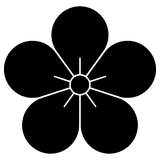
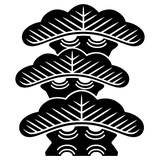
The scholar and statesman Sugawara no Michizane loved the plum. After his death in exile in 903 he was worshipped as Tenjin, god of learning, and the plum became the crest of his shrines, each in its own version: Kitano Tenmangū in Kyoto uses the star plum (hoshi umebachi), Dazaifu the plum flower, Yushima Tenjin in Tokyo the plum “drumstick” (umebachi). Kitano also uses the pine, after a tradition that a thousand pines sprang up there in a single night. Students still visit Tenmangū shrines before their exams.
The Kamo shrines · Hollyhock
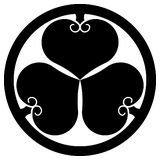
The two-leaved futaba aoi is the sacred plant of the Kamigamo and Shimogamo shrines in Kyoto, worn by the whole procession in their Aoi Festival every May. Many warriors of Mikawa were parishioners of these shrines, the Tokugawa among them, and that is how a shrine’s plant became the most powerful family crest of the Edo period. See the hollyhock in the Atlas.
Kasuga shrines · Wisteria
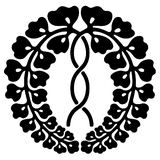
Kasuga Taisha in Nara was the guardian shrine of the Fujiwara, and their wisteria is its crest. The Fujiwara’s family temple, Kōfuku-ji, stands beside it and uses the peony, the crest of the Konoe, first of the Fujiwara regent houses.
Suwa Taisha · Kaji leaf
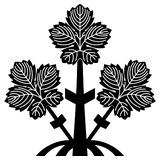
The leaf of the paper mulberry (kaji) was used in offerings to the gods, and it is the sacred crest of Suwa Taisha in Nagano and of Suwa shrines across Japan. The two halves of the shrine draw it differently: the Upper Shrine’s leaf has four roots, the Lower Shrine’s five. See the kaji leaf.
Yasaka Shrine · Mokkō
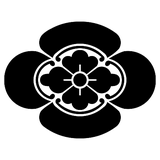
Yasaka Shrine in Kyoto, home of the Gion Festival, uses the mokkō, the same five-lobed shape as the Oda crest. Because a sliced cucumber looks like it, people in some areas avoid eating cucumbers during the Gion festival. The shrine’s charm against epidemics gave rise to its own crest, the Gion mamori.
Izumo, Inari, Aso and Ōmiwa

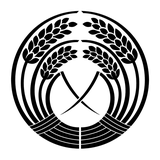

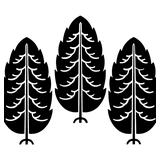
Izumo Taisha uses the tortoise shell, a hexagon valued for the tortoise’s long life. Fushimi Inari Taisha, head of the thirty thousand Inari shrines, uses bound sheaves of rice, the offering to its god of harvests; rice sheaves were also the crest of the Hozumi, priests of Kumano. The Aso Shrine in Kyushu uses crossed hawk feathers, which by a legend in the chronicle Hokuhi Senshi was granted in a dream at the shrine. At Ōmiwa Shrine in Nara the mountain itself is worshipped and its sacred cedar is the crest, which is why sake brewers, who hang a ball of cedar outside their doors, took it up too.
The crests of the Buddhist schools
Temple crests work the same way. Some come from a school’s founder or from the family that supported it, some from a symbol of the faith.
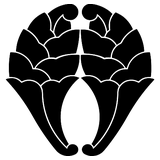
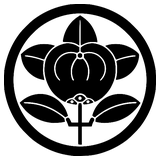

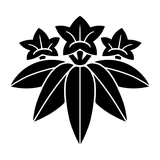
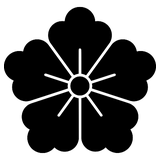
- Jōdo (Pure Land) school: the gyōyō, an apricot-leaf ornament once used exclusively by the Ōtomo, from whose line Hōnen, the school’s founder, is by tradition descended. The school is also associated with the hollyhock.
- Jōdo Shinshū: the Hongan-ji temples use a wisteria, the Hongan-ji fuji, and Higashi Hongan-ji also uses the peony.
- Nichiren school: a tachibana inside a well frame (igeta ni tachibana), and a coiled dragon.
- Tendai school: the chrysanthemum in its Santaishō form, and the myōga, symbol of the guardian god Matarajin. Tendai and Shingon temples also use the dharma wheel (rinbō).
- Sōtō Zen: the Koga gentian, the crest of the Koga family into which Dōgen, the school’s founder, is by tradition said to have been born.
- Ji school: the character three on a ceremonial tray, crest of the Kōno family of the founder Ippen. See the two and three crests.
- Single temples: Daitoku-ji in Kyoto uses the karahana, Zenkō-ji in Nagano the standing hollyhock, Tō-ji in Kyoto a cloud.
The manji

The manji 卍 is an ancient Buddhist sign of good fortune, the oldest Japanese example being on the main Buddha of Yakushi-ji in Nara. It still marks temples on Japanese maps. As a family crest it was borne by the Hachisuka, Tsugaru and other daimyō houses. It has nothing to do with the twentieth-century European swastika, though visitors from abroad sometimes mistake it for one; Japanese maps for foreign visitors now often use a pagoda symbol instead.
Can I wear a shrine or temple crest?
Yes. Many Japanese families use a crest that is also a shrine’s or a temple’s, because their ancestors were its parishioners or followers; there is nothing presumptuous in it. The only crest Japanese law ever restricted was the sixteen-petal imperial chrysanthemum, and families have long used other chrysanthemum designs. If you feel close to a particular shrine or temple, or your family has followed a school of Buddhism for generations, its crest is a natural choice for a brooch.
Find any of these crests in the Kamon Atlas, choose from the Kamon Series, or send us a shrine, temple or church emblem for a custom brooch. Christian crests have a guide of their own: hidden crosses in Japanese kamon.