
Kimono crests explained: five, three and one-crest montsuki
A kimono with the family crest on it is called montsuki, “crest-bearing”. The number of crests, and the way they are made, tell you how formal it is.
Where the crests go
Crests are placed in fixed positions, always in the same order of importance:
- The back (se-mon): centred just below the collar. Every montsuki has this one.
- The sleeves (sode-mon): one on the back of each sleeve.
- The chest (mune-mon): one on each side of the front, just below the collarbone.
Five crests (itsutsu-mon) use all five positions and are the most formal. Three crests (mitsu-mon) use the back and the two sleeves. One crest (hitotsu-mon) uses the back only. More crests mean more formality, and a kimono cannot be made more formal later without having crests added.
Which kimono carry crests
For men, the most formal dress in Japan is the black montsuki with five crests, worn with a haori jacket (which carries the crests) and striped hakama. It is what a groom wears at a traditional wedding, and what men wear at the most formal ceremonies.
For women, the black kurotomesode, with five crests and a pattern only below the waist, is worn by the mothers and close relatives of the bride and groom. A coloured irotomesode may have five, three or one crest. A visiting kimono (hōmongi) or a single-colour iromuji is made semi-formal by adding a single crest. Black mourning kimono (mofuku) carry five crests.
So when you see a family photo of a wedding or a funeral, the crest is there to be read, on the chest of the people dressed most formally.
Dyed, painted or embroidered
How a crest is made matters as much as how many there are.
- Dyed-in crests (somenuki-mon): the crest is left white when the cloth is dyed, so it shows as pure white on black. This is the most formal.
- Painted crests (kaki-mon): drawn onto the cloth afterwards, often used when a crest is added to an existing kimono.
- Embroidered crests (nui-mon): stitched in silk thread, softer and less formal. Decorative embroidered crests, sometimes not family crests at all, are called share-mon, “fashion crests”, and are worn for pleasure rather than ceremony.
The way the crest is drawn follows the same rule. A solid crest (hinata) is the most formal; a crest drawn in outline (kage) is less so. Our page on how to read a crest name shows the difference.
How big is a kimono crest?
Traditionally about 3.8 cm across for men (one sun, the old Japanese inch) and about 2 cm for women. That is why our brooches come in Ø20, Ø25 and Ø30 mm: the small size matches a woman’s kimono crest, the large one comes close to a man’s.
Crests on rented and ready-made kimono
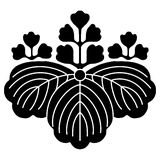
Kimono for rent, or sold ready-made, are often given a general-purpose crest (tsūyō-mon) so that anyone can wear them. The five-three paulownia is the most common choice. It is perfectly correct to wear, but it is not a family crest. If you own a kimono and want your own crest on it, a kimono shop can have a crest painted or dyed over the old one.
Women’s crests
In some regions, especially western Japan, a woman traditionally wore a crest from her mother’s side, the onna-mon, rather than her husband’s or father’s. It was often the same motif drawn more delicately, or without its frame. A woman’s kimono can therefore carry a different crest from the family grave, which is worth knowing if you are looking for your family crest.
A crest without the kimono
A brass crest brooch sits where the chest crest (mune-mon) sits on a montsuki: at the left of the chest or on the collar. It carries the same signal on a coat, a jacket or a dress. Choose one from the Kamon Series, or have your own family crest made in brass.