
Sacred symbols of the world’s faiths
Every faith has signs it holds sacred, and some are older than the faiths that keep them. These eight are among the most widely worn today, and each comes with its own history and its own customs.
A sacred sign does two things at once. It says something about the world, as the lotus says that purity can rise out of mud, and it says something about the person wearing it: this is what I hold to. That second meaning is why customs grow up around wearing them, and why it is worth knowing a sign’s story before choosing one. The Christian symbols have a guide of their own; this one covers the eight signs of other traditions that we draw for brass.
The lotus · Buddhism and Hinduism
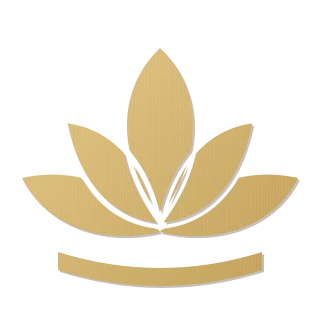
The lotus roots in the mud at the bottom of a pond and opens its flower clean above the water, and that single fact has made it the flower of the spiritual life across Asia. In Hindu art the gods sit or stand on lotuses: Lakshmi, goddess of fortune, holds one in each hand, and Brahma, the creator, is born on a lotus that grows from the navel of Vishnu. In Buddhism it stands for the mind that rises through suffering to awakening without being stained by it. The Buddha sits on an open lotus, the Lotus Sutra takes its name from the flower, and in Japan almost every temple image stands on a lotus pedestal.
Today it is the national flower of India, and it is worn widely, by Buddhists and Hindus and by many who meditate, as a sign of a new beginning after a hard time.
The dharma wheel · Buddhism
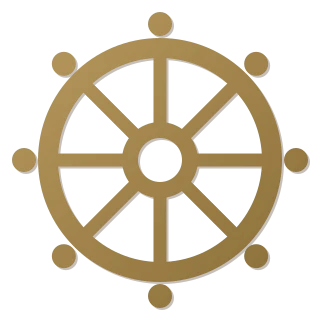
The dharmachakra, “wheel of the teaching,” stands for the Buddha’s first sermon, given in the Deer Park near Sarnath and called the first turning of the wheel. Its eight spokes are the Noble Eightfold Path: right view, intention, speech, action, livelihood, effort, mindfulness and concentration. For the first centuries of Buddhist art the Buddha was not shown in human form at all, and a wheel stood for him, beside a footprint, an empty seat and a tree.
In the third century BC the emperor Ashoka, a convert to Buddhism, set up stone pillars across India crowned with lions and wheels. The lion capital from Sarnath is now India’s state emblem, and its wheel, with twenty-four spokes, is at the centre of the Indian flag.
Yin and yang · Taoism and Chinese thought
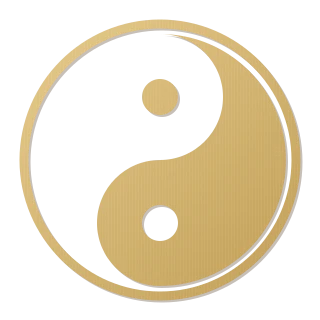
Yin and yang are not good and evil but the two sides of every change: shade and sun, rest and motion, receiving and giving. Each grows out of the other, which is why each half of the circle holds a dot of the opposite colour. The idea is ancient and runs through the Book of Changes; the curled circle that draws it, the taijitu, became the usual way of picturing it much later, from the Ming dynasty on. It is the red and blue circle at the centre of the flag of South Korea.
Today it is worn by Taoists, by people who practise tai chi and the martial arts, and by many more as a reminder of balance. It belongs to Chinese thought broadly rather than to one religion, so it is one of the easiest of these signs to give.
The Star of David · Judaism
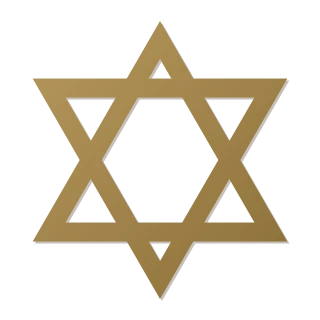
The Magen David, “shield of David,” is two triangles laid over one another. The figure is old and was used by many peoples; for centuries it decorated churches and mosques as well as synagogues. Its life as the sign of the Jewish people is younger. Prague’s Jewish community carried it on its flag in the Middle Ages, it spread through Jewish books and synagogues in the following centuries, and in 1897 the First Zionist Congress took it up. In the Nazi years it was forced on Jews as a yellow badge of exclusion; since 1948 it has stood on the flag of Israel.
Today it is worn by Jews around the world, and a Star of David is a favourite gift for a bar or bat mitzvah.
The Rub el Hizb · Islam
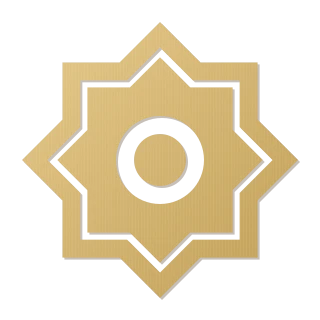
Islam has no official symbol, and many Muslims prefer none at all: its art speaks through geometry and calligraphy rather than images. (The crescent and star, often taken for a sign of Islam, came into wide use as an emblem of the Ottoman state.) The eight-pointed star of two squares, the Rub el Hizb, has a closer tie to the faith. The Qur’an is divided into sixty sections, each called a hizb, for recitation, and this star marks the quarters of each one in the margins of the text. The same star runs through Islamic tilework and woodwork from Andalusia to Central Asia.
We draw it without any lettering. Words of the Qur’an are treated with great care, kept clean and not taken into a bathroom, so a piece meant for everyday wear is better with the star alone.
The hamsa · the hand of protection
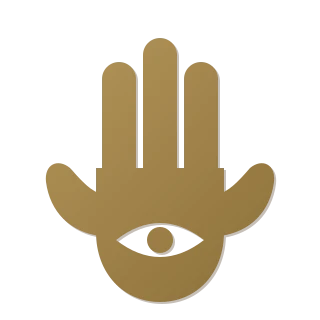
An open right hand, the fingers together, often with an eye in the palm. Hamsa is Arabic for “five,” as hamesh is in Hebrew. It is an amulet against the evil eye, the harm that envy is believed to bring, and it is older than the faiths that keep it. Muslim families call it the Hand of Fatima, after the Prophet’s daughter; Jewish families call it the Hand of Miriam, after the sister of Moses. It hangs by front doors and over cradles from Morocco to the Levant.
Today it is one of the few signs worn by Muslims, Jews and Christians of the Middle East alike, and a common gift for a new home or a new baby.
Om · Hinduism, Buddhism and Jainism
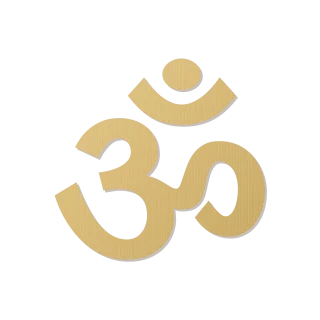
The sacred syllable Om, or Aum, written here in Devanagari. The Upanishads call it the sound of all that is. The Mandukya Upanishad reads its three sounds, A, U and M, as waking, dreaming and deep sleep, and the silence after them as a fourth state beyond all three. It is chanted at the beginning and end of prayers, readings and meditation, and it opens many Buddhist mantras, among them Om mani padme hum.
Because Om is a word as well as a sign, many Hindus keep the same customs with it as with scripture: worn above the waist, not on the feet or the floor, and taken off before a bathroom. Our Om is a brooch for the chest or collar for that reason.
Thor’s hammer · the faith of the North
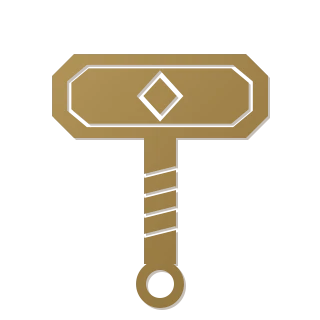
Mjölnir, the hammer of the thunder god Thor, who guarded gods and people against the giants. Small hammer amulets were worn across Viking Age Scandinavia, most of them from the tenth century, the same years the cross was arriving in the North. A soapstone mould found at Trendgården in Denmark has room to cast crosses and hammers side by side: one smith, serving customers of both faiths.
Today it is the emblem of the revived Norse faith, called Heathenry or Ásatrú, and is among the emblems of belief the United States allows on veterans’ headstones. It is also worn by many with Scandinavian roots as a sign of where they come from.
Wearing a sign that is not your own
Some of these signs are worn freely by people of every background, and the people who hold them sacred are usually glad to see them understood. A few simple habits go a long way:
- Know what it means. Someone will ask, and the answer is part of the gift.
- Keep it in its place. Signs that carry sacred words, like Om, belong above the waist, never on shoes or a floor mat.
- Ask when it is for someone else. A Star of David for a bar mitzvah, or a hamsa for a new home, is best chosen with the family.
- Leave out what a faith keeps apart. We do not carve the name of God or verses of the Qur’an on everyday jewellery.
All eight are drawn for our solid-brass round frame and made to order in either finish. See them on the Sacred Series page, or send us the emblem of your own temple, synagogue or community for a custom piece.