
The crosses of the knightly orders, and how to tell them apart
Every military order of the Crusades took a cross, and each had to be told apart across a battlefield or a crowded port. A few changes in the shape of the arms were enough, and the shapes have outlived the orders that wore them.
The military orders were a new idea in the twelfth century: men who took the vows of monks, poverty, chastity and obedience, and fought as knights. They grew up to guard pilgrims and hold castles in the Holy Land, and then in Spain and Portugal and on the Baltic. Each wore a cross on its mantle, and heralds learned to name the shapes: pattée for arms that widen toward their ends, fleury for arms ending in lilies, potent for arms ending in crossbars.
Telling them apart at a glance
- Arms that widen to flat ends: the cross pattée of the Templars.
- Four arrowhead arms with eight points: the Maltese cross of the Hospitallers.
- A large cross with a small cross in each quarter: the Jerusalem cross.
- A lower arm shaped like a sword, the others ending in lilies: the cross of Santiago.
- Two crossbars, the upper one shorter: the cross of Lorraine.
The Templar cross · cross pattée
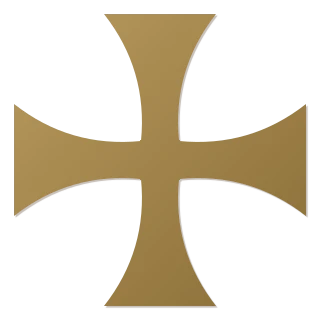
The Order of the Poor Fellow-Soldiers of Christ and of the Temple of Solomon was founded in Jerusalem around 1119 by Hugues de Payens and a handful of knights, and took its name from its first quarters on the Temple Mount. The Council of Troyes gave it a rule in 1129, with a white mantle for its knights; Pope Eugenius III is said to have granted the red cross in 1147. The Templars grew rich and powerful, with houses across Europe that worked almost as a bank, until King Philip IV of France had them arrested in 1307 and the Pope dissolved the order in 1312.
Their seals and wall paintings show the cross in several forms, but the red cross pattée on white is the one remembered. It lives on in the Masonic Knights Templar, which took up the name in the eighteenth century as a tribute rather than an unbroken line. The black cross pattée of the Teutonic Knights, a German order founded at Acre in 1190, is the ancestor of the Prussian Iron Cross of 1813.
The Maltese cross · the Hospitallers
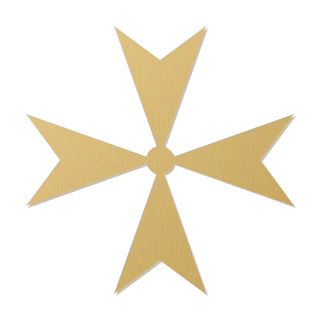
The Knights Hospitaller began as a hospital for pilgrims in Jerusalem, recognised by the Pope in 1113, and became a military order to defend them. After the crusader states fell they held Rhodes from 1310 to 1522, and then Malta from 1530 until Napoleon took the island in 1798; the island gave the cross its name. Its eight points are read as the eight beatitudes, and also as the eight “tongues,” the national divisions of the order’s knights.
Today it is the emblem of the Sovereign Military Order of Malta and of the Order of St John, whose St John Ambulance volunteers wear it in a white form. Nurses and first-aiders choose it for that reason.
The Jerusalem cross · the crusader kingdom
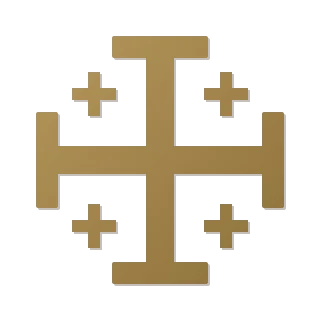
A great cross with crossbars at its ends, and a small cross in each quarter: the arms of the Kingdom of Jerusalem from the thirteenth century. The kingdom’s arms were gold on silver, metal on metal, which breaks the first rule of heraldry; it was allowed for Jerusalem alone. The five crosses are read as the five wounds of Christ, or as Christ and the four evangelists.
Today it is the emblem of the Order of the Holy Sepulchre, in red, and of the Franciscans who keep the holy places, and the five-cross flag of Georgia is modelled on it. Pilgrims to the Holy Land often bring one home.
The cross of Santiago · the sword of St James
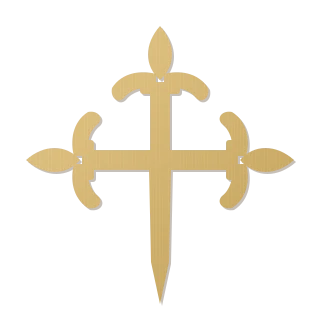
The Order of Santiago was founded in 1170 to guard pilgrims on the road to the shrine of St James at Compostela and to fight in the wars against the Moors. Its red cross has a lower arm shaped like a sword blade and other arms ending in lilies, which is why it is also called the cruz espada, the sword cross. Velázquez painted himself in Las Meninas with the red cross on his chest; he was only admitted to the order in 1659, three years after the painting was finished, and the cross was added later.
Today it is the sign of the Camino de Santiago, worn by pilgrims who have walked it, and it is dusted in sugar on top of every tarta de Santiago, the almond cake of Galicia. The Spanish orders of Calatrava and Alcántara wore related crosses ending in lilies, in red and in green.
The cross of Lorraine · two bars
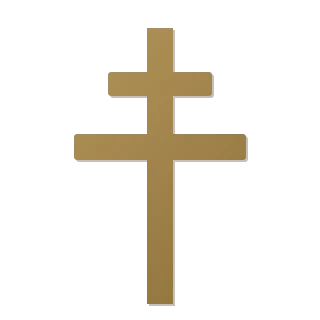
The upper, shorter bar stands for the inscription set over Christ’s head on the cross. The double cross came to the Dukes of Anjou and of Lorraine with a relic of the True Cross, and René of Anjou, Duke of Lorraine in the fifteenth century, made it his emblem. In 1940 Charles de Gaulle took it as the emblem of the Free French, against the swastika, and it stands today on the memorial to him at Colombey-les-Deux-Églises. Since 1902 it has also been the international sign of the fight against tuberculosis.
Which cross to choose
- For a commandery, or a love of the Templars: the cross pattée.
- For nurses, first-aiders and St John volunteers: the Maltese cross.
- For a pilgrimage to the Holy Land: the Jerusalem cross.
- For the Camino: the cross of Santiago.
- For French roots, or a family that served: the cross of Lorraine.
All five are drawn for our solid-brass round frame and made to order. See them with the emblems of the lodge on the Orders & Fraternities page, and read how the Templar cross came to the lodge in our guide to Masonic symbols.