
Masonic symbols explained
Freemasonry teaches by symbol. Its emblems are the tools and buildings of the medieval stonemason, each given a moral meaning, so that a set square on a lapel stands for a whole way of behaving.
Medieval stonemasons met in lodges, sheds beside the building site where they kept their tools, settled their rules and taught their apprentices. In the seventeenth century gentlemen who had never cut a stone began to join the lodges in Scotland and England, and the craft became a society of “speculative” masons, who used the working tools to teach how to live. Four London lodges formed the first Grand Lodge in 1717. A mason passes through three degrees, Entered Apprentice, Fellowcraft and Master Mason, and each has its own working tools and emblems.
The meanings are less secret than people think. They have been printed for more than two centuries, in books such as William Preston’s Illustrations of Masonry (1772) and Thomas Smith Webb’s Freemason’s Monitor (1797), and painted on the tracing boards that hang in lodge rooms. What follows is drawn from those books.
The square and compasses
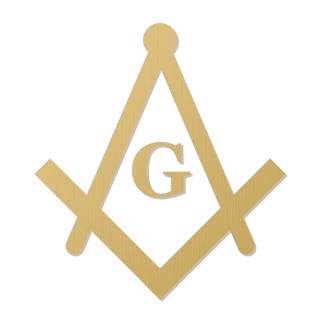
The best-known Masonic emblem joins two tools. The square, which tests a right angle, teaches a mason to square his actions by virtue; the compasses, which draw a circle, teach him to keep his desires within due bounds. Their position changes with the degrees: in the first both points of the compasses lie beneath the square, in the second one point is raised above it, and in the third both are, for the higher nature has mastered the lower.
The G between them, more usual in American lodges than in British ones, is read two ways: as God, whom masons call the Great Architect of the Universe, and as Geometry, the science on which the old craft was founded.
The working tools
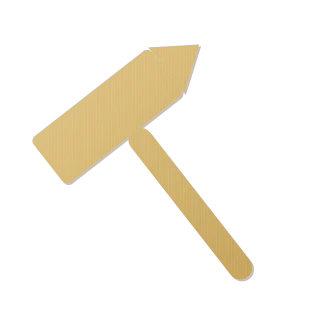
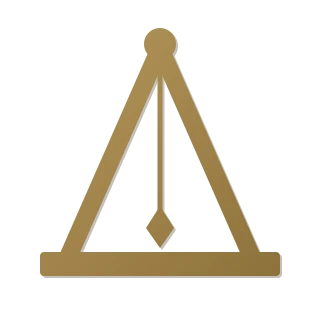
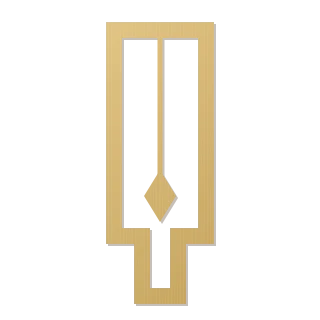
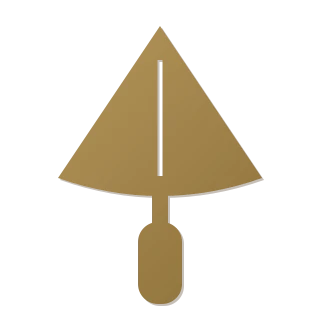
The Entered Apprentice is given the twenty-four-inch gauge, to divide the day between work, rest and the service of others, and the common gavel, to knock the rough corners off his own character. The Fellowcraft is given the square, the level and the plumb rule: the level for equality, since all masons meet on the level whatever their rank outside, the plumb for walking uprightly. In American lodges the Master Mason is given the trowel, which spreads the mortar of brotherly love binding the members into one building; English lodges give him the skirret, the pencil and the compasses.
The same tools mark the three principal officers of a lodge. The Master wears the square, the Senior Warden the level and the Junior Warden the plumb.
Solomon’s Temple
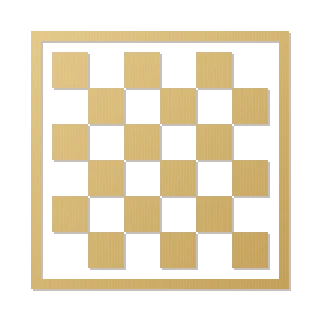
Masonic ritual is set in the building of King Solomon’s Temple, and every lodge room recalls it. At its porch stood two bronze pillars: “he set up the right pillar, and called the name thereof Jachin: and he set up the left pillar, and called the name thereof Boaz” (1 Kings 7:21). In many lodges they are topped with a celestial and a terrestrial globe. The black and white mosaic pavement of the lodge floor stands for the light and dark, the joy and sorrow, that make up every life. At its centre is the blazing star, read as divine providence, as the star that led the wise men, or as the sun that lights the earth.
The all-seeing eye
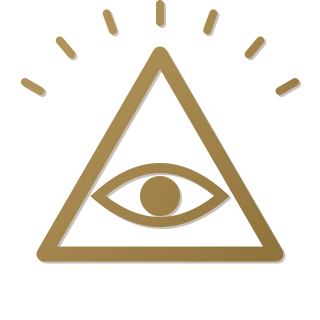
An eye within a triangle and rays of light: the Eye of Providence, the watchfulness of the Great Architect over every thought and deed. It is an older Christian image, often painted over church altars, and it entered Masonic books in the 1790s. The eye on the Great Seal of the United States, printed on the dollar bill, did not come from the lodge: it was proposed in 1776 by the artist Pierre Eugène du Simitière, who was not a mason, and was adopted on the reverse of the seal in 1782.
The Master Mason’s emblems
The third degree tells the legend of Hiram Abiff, the architect of the Temple, who was killed rather than give up the secrets of a master. A sprig of acacia marked his grave. As an evergreen it stands for the immortality of the soul, and a sprig is still dropped into the grave at a Masonic funeral. The beehive, every bee working for the good of all, stands for industry. Other emblems of the degree, the hourglass and the scythe, the anchor and the ark, speak of time, death and hope.
Geometry and the stone
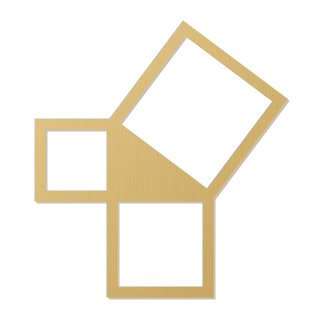
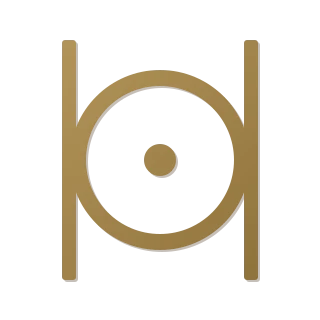

The forty-seventh problem of Euclid, the theorem of Pythagoras, shows a right triangle with a square on each side. A triangle with sides of three, four and five lets a builder set out a true right angle with nothing but a cord, and in English lodges the figure hangs from the jewel of a Past Master. The point within a circle is the individual and the bounds of his conduct, set between two parallel lines for the two Saints John, the patrons of the lodge. The rough ashlar is the stone as it comes from the quarry, the perfect ashlar the stone squared and ready for the wall: the member before and after a life of learning.
The Royal Arch and other orders
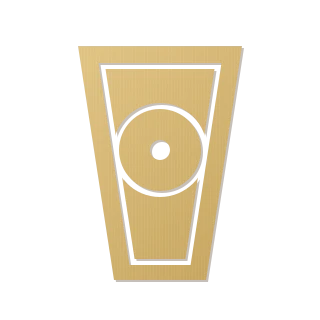
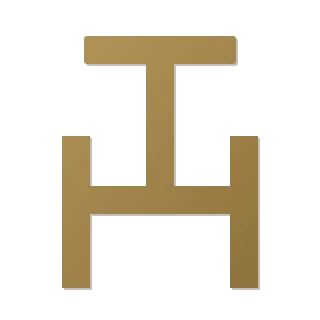
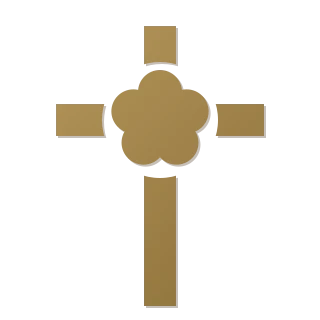
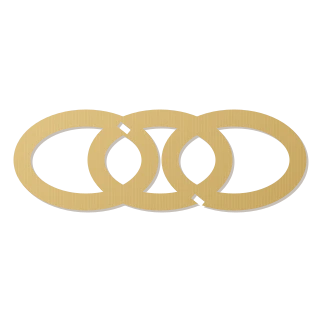
Beyond the three degrees lie further orders, grouped in the York Rite and the Scottish Rite. The keystone belongs to Mark masonry, “the stone which the builders refused” (Psalm 118:22); each member’s keystone carries his own mark. The triple tau, three tau crosses joined as one, is the emblem of the Royal Arch. The rose cross comes from the Rosicrucian pamphlets of 1614 to 1616 and passed into the Rose Croix degree of the Scottish Rite. The three links are not Masonic at all: they belong to the Odd Fellows, a separate friendly society, for friendship, love and truth. The Templar cross, worn by the Masonic Knights Templar, has a guide of its own: the crosses of the knightly orders.
Who wears them
A square and compasses on a lapel is generally taken as a sign of membership, so it is usually worn by masons, or given to one: for a raising to the third degree, an installation as Master, or years of service. The working tools and the lodge emblems make good gifts for the same occasions, and the beehive, the acacia and the anchor are worn more widely for what they mean. Families often keep a father’s or grandfather’s emblem in his memory.
We draw all of these for our solid-brass round frame and make them to order, and we make lodge, chapter and commandery emblems for every member, with the lodge’s number and founding year. See the Orders & Fraternities page, or ask about a lodge order. The emblems of modern fraternities such as the Shriners and the Order of the Eastern Star are registered marks, so we make them only with a chapter’s written permission.