
The Royal Arch, the York Rite and the Scottish Rite: Masonic orders and their emblems
Every Freemason belongs first to a lodge. Beyond it lie a dozen further orders, each with its own degrees, its own regalia and its own emblem, and the emblem on a lapel says which of them its wearer has joined.
The lodge, sometimes called the craft or blue lodge, confers the three degrees of Entered Apprentice, Fellow Craft and Master Mason. A Master Mason may then join other Masonic bodies, which add degrees and legends of their own. They are organised differently in different countries, and the names can be confusing, so here are the main ones and the emblems that mark them. The emblems of the lodge itself, the square and compasses and the working tools, have a guide of their own.
The Royal Arch · the triple tau
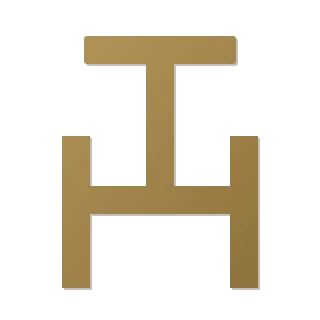
The Royal Arch tells of the rebuilding of the Temple in Jerusalem after the exile, and of a secret vault found beneath its ruins. Its members are called companions and meet in chapters. In England the first Grand Chapter was formed in 1766, and when the two rival Grand Lodges united in 1813 they declared that pure ancient masonry consists of three degrees, “including the Supreme Order of the Holy Royal Arch”, and for a long time it was seen there as the completion of the Master Mason’s degree. Its emblem is the triple tau, three tau crosses joined as one and set in a triangle within a circle.
Mark masonry · the keystone
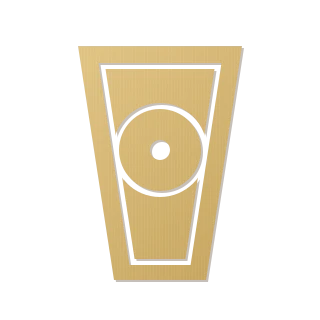
Medieval masons cut a personal mark into the stones they dressed, so that their work could be counted and paid. The Mark degree keeps the custom: each new Mark Master chooses a mark of his own, and the legend tells of a keystone the builders rejected that was found to be the stone the arch needed. In England Mark masonry has had its own Grand Lodge since 1856; in America the Mark degree is worked in the Royal Arch chapter. A Mark keystone carries a ring of letters and the member’s own mark at its centre, which is why it is often made to order.
The York Rite · chapter, council and commandery
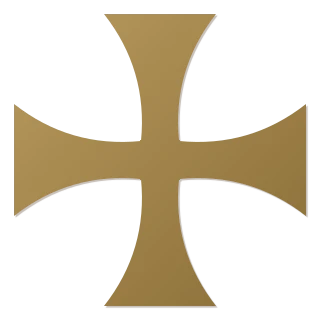
In the United States the York Rite gathers three bodies: the Royal Arch chapter, the council of Royal and Select Masters, sometimes called Cryptic Masonry for its legend of a crypt beneath the Temple, and the commandery of Knights Templar. The name comes from the old legend, set down in the medieval charges of the masons, that the craft held its first assembly at York. The Knights Templar, open to Christian masons, wear the red cross pattée, often with a crown and the words In hoc signo vinces, “in this sign you will conquer.” Their national body, the Grand Encampment, was founded in 1816. The medieval order the commandery remembers is told in our guide to the crosses of the knightly orders.
The Scottish Rite · the Rose Croix and the eagle
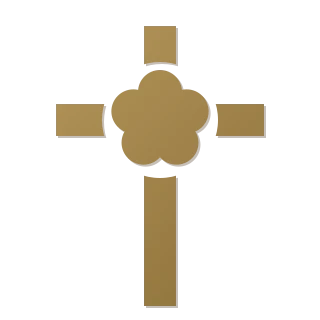
Despite its name, the Scottish Rite took its form in France and in the United States, where the first Supreme Council was founded at Charleston, South Carolina, in 1801. It confers degrees from the fourth to the thirty-second, with the thirty-third given as an honour. Its best-known degree is the eighteenth, the Rose Croix, whose emblems are the rose blooming on a cross and the pelican feeding her young with her own blood. The thirty-second and thirty-third degrees take the double-headed eagle, the old eagle of Byzantium, usually with the motto Deus meumque jus, “God and my right.”
The Odd Fellows · the three links
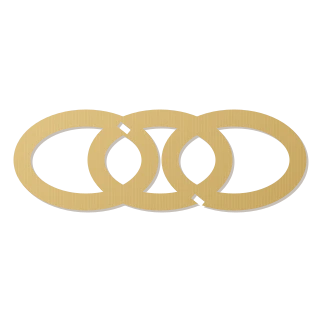
The Odd Fellows are not Freemasons, though the two are often confused: they are a friendly society, one of the great mutual aid orders that paid sick pay, pensions and funerals for working people before any welfare state. Lodges of Odd Fellows met in eighteenth-century England, and the Independent Order of Odd Fellows was founded in Baltimore in 1819 by Thomas Wildey. Their emblem is three links of a chain, for friendship, love and truth.
Registered emblems
Some of the best-known fraternal emblems belong to modern organisations: the Shriners, the Order of the Eastern Star, the Knights of Columbus, Rotary and the Elks. They are registered marks, so we do not show them, and we make them only for a chapter or club with written permission. The older signs on this page, like the square and compasses, are shared by many bodies and belong to none.
Which emblem to wear
- A Royal Arch companion: the triple tau, or the keystone for a Mark Master.
- A Knight Templar of the York Rite: the red cross pattée.
- A Scottish Rite mason: the rose cross, for the Rose Croix degree.
- An Odd Fellow: the three links.
- For a whole chapter or commandery: your own emblem with its name and number, made for every member.
All of these are drawn for our solid-brass round frame and made to order. See the Royal Arch and other fraternities on the Orders page, or ask about an order for your chapter.